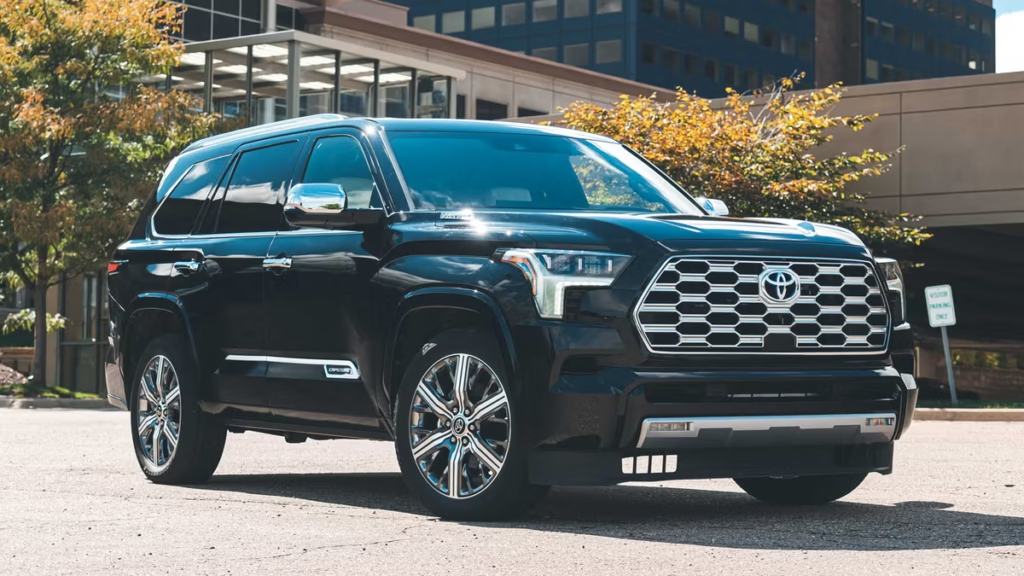
When I examine the full-size SUV market, I see a growing need for vehicles that can combine family transportation, strong towing ability, modern technology, comfort, and off-road capability. The 2025 Toyota Sequoia occupies an interesting position because it combines a traditional body-on-frame SUV design with Toyota’s i-FORCE MAX hybrid powertrain. In my analysis, this combination is the defining characteristic of the Sequoia and one of the main reasons it deserves attention from buyers looking for a large SUV.
The 2025 Toyota Sequoia uses a twin-turbocharged 3.4-liter V6 hybrid system that produces 437 horsepower and 583 lb.-ft. of torque. A 10-speed automatic transmission sends the power to the wheels. Rear-wheel drive is available on certain versions, while four-wheel drive is available or standard depending on the trim.
I believe the Sequoia is best understood as a capability-focused full-size SUV rather than simply a large family vehicle. Its substantial towing capacity, available four-wheel drive, hybrid powertrain, and body-on-frame construction give it capabilities that many crossover SUVs cannot match.
At the same time, I would not describe it as perfect. Its large exterior dimensions can make city driving and parking more difficult, while its third-row and cargo-area packaging deserves careful consideration. Based on the available evidence, the Sequoia’s strengths are most convincing when a buyer actually needs the capabilities that define the vehicle.
Key Takeaways
The 2025 Toyota Sequoia uses the i-FORCE MAX hybrid powertrain across its lineup, producing 437 horsepower and 583 lb.-ft. of torque.
The maximum published towing capacity reaches 9,520 pounds when properly equipped, although the exact capacity varies according to configuration.
Toyota offers the Sequoia in SR5, Limited, Platinum, TRD Pro, 1794, and Capstone grades.
The new 1794 grade is one of the most important additions for the 2025 model year.
The TRD Pro is the most specialized version for buyers who prioritize factory off-road capability.
The Sequoia can seat seven or eight people depending on the second-row configuration.
Fuel economy is relatively respectable for a large, powerful SUV, but buyers should not expect compact-hybrid efficiency.
The Sequoia provides extensive standard driver-assistance technology, although independent crash-test results should also be considered.
I believe the biggest question for potential buyers is not whether the Sequoia is powerful enough. It clearly is. The more important question is whether its size, cargo packaging, price, and truck-based driving character fit the buyer’s everyday needs.
What Is the 2025 Toyota Sequoia?
I consider the 2025 Toyota Sequoia a conventional full-size SUV in architecture but a modern hybrid in powertrain technology. Its body-on-frame construction connects it conceptually with pickup trucks and other traditional utility vehicles rather than car-based crossovers.
This construction has several advantages. It can provide a strong foundation for towing, carrying passengers and equipment, and traveling over difficult terrain. However, it also contributes to the vehicle’s substantial dimensions and driving characteristics.
Toyota offers several versions of the Sequoia to appeal to different types of buyers. The SR5 provides an entry point into the lineup, while the Limited adds comfort and convenience equipment. Platinum and Capstone emphasize luxury. The TRD Pro concentrates on off-road performance, while the 1794 grade combines premium features with its own distinctive styling theme.
From my perspective, this range makes the Sequoia more versatile than a vehicle with only one clearly defined purpose.
The hybrid powertrain is particularly significant. Instead of offering a conventional gasoline V8, Toyota uses a twin-turbocharged V6 combined with an electric motor. This gives the SUV strong torque while maintaining the efficiency benefits associated with hybrid assistance.
2025 Toyota Sequoia Hybrid Powertrain
The i-FORCE MAX system is the mechanical centerpiece of the 2025 Toyota Sequoia. It combines a twin-turbocharged 3.4-liter V6 engine with electric motor assistance and a 10-speed automatic transmission.
Toyota rates the system at 437 horsepower and 583 lb.-ft. of torque. Those numbers place the Sequoia firmly in the high-performance portion of the full-size SUV segment.
In my view, the torque figure is especially important because large SUVs need substantial pulling power. The Sequoia can carry passengers, luggage, and equipment while also being used for towing. Strong torque helps the powertrain manage that additional load.
The electric motor also contributes to the driving response. Rather than relying entirely on the gasoline engine to build power, the hybrid system can provide electric assistance as part of the overall powertrain operation.
Let us consider a hypothetical example. Imagine a Sequoia carrying several passengers while merging onto a highway. The vehicle has considerable mass, so strong torque is useful when acceleration is required. The hybrid system’s electric assistance works alongside the turbocharged engine rather than forcing the driver to rely entirely on engine speed.
Car and Driver recorded a 0-to-60-mph time of 5.6 seconds for a four-wheel-drive Capstone during its testing. I consider that impressive for a large three-row SUV, although acceleration should not be the primary reason someone chooses a Sequoia.
For me, the greater benefit is the combination of power, torque, towing capability, and everyday drivability.
2025 Toyota Sequoia Fuel Economy
The Sequoia’s hybrid powertrain also has an important efficiency objective. Rear-wheel-drive versions are EPA-rated at approximately 21 mpg city, 24 mpg highway, and 22 mpg combined. Four-wheel-drive versions have lower ratings, with figures around 19 mpg city, 22 mpg highway, and 20 mpg combined.
These numbers should be interpreted carefully.
A vehicle’s official fuel-economy rating is produced under standardized testing conditions. Actual consumption can vary significantly depending on speed, traffic, weather, tire selection, cargo, passenger load, terrain, and towing.
I would particularly caution buyers against comparing the Sequoia directly with smaller hybrid SUVs. The Sequoia is a large body-on-frame vehicle with a powerful turbocharged engine. Its hybrid system is helping a large vehicle achieve better efficiency; it is not transforming the vehicle into a small economy car.
For example, a hypothetical driver who spends most of the week traveling on highways at moderate speeds may achieve relatively favorable fuel consumption. Another driver who makes frequent short urban trips with heavy loads may see considerably different results.
In my view, the correct question is whether the Sequoia’s efficiency is reasonable for its size and capabilities. On that basis, the hybrid system makes a strong case.
2025 Toyota Sequoia Towing Capacity
Towing is one of the strongest reasons to consider the Sequoia. Toyota publishes a maximum towing capacity of up to 9,520 pounds when properly equipped.
However, I believe buyers should pay close attention to the words “when properly equipped.” The maximum figure does not apply automatically to every Sequoia.
Different drivetrain and trim configurations can have different ratings. Car and Driver reports towing capacities ranging from approximately 8,980 pounds for certain four-wheel-drive configurations to 9,520 pounds for the rear-wheel-drive SR5.
A buyer should therefore identify the exact vehicle configuration before making a towing decision.
Toyota also provides several technologies intended to improve trailer operation. Depending on configuration, these can include trailer cameras, Trailer Backup Guide, Straight Path Assist, tow modes, and a digital rearview mirror.
Toyota’s towing material provides an important warning:
“Never tow beyond a vehicle’s published towing capacities.”
Toyota
I consider this statement particularly important because towing capacity should never be treated as a suggestion. The vehicle’s specific rating, payload, trailer weight, tongue weight, passengers, cargo, hitch equipment, and other factors all need to be considered.
A hypothetical example illustrates the point. Suppose a buyer sees the 9,520-pound maximum and chooses a trailer weighing nearly that amount. I would not consider that sufficient analysis. The buyer should verify the exact vehicle’s towing rating and ensure that the combined passenger, cargo, and trailer requirements remain within the appropriate limits.
2025 Toyota Sequoia Trim Levels
Toyota’s 2025 Sequoia lineup includes SR5, Limited, Platinum, TRD Pro, 1794, and Capstone.
I think the most useful way to understand these trims is by their intended purpose rather than simply considering them from least expensive to most expensive.
SR5
The SR5 serves as the entry point to the Sequoia lineup. I see it as a logical choice for buyers who want the vehicle’s core powertrain and body-on-frame capability without immediately paying for extensive luxury equipment.
The major advantage is that the SR5 still receives the 437-horsepower i-FORCE MAX hybrid system.
For buyers focused on towing, family transportation, and basic full-size SUV capability, the SR5 deserves serious consideration.
Limited
The Limited adds comfort and convenience features and makes the Sequoia more appealing as an everyday family vehicle.
In my view, this trim can be a strong middle-ground option because it does not move as far into premium territory as the highest grades while providing more equipment than the base model.
Platinum
The Platinum moves the Sequoia further toward luxury. It adds premium equipment and technology intended to improve comfort during daily driving and long-distance travel.
For buyers who use the Sequoia as a premium family vehicle rather than primarily as a work-oriented SUV, Platinum can make considerable sense.
TRD Pro
The TRD Pro is the off-road specialist of the lineup.
It includes equipment such as Fox dampers, a locking rear differential, skid-plate protection, specialized wheels, and 33-inch tires.
I believe this trim makes the most sense for buyers who actually intend to use the vehicle in demanding off-road conditions. Someone who spends nearly all of their driving time on paved roads may not gain enough practical benefit from all of the specialized equipment.
1794
The 1794 grade is one of the major additions for the 2025 model year.
Toyota uses the 1794 name to create a more distinctive premium character. The grade includes features such as brown leather upholstery, walnut-style interior trim, a panoramic sunroof, second-row captain’s chairs, towing equipment, and massaging front seats.
From my perspective, the 1794 is an interesting alternative to the Capstone because it provides a premium experience while retaining a distinctive identity.
Capstone
The Capstone sits at the luxury-focused end of the Sequoia lineup.
It combines premium interior materials, advanced technology, upscale exterior details, and the same fundamental hybrid powertrain found throughout the lineup.
I would recommend Capstone primarily to buyers who genuinely value its additional luxury equipment rather than assuming that the most expensive trim is automatically the best choice.
2025 Toyota Sequoia Trim Comparison
The following table gives me a useful way to compare the character of each version.
| Trim | Main Focus | Drivetrain Character | Ideal Buyer |
|---|---|---|---|
| SR5 | Core capability | RWD or available 4WD | Value-focused SUV buyer |
| Limited | Comfort and practicality | RWD or available 4WD | Family-oriented driver |
| Platinum | Premium comfort and technology | 4WD available | Luxury-oriented family |
| TRD Pro | Off-road performance | 4WD standard | Serious off-road user |
| 1794 | Distinctive luxury | 4WD standard | Premium buyer wanting unique styling |
| Capstone | Maximum luxury | 4WD standard | Buyer seeking flagship equipment |
The table makes one point especially clear: there is no universally correct Sequoia trim. I would choose based on intended use rather than simply moving upward through the lineup.
Interior and Seating Capacity
The 2025 Toyota Sequoia can seat up to eight people with the appropriate second-row bench configuration. Versions equipped with second-row captain’s chairs seat seven.
At first glance, this seems like a straightforward advantage for families. However, I think buyers should look beyond the seating number.
The third row has some packaging compromises, and cargo capacity behind the third row is limited compared with what the Sequoia’s exterior size might suggest.
Car and Driver reports approximately 12 cubic feet of cargo space behind the third row.
That is important for families who regularly travel with all three rows occupied.
Imagine a hypothetical family of seven preparing for a week-long trip. Every passenger may have a suitcase, backpack, or other equipment. Although the Sequoia has a large overall footprint, the family may need to carefully organize the cargo area or adjust the third row to create additional storage space.
This is why I recommend evaluating the Sequoia using real-life requirements rather than relying exclusively on exterior dimensions.
If a buyer frequently carries seven or eight people plus substantial luggage, I would consider cargo testing one of the most important parts of the purchasing process.
Technology and Infotainment
Technology plays a significant role in the modern Sequoia. Toyota offers a large multimedia display, with a 14-inch screen available on many versions.
A large display is particularly useful in a full-size SUV because drivers may need to view navigation information, camera feeds, audio controls, vehicle settings, and towing-related information.
I think the towing technology is more significant than entertainment features because it addresses a practical challenge.
When a trailer is attached, rear visibility becomes more complicated. Camera systems and trailer-guidance functions can help the driver understand the vehicle’s position relative to the trailer.
Toyota’s available trailer technology includes Trailer Backup Guide and Straight Path Assist.
These systems should not be considered replacements for proper towing knowledge. Instead, I view them as tools that can make certain maneuvers easier.
Safety Features and Crash-Test Information
The 2025 Sequoia includes Toyota Safety Sense 2.5 and a broad range of driver-assistance technologies.
Depending on the feature, these systems can assist with collision avoidance, lane positioning, adaptive cruise control, and other driving situations.
Car and Driver lists forward-collision warning with automated emergency braking, lane-departure warning and lane-keeping assistance, and adaptive cruise control among the vehicle’s safety equipment.
However, I believe it is important to distinguish between safety technology and crashworthiness.
Driver-assistance systems are designed to help avoid or reduce certain collisions. Crash tests evaluate how the vehicle performs when a collision occurs.
The Insurance Institute for Highway Safety reports Good ratings for the Sequoia in the small-overlap front and updated side tests, while the updated moderate-overlap front evaluation receives a Marginal rating.
That mixed result is worth considering rather than ignoring.
2025 Toyota Sequoia Safety Comparison
I find the following table useful because it separates the main independent crash-test results from the vehicle’s active-safety technology.
| Safety Area | Reported Result or Feature | Practical Meaning |
|---|---|---|
| Small-overlap front | Good | Strong result in this evaluation |
| Updated moderate-overlap front | Marginal | Area that deserves attention |
| Updated side | Good | Strong side-impact result |
| Automatic emergency braking | Standard technology | Helps reduce certain forward collisions |
| Lane assistance | Standard technology | Supports lane positioning |
| Adaptive cruise control | Available/standard depending on configuration | Helps maintain speed and following distance |
| Blind-spot assistance | Available/standard depending on configuration | Helps monitor adjacent areas |
The important takeaway is that the Sequoia has substantial driver-assistance equipment, but I would still review current independent crash-test information before purchasing.
Driving Experience
The Sequoia’s driving experience reflects its size and body-on-frame construction.
Car and Driver describes the ride as comfortable and the cabin as relatively quiet while also identifying its width, light steering, and brake-pedal feel as potential weaknesses.
From my perspective, this is an important distinction for shoppers moving from smaller SUVs.
A large vehicle can provide a commanding driving position and substantial road presence, but those benefits come with physical dimensions that cannot be eliminated through technology.
A hypothetical buyer moving from a midsize crossover may initially notice the Sequoia’s width when parking, entering narrow roads, or navigating older parking garages.
On highways, those dimensions may be less troublesome. In fact, the large size and strong powertrain can make long-distance travel comfortable.
I therefore believe the driving environment should influence the purchase decision.
Off-Road Capability
The TRD Pro version demonstrates Toyota’s effort to make the Sequoia more than a pavement-focused family SUV.
The TRD Pro includes specialized suspension equipment, a locking rear differential, skid-plate protection, 33-inch tires, and other off-road-oriented hardware.
Toyota also makes an off-road package available on selected grades.
I would separate occasional rough-road use from serious off-road driving. A driver who occasionally encounters gravel, dirt, or rough access roads may not need the full TRD Pro configuration.
Someone who regularly travels through difficult terrain may appreciate the additional equipment.
In my view, the TRD Pro is most compelling when its specialized hardware will actually be used.
Towing Technology
The Sequoia’s towing technology complements its mechanical capability.
Tow/HAUL and Tow+ modes can modify vehicle behavior for towing conditions. Available camera systems and trailer-guidance functions can also improve visibility during trailer maneuvers.
I believe this technology is useful because towing involves more than engine power.
A vehicle may have enough horsepower to pull a trailer, but the driver still needs to control the trailer while reversing, turning, parking, and maneuvering through confined areas.
A hypothetical example would be backing a trailer into a campsite. The engine’s 583 lb.-ft. of torque does not solve the visibility problem. Camera systems and trailer-guidance technology can help the driver understand where the trailer is moving.
They do not replace proper towing technique, but they can complement it.
What Changed for 2025?
The biggest change for the 2025 model year is the introduction of the 1794 grade.
Toyota also expanded luxury equipment with available massaging front seats and added towing-related technology.
The 1794 grade brings a distinctive premium theme with brown leather, walnut-style trim, a panoramic sunroof, second-row captain’s chairs, and towing equipment.
I see these changes as refinements rather than a completely new generation. The basic mechanical identity of the Sequoia remains centered around its body-on-frame platform and i-FORCE MAX hybrid powertrain.
For someone comparing a 2025 Sequoia with an earlier model, I would therefore focus on the equipment, pricing, condition, warranty, and specific configuration rather than assuming the model-year change represents an entirely different SUV.
Common Mistakes When Choosing a Sequoia
One common mistake is assuming that every Sequoia has the same towing capacity. The published maximum applies only to the appropriate configuration.
Another mistake is choosing a trim based solely on its position in the lineup. A more expensive trim is not automatically better for every driver.
A third mistake is assuming that the Sequoia’s large exterior automatically means enormous cargo space behind the third row.
I would also avoid assuming that the hybrid system makes the Sequoia inexpensive to operate. Fuel efficiency is only one component of ownership cost.
Insurance, financing, maintenance, tires, depreciation, taxes, and fuel all contribute to the total cost.
Finally, I would not overlook independent safety testing. Standard driver-assistance technology is valuable, but crash-test results provide additional information.
How I Would Choose a 2025 Toyota Sequoia
I would begin by defining the primary purpose of the SUV.
If family transportation is the priority, I would evaluate seating comfort, child-seat compatibility where applicable, cargo requirements, parking space, and daily usability.
If towing is the priority, I would determine the trailer’s loaded weight before selecting the vehicle.
If off-road driving is the main purpose, I would compare the TRD Pro with other four-wheel-drive configurations and available off-road equipment.
If luxury is the priority, I would compare the Platinum, 1794, and Capstone grades based on the specific features I actually want.
I believe this process is better than starting with the most expensive trim and working backward.
Step-by-Step Buying Checklist
Step 1: Determine How You Will Use the SUV
Identify whether your main needs are family transportation, towing, long-distance travel, off-road driving, or a combination of these.
Step 2: Determine Seating Requirements
Decide whether you need seven or eight seats and whether second-row captain’s chairs are important.
Step 3: Evaluate Cargo Requirements
Measure the luggage and equipment you typically carry. If all three rows will be occupied, pay particular attention to the available cargo area.
Step 4: Calculate Trailer Requirements
If you tow, determine the trailer’s loaded weight and confirm the exact Sequoia configuration’s towing rating.
Step 5: Compare Trim Equipment
Create a list of essential features and compare the trims against that list.
Step 6: Decide Whether Four-Wheel Drive Is Necessary
Consider your climate, terrain, towing requirements, and intended use before paying for four-wheel drive.
Step 7: Review Safety Information
Check the latest independent crash-test results and the vehicle’s recall status.
Step 8: Calculate Total Ownership Costs
Consider fuel, insurance, maintenance, tires, financing, taxes, and depreciation.
Step 9: Compare Competing SUVs
I would compare the Sequoia with other large SUVs such as the Chevrolet Tahoe, GMC Yukon, Ford Expedition, and Jeep Wagoneer.
Step 10: Make the Decision Based on Real Needs
The final choice should be based on actual requirements rather than the most impressive specification.
2025 Toyota Sequoia Strengths and Weaknesses
I find it useful to summarize the major advantages and disadvantages before making a purchase decision.
| Area | Strength | Potential Concern |
|---|---|---|
| Powertrain | 437-hp hybrid system | Complex and powerful rather than economy-focused |
| Torque | 583 lb.-ft. | Large vehicle still requires substantial fuel |
| Towing | Up to 9,520 pounds in suitable configuration | Capacity varies by configuration |
| Seating | Seven or eight passengers | Third-row space is not class-leading |
| Cargo | Flexible with seats folded | Limited space behind third row |
| Off-road ability | Strong TRD Pro option | Specialized equipment may not suit every buyer |
| Luxury | 1794, Platinum, and Capstone | Upper trims can become expensive |
| Technology | Large display and towing systems | Equipment varies by trim |
| Safety | Extensive driver assistance | Mixed independent crash-test results |
The table reinforces my view that the Sequoia is a vehicle of trade-offs. Its strengths are substantial, but buyers should understand exactly what they are paying for.
Verified Quotes About the 2025 Sequoia
Toyota’s own description of the vehicle helps explain the company’s intended balance between family usability, performance, and efficiency:
“This vehicle offers families an ‘adventure in style’ ride with incredible utility and heart pumping performance, all from an efficient hybrid powertrain.”
Toyota USA
I find this quotation useful because it captures the basic philosophy behind the Sequoia. Toyota is not positioning it solely as a luxury vehicle or solely as an off-road machine. Instead, the company is trying to combine utility and performance with hybrid technology.
Toyota also emphasizes the vehicle’s towing and efficiency combination:
“With its powerful combination of efficiency and heavy-hitting towing prowess”
Toyota USA
In my analysis, the engineering goal behind that statement is more important than the promotional wording. The Sequoia uses hybrid assistance while retaining the power and structure expected from a full-size towing-oriented SUV.
Independent testing provides another useful perspective. Car and Driver’s evaluation resulted in a 5.6-second 0-to-60-mph time for a tested four-wheel-drive Capstone.
I believe this result demonstrates that the Sequoia’s hybrid system is not merely about fuel-saving. It also contributes meaningfully to performance.
Recalls and Ownership Checks
I recommend checking recall information for the exact vehicle before buying any 2025 Sequoia, especially when purchasing a used example.
Recall campaigns can apply only to particular production ranges or configurations. A recall notice does not necessarily mean every vehicle of the same model year has the same unresolved issue.
For example, the National Highway Traffic Safety Administration published recall information involving certain 2023–2025 Sequoia Hybrid vehicles concerning a software issue that could affect the rearview image during backing.
I would therefore use the vehicle identification number to confirm whether an individual vehicle has outstanding recall work.
This is particularly important when buying a used vehicle because the vehicle may have changed owners since the original recall notification.
Is the 2025 Toyota Sequoia Good for Families?
I believe the Sequoia can be a strong family SUV when its particular strengths match the family’s needs.
Its three-row layout, substantial power, available four-wheel drive, towing capability, and broad technology package make it versatile.
However, families should not assume that physical size automatically translates into unlimited interior practicality.
The third row and cargo space need to be evaluated carefully. A family that regularly carries seven or eight people plus large amounts of luggage may discover that the cargo area behind the third row requires careful planning.
For that reason, I would recommend physically testing the seating and cargo arrangement before purchasing.
Is the 2025 Toyota Sequoia Good for Towing?
For towing, the Sequoia is one of the more compelling large SUVs because of its powerful hybrid powertrain and published maximum capacity of up to 9,520 pounds in an appropriate configuration.
The combination of 583 lb.-ft. of torque and available towing technology makes it particularly suitable for buyers who need substantial pulling ability.
However, I would always match the specific vehicle to the specific trailer.
A trailer’s loaded weight, tongue weight, passengers, cargo, hitch equipment, and other factors all need to be considered.
Is the 2025 Toyota Sequoia Good for Long Trips?
From my perspective, the Sequoia can be an excellent long-distance vehicle for buyers who value space, power, seating capacity, and available luxury features.
The hybrid powertrain also provides relatively respectable fuel economy for a full-size SUV.
The biggest consideration is the vehicle’s size. Highway driving can suit the Sequoia very well, while crowded city streets and tight parking structures can be less convenient.
A buyer who spends most of their time on highways may appreciate the vehicle’s strengths more than someone who spends most of every day navigating congested urban areas.
My Overall Assessment
I believe the 2025 Toyota Sequoia has a clear identity in the full-size SUV market.
Its 437-horsepower hybrid powertrain gives it substantial performance, while the 583 lb.-ft. of torque supports towing and heavy-load applications.
The body-on-frame architecture gives the Sequoia the foundation for serious utility, and Toyota’s available TRD Pro equipment expands its off-road capability.
At the same time, I would not recommend the vehicle simply because it is large and powerful.
The third-row and cargo packaging deserve attention, especially for large families. The vehicle’s dimensions can also make urban driving more demanding.
The trim lineup is another reason to approach the purchase carefully. SR5 may be sufficient for a capability-focused buyer, Limited can provide a strong balance of comfort and practicality, TRD Pro targets off-road users, and 1794 and Capstone appeal more strongly to luxury-oriented buyers.
In my view, the best Sequoia is not necessarily the most expensive one. It is the configuration that matches the buyer’s actual requirements.
Conclusion
I believe the 2025 Toyota Sequoia is most compelling when its capabilities are genuinely useful to the person buying it. The combination of a 437-horsepower i-FORCE MAX hybrid powertrain, 583 lb.-ft. of torque, body-on-frame construction, available four-wheel drive, and substantial towing capacity gives the SUV a strong mechanical foundation.
The 2025 Toyota Sequoia also offers considerable variety. I can see why a buyer focused on value might prefer the SR5, while another buyer may choose Limited for family comfort, TRD Pro for off-road use, or 1794 and Capstone for luxury.
At the same time, I would carefully examine third-row comfort, cargo space, exterior dimensions, fuel consumption, safety results, and total ownership costs before making a decision.
My practical recommendation is to start with your actual requirements. Determine how many people you need to carry, how much cargo you need, whether you will tow, whether four-wheel drive is necessary, and which features genuinely matter. Then compare the appropriate Sequoia trim with competing full-size SUVs. In my view, that approach gives buyers a much clearer answer than simply choosing the most powerful or expensive version.
Frequently Asked Questions
How much horsepower does the 2025 Toyota Sequoia have?
The 2025 Toyota Sequoia produces 437 horsepower from its standard i-FORCE MAX twin-turbocharged V6 hybrid powertrain. The system also generates 583 lb.-ft. of torque and works with a 10-speed automatic transmission. I consider the combination particularly significant because the vehicle is large and intended for towing, passenger transportation, and demanding driving conditions.
How much can the 2025 Toyota Sequoia tow?
The maximum published towing capacity reaches 9,520 pounds when the vehicle is properly equipped. The exact rating depends on configuration, drivetrain, and equipment. I recommend checking the specific vehicle’s published rating rather than assuming every Sequoia can tow the maximum amount.
Is the 2025 Toyota Sequoia a hybrid?
Yes. The 2025 Toyota Sequoia uses the i-FORCE MAX hybrid powertrain throughout its lineup. It combines a twin-turbocharged V6 engine with an electric motor system to produce 437 horsepower and 583 lb.-ft. of torque. The hybrid system is designed to provide both strong performance and improved efficiency compared with what might otherwise be expected from a large gasoline-powered SUV.
How many passengers can the 2025 Toyota Sequoia carry?
The Sequoia can seat up to eight people when equipped with a second-row bench seat. Configurations with second-row captain’s chairs seat seven. I recommend choosing the seating configuration according to actual family needs because captain’s chairs can improve second-row comfort but reduce maximum seating capacity.
What is the fuel economy of the 2025 Toyota Sequoia?
Rear-wheel-drive versions can achieve approximately 21 mpg city, 24 mpg highway, and 22 mpg combined according to EPA estimates. Four-wheel-drive versions receive lower ratings. Actual fuel economy can vary substantially depending on driving style, weather, cargo, passengers, terrain, and towing.
What is new for the 2025 Toyota Sequoia?
The most significant change for 2025 is the introduction of the 1794 grade. Toyota also expands premium features and towing technology, including massaging front seats on applicable grades. The new 1794 version provides a distinctive luxury-focused interior with brown leather, walnut-style trim, a panoramic sunroof, and second-row captain’s chairs.
Which Sequoia trim is best for off-road driving?
I would choose the TRD Pro for buyers who prioritize factory off-road capability. It includes specialized suspension components, a locking rear differential, skid-plate protection, off-road tires, and other equipment designed for challenging terrain. Buyers who only occasionally drive on gravel or rough roads may not need the complete TRD Pro package.
Does the 2025 Toyota Sequoia have good cargo space?
The Sequoia provides useful cargo flexibility, but its cargo space behind the third row is limited compared with what its large exterior dimensions might suggest. Car and Driver reports approximately 12 cubic feet behind the third row. Families who regularly use all three rows should therefore test their typical luggage arrangement before purchasing.
Is the 2025 Toyota Sequoia safe?
The Sequoia includes extensive standard driver-assistance technology, including collision avoidance, lane assistance, and adaptive cruise control. Independent testing also provides important information. The Insurance Institute for Highway Safety reports Good results in several evaluations but a Marginal result in the updated moderate-overlap front test. I recommend reviewing the latest safety information before purchasing.
Which 2025 Toyota Sequoia trim should I buy?
I would select the trim based on your intended use rather than simply choosing the highest grade. SR5 is suitable for buyers who prioritize core capability, Limited adds comfort, TRD Pro targets off-road users, and 1794 and Capstone focus more strongly on luxury. The right choice depends on the equipment you actually need.
Is the 2025 Toyota Sequoia worth considering for towing?
Yes, particularly for buyers who need substantial towing capability combined with three-row seating and hybrid power. The maximum published capacity reaches 9,520 pounds in the appropriate configuration. I would still verify the exact towing rating of the vehicle and account for trailer weight, tongue weight, passengers, cargo, and hitch equipment before towing.
Sources and References
Toyota USA, 2025 Toyota Sequoia specifications and product information.
Toyota USA, 2025 Sequoia product brochure and technical specifications.
Toyota USA Newsroom, information about the 2025 Sequoia 1794 grade and model-year updates.
Car and Driver, 2025 Toyota Sequoia review, specifications, testing, fuel economy, and towing information.
Edmunds, 2025 Toyota Sequoia review and competitive information.
Insurance Institute for Highway Safety, 2025 Toyota Sequoia crash-test information.
National Highway Traffic Safety Administration, vehicle recall and safety information.
Disclaimer
This article is intended for general informational and educational purposes. Vehicle specifications, equipment, towing capacity, fuel-economy ratings, safety evaluations, warranty coverage, pricing, and availability can vary according to configuration, market, production date, and individual vehicle. I recommend verifying current specifications and recall information for the exact vehicle before making a purchasing, towing, or safety-related decision.