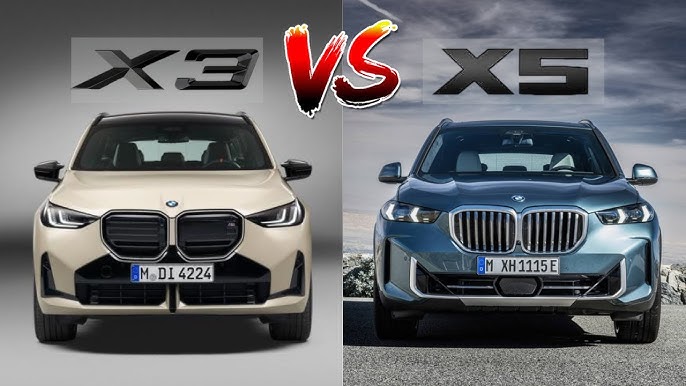
When I compare the BMW X3 vs X5, I see two SUVs that share the same BMW identity but serve noticeably different purposes. The X3 is the smaller, more affordable compact luxury SUV, while the X5 occupies the midsize luxury SUV category and emphasizes additional space, power and long-distance comfort. Based on the available 2026 specifications, I believe the decision is less about choosing the “better” BMW and more about deciding which vehicle fits a driver’s priorities.
The 2026 BMW X3 30 xDrive starts at $51,300 in the United States, according to BMW, while the X5 range starts at $68,300 for the rear-wheel-drive X5 sDrive40i. Those figures can change with destination charges, taxes, options and market conditions, so I would treat them as starting points rather than final transaction prices.
The difference becomes more interesting when we look beyond price. The X3 is 187.2 inches long, while the X5 measures about 194.3 inches. The X5 is also wider and taller, and it provides more cargo volume. At the same time, the X3 30 xDrive has a meaningful fuel-economy advantage in U.S. EPA estimates.
From my perspective, this makes the X3 especially appealing to drivers who spend significant time in cities, want a premium SUV without moving into the higher X5 price bracket, and still want strong performance. The X5 makes more sense when passenger comfort, cargo capacity, towing and six-cylinder power carry greater weight.
Key Takeaways From My BMW X3 vs X5 Comparison
The simplest way for me to frame the comparison is this: the X3 is the more compact and efficient choice, while the X5 is the larger and more powerful choice.
The 2026 X3 30 xDrive uses a 2.0-liter turbocharged four-cylinder with 255 horsepower and 295 lb-ft of torque, combined with a 48-volt mild-hybrid system and all-wheel drive. BMW lists a preliminary 0-to-60-mph time of 6.0 seconds for this version.
The X5 sDrive40i uses a 3.0-liter turbocharged inline-six with 375 horsepower. BMW lists a preliminary 0-to-60-mph time of 5.3 seconds for the rear-wheel-drive version and 5.2 seconds for the xDrive40i.
The X5 also offers substantially more capability. Depending on configuration, Car and Driver lists maximum towing capacity at up to 7,200 pounds, compared with 4,850 pounds for the X3.
Fuel economy reverses that advantage. Edmunds lists the 2026 X3 30 xDrive at 27 mpg city, 33 mpg highway and 29 mpg combined, while the X5 sDrive40i is listed at 23 mpg city, 27 mpg highway and 25 mpg combined.
I would therefore summarize the decision this way:
- I would choose the X3 for easier everyday maneuverability and lower starting cost.
- I would choose the X5 for greater cabin space and stronger six-cylinder performance.
- I would favor the X3 when fuel economy is important.
- I would favor the X5 for frequent long-distance travel and heavier towing needs.
- I would consider the X3 M50 when I want compact dimensions with substantially more performance.
- I would consider the X5 xDrive50e when plug-in hybrid capability is a priority.
What the BMW X3 and X5 Actually Represent
BMW positions both vehicles as members of its X family, but they sit in different segments. The X3 is a compact SUV, while the X5 is a midsize SUV. BMW itself describes the X3 as the more compact model between the X3, X5 and X7.
That distinction matters because size affects much more than appearance. A larger vehicle can offer more passenger room, cargo capacity and road presence, but it can also require more space to park and maneuver. A smaller vehicle can be easier to live with in tight environments while still providing enough room for many families.
The X3 therefore occupies a particularly interesting middle ground. It is not BMW’s smallest SUV, but it provides the practicality of an SUV without reaching the physical dimensions of the X5.
The X5 has a different mission. BMW describes it as suitable for families, frequent travelers and drivers who prefer high-performance SUVs. The company also emphasizes its suitability for long journeys and transporting heavy loads.
In my analysis, those descriptions line up with the fundamental differences between the two vehicles. The X3 is easier to justify when I want premium SUV functionality without needing maximum space. The X5 becomes more compelling when I expect the vehicle to function as a larger family transporter or long-distance machine.
BMW X3 vs X5 Size and Interior Space
Size is one of the first differences I would examine because it influences everyday usability.
The 2026 X3 measures 187.2 inches in length and 75.6 inches in width without mirrors. Its wheelbase is 112.8 inches. The X5 measures approximately 194.3 inches long and 78.9 inches wide, with a 117.1-inch wheelbase.
That means the X5 is roughly seven inches longer and more than three inches wider without mirrors. Those numbers may appear modest on paper, but the additional dimensions become relevant when parking, navigating narrow streets or loading passengers.
The X5 also has a longer wheelbase, which contributes to its larger overall footprint and provides additional cabin room. Edmunds lists X5 front shoulder room at 61.4 inches and rear shoulder room at 60.0 inches, compared with 57.9 inches and 55.7 inches respectively for the X3.
For a family that regularly carries several adults, I believe those differences can matter more than exterior styling.
A Practical Family Scenario
Consider a hypothetical family of four that regularly takes weekend road trips. Both SUVs can accommodate five passengers, but the X5 gives that family more overall cabin and cargo space.
Now consider a driver who usually travels alone or with one passenger and spends most of the week in a crowded city. In that scenario, I would give the X3 a stronger advantage because the additional size of the X5 may provide benefits that the driver rarely uses.
This is why I would avoid automatically assuming that bigger means better.
BMW X3 vs X5 Cargo Capacity
Cargo capacity is another area where the X5 has a measurable advantage.
Edmunds lists the X3 with 31.5 cubic feet of cargo capacity and 67.1 cubic feet with the rear seats folded. The X5 is listed with 33.9 cubic feet behind the second row and 72.3 cubic feet with the rear seats folded.
Car and Driver reports very similar figures, listing 32 cubic feet behind the X3’s rear seats and 67 cubic feet behind the front seats, compared with 33.9 and 72.3 cubic feet for the X5.
The difference is not enormous for ordinary shopping. However, it can become useful when carrying bulky luggage, sports equipment, camping equipment or larger household items.
I would therefore look at how frequently I actually use the maximum cargo area rather than paying for capacity that may remain empty.
| Practical Need | BMW X3 | BMW X5 | My Assessment |
|---|---|---|---|
| Daily commuting | Excellent | Excellent | X3 has the size advantage |
| Small family | Excellent | Excellent | Either can work |
| Larger luggage loads | Very good | Better | X5 |
| Frequent road trips | Very good | Excellent | X5 |
| Urban parking | Easier | More demanding | X3 |
| Bulky cargo | Good | Better | X5 |
| Maximum cargo volume | 67.1 cu. ft. | 72.3 cu. ft. | X5 |
The key takeaway from this table is that the X5 wins on absolute capacity, but the X3 does not sacrifice practicality to the point that it becomes unsuitable for ordinary family use. For many drivers, the X3’s cargo area is already sufficient.
BMW X3 vs X5 Engine Performance
Performance is where I think the X5 starts to justify its higher price more clearly.
The 2026 X3 30 xDrive produces 255 horsepower and 295 lb-ft of torque from its 2.0-liter four-cylinder mild-hybrid powertrain. BMW lists a preliminary 0-to-60-mph time of 6.0 seconds.
The X3 M50 xDrive takes a significant step upward. BMW lists its 3.0-liter inline-six mild-hybrid engine at 393 horsepower, with a preliminary 0-to-60-mph time of 4.4 seconds.
The X5 40i uses a 3.0-liter inline-six and produces 375 horsepower. BMW lists 5.2 seconds for the xDrive40i and 5.3 seconds for the sDrive40i.
This creates an interesting situation. A base X3 is considerably less powerful than an X5 40i, but the X3 M50 sits much closer to the X5’s performance territory.
From my perspective, shoppers should therefore compare actual trims rather than simply comparing the X3 badge with the X5 badge.
The Performance Quote That Explains BMW’s Philosophy
BMW’s long-standing marketing identity is relevant here because performance remains a major part of the brand’s positioning.
“The Ultimate Driving Machine®”
BMW
The phrase appears in official BMW vehicle documentation and has been associated with BMW’s brand identity for decades.
I think the quote matters because neither SUV is designed merely to be a transportation appliance. BMW has built both around a combination of utility and driving performance, although the X5 delivers that mission from a larger and more powerful platform.
Fuel Economy and Efficiency
When I compare the X3 and X5, fuel economy is one of the clearest advantages for the smaller SUV.
For the 2026 X3 30 xDrive, Edmunds lists 27 mpg city, 33 mpg highway and 29 mpg combined. The X5 sDrive40i is listed at 23 mpg city, 27 mpg highway and 25 mpg combined.
Those differences can become meaningful over years of driving.
For example, suppose a hypothetical driver travels 15,000 miles per year. At 29 mpg, that driver would theoretically use about 517 gallons annually. At 25 mpg, the same mileage would require about 600 gallons. Actual fuel consumption will vary with driving conditions, traffic, temperature, tires and driving style, but the example demonstrates why efficiency deserves attention.
The X5 has a larger 21.9-gallon fuel tank compared with the X3’s 17.2-gallon tank, according to Edmunds.
So the X5 can offset some of its lower fuel economy with a larger tank, but that does not change the basic efficiency advantage of the X3.
BMW X3 vs X5 Technology and Comfort
Both SUVs offer modern BMW technology, but the X5’s larger dimensions and higher positioning give it a more substantial luxury-SUV character.
Edmunds lists navigation, Bluetooth, satellite radio and keyless ignition as standard on both compared models. Heated seats are also listed as standard, while some features such as adaptive cruise control and ventilated seats can depend on configuration.
The X5 also benefits from additional standard or available equipment depending on trim and package.
I would pay close attention to the actual equipment list rather than assuming every X5 automatically includes every luxury feature. BMW offers extensive configuration options, and pricing can change substantially as packages and upgrades are added.
What BMW Says About the X5
BMW’s own description helps explain the X5’s intended character:
“the power to do more, the space to sprawl, and the confidence to conquer”
BMW
That wording appears in BMW’s 2026 X5 model description.
I interpret this as a concise description of the X5’s role in the lineup. BMW is emphasizing capability and space rather than simply presenting it as a larger version of the X3.
Ride Comfort and Everyday Driving
Ride comfort is difficult to reduce to a single specification because wheel sizes, tires, suspension settings, road quality and personal expectations all influence the experience.
Still, I would expect the X5’s larger body and longer wheelbase to appeal strongly to drivers who prioritize relaxed highway travel and a spacious cabin. The X3, meanwhile, has the advantage of being more compact.
For city driving, the X3’s smaller footprint can make the vehicle feel more manageable. That is especially relevant in parking structures, narrow roads and busy urban areas.
For long-distance driving, the X5’s extra space becomes more attractive. BMW specifically identifies the X5 as a vehicle suited to long journeys.
A useful hypothetical example would be a driver who spends 80 percent of the week commuting through congested streets and only occasionally travels long distances. I would lean toward the X3.
If another driver spends several hours each week on highways with multiple passengers and luggage, I would lean toward the X5.
Towing and Utility
If towing is an important part of the purchase decision, I would give the X5 serious consideration.
Car and Driver lists maximum towing capacity of 7,200 pounds for the X5, compared with 4,850 pounds for the X3. Exact towing capability can depend on the vehicle configuration and equipment, so buyers should verify the rating for the specific vehicle they intend to purchase.
That difference is substantial.
A hypothetical driver towing a small utility trailer may have no need for the X5’s extra capability. Someone towing a larger boat, trailer or substantial recreational equipment could find the X5 much better suited to the task.
I would not choose the X5 solely because it can tow more. I would choose it if that capability is genuinely relevant to my regular use.
BMW X3 vs X5 Plug-In Hybrid Choices
The X5 has another major advantage in powertrain variety.
BMW offers the X5 xDrive50e plug-in hybrid. BMW says the 2026 model produces 483 horsepower and has an electric range of up to 38 miles under its stated U.S. specifications.
That option changes the comparison because the X3 and X5 are no longer simply two gasoline SUVs of different sizes.
The X5 plug-in hybrid could make sense for a driver whose daily commute fits within its electric range but who still wants a gasoline powertrain for longer trips.
BMW also announced a new fifth-generation X5 for global markets in 2026 with petrol, diesel, plug-in hybrid and battery-electric versions planned across different markets. BMW Group says production of the new generation is scheduled to begin in August 2026, with the new fully electric iX5 following later in the year. Availability and specifications vary by market.
This is important because a buyer outside the United States should not assume that the U.S. X5 lineup applies unchanged to their local market.
Which BMW Is Better for Families?
For a small family, I believe the X3 is often sufficient.
It seats five and offers useful cargo capacity. BMW lists the X3 as a five-seat SUV with space for six suitcases in its current U.S. lineup presentation.
The X5 also seats five, but BMW’s lineup presentation gives it a larger luggage capacity, listing seven suitcases.
The X5’s extra rear-seat width can also matter. Edmunds lists 60.0 inches of rear shoulder room for the X5 versus 55.7 inches for the X3.
For child seats, multiple passengers or frequent luggage, that extra room can be useful.
However, I would still recommend measuring the actual equipment and cargo requirements before deciding. Families differ considerably, and a larger SUV is not automatically necessary for everyone.
Which BMW Is Better for City Driving?
For urban use, I would favor the X3.
Its shorter length, narrower body and smaller overall footprint make it easier to position in confined spaces. The X3 is approximately 187.2 inches long and 75.6 inches wide without mirrors, while the X5 is about 194.3 inches long and 78.9 inches wide.
The difference becomes particularly relevant when parking spaces are narrow.
The X3 also has a smaller turning circle in Edmunds’ comparison: 40.0 feet versus 41.3 feet for the X5.
That is not a dramatic difference, but it supports the larger conclusion that the X3 is the easier vehicle to maneuver in tight surroundings.
Which BMW Is Better for Highway Travel?
For frequent highway travel, I lean toward the X5.
The stronger six-cylinder engine provides more power, while the larger cabin provides additional passenger space. BMW itself describes the X5 as appropriate for long journeys.
The X3 is certainly capable of highway travel, and its better fuel economy may actually appeal more to high-mileage drivers.
This is where I would separate comfort from efficiency. If my priority is minimizing fuel consumption, I would select the X3. If my priority is a larger, more powerful and spacious long-distance SUV, I would select the X5.
Pricing and Ownership Considerations
The initial price difference is significant.
BMW lists a starting MSRP of $51,300 for the 2026 X3 30 xDrive. BMW lists the X5 sDrive40i at $68,300. The X5 xDrive40i starts at $72,100, while the X5 xDrive50e starts at $76,000 according to BMW’s current U.S. SUV lineup.
Edmunds’ comparison also estimates higher five-year ownership costs for the X5. Its figures show a True Cost to Own estimate of $78,048 for the X3 and $100,237 for the X5 under the selected configurations and assumptions. These are estimates, not universal ownership costs, and individual financing, insurance, fuel, maintenance and depreciation can differ considerably.
| Ownership Factor | BMW X3 30 xDrive | BMW X5 sDrive40i | What I Would Consider |
|---|---|---|---|
| Starting MSRP | $51,300 | $68,300 | X3 costs less initially |
| Engine | 2.0L turbo I4 mild hybrid | 3.0L turbo I6 mild hybrid | X5 has more displacement |
| Horsepower | 255 hp | 375 hp | X5 |
| Combined EPA economy | 29 mpg | 25 mpg | X3 |
| Cargo behind rear seats | 31.5 cu. ft. | 33.9 cu. ft. | X5 |
| Maximum cargo | 67.1 cu. ft. | 72.3 cu. ft. | X5 |
| Seating | 5 | 5 | Tie |
| Maximum towing listed by C/D | 4,850 lb | 7,200 lb | X5 |
| Five-year TCO estimate from Edmunds | $78,048 | $100,237 | X3 |
The main point I take from these numbers is that the X5’s higher cost is connected to genuine increases in power, size, utility and available powertrains. The question is whether I personally need those additional capabilities enough to justify paying for them.
Step-by-Step: How I Would Choose Between the X3 and X5
Step 1: Establish My Budget
I would start with the total purchase budget rather than the monthly payment.
A lower monthly payment can sometimes hide a longer loan term or additional financing cost. I would compare the full vehicle price, taxes, financing and expected running expenses.
Step 2: Decide How Much Space I Actually Need
Next, I would examine how many passengers normally travel with me and what I typically carry.
If five adults and large luggage are common, the X5 deserves more attention. If most journeys involve one or two people, the X3 may provide enough space.
Step 3: Calculate My Annual Mileage
If I drive a high number of miles annually, fuel economy becomes more important.
The X3’s 29-mpg combined rating compared with 25 mpg for the X5 sDrive40i gives the smaller vehicle a measurable efficiency advantage in the cited EPA estimates.
Step 4: Consider Towing
If I regularly tow equipment near the upper limits of the X3, I would move toward the X5.
I would verify the exact towing specification for the selected configuration before purchasing because tow ratings can depend on equipment.
Step 5: Compare Powertrain Requirements
For ordinary driving, the X3 30 xDrive’s 255 horsepower may be enough.
For drivers who strongly value acceleration, I would also compare the X3 M50 with the X5 40i rather than assuming the X5 is automatically faster. BMW lists 393 horsepower for the X3 M50 and 375 horsepower for the X5 40i.
Step 6: Consider the Driving Environment
I would think honestly about where the SUV will spend most of its time.
Urban drivers may appreciate the X3’s smaller footprint. Drivers covering long highway distances may prefer the X5’s additional space and power.
Step 7: Price the Actual Configurations
Finally, I would build both vehicles with the equipment I actually want.
The base MSRP is only the beginning. Options, packages, wheels and other equipment can change the final price substantially.
Common BMW X3 vs X5 Mistakes I Would Avoid
Assuming the X5 Is Always the Better BMW
The X5 is larger and more powerful, but that does not automatically make it the better purchase.
If I rarely carry passengers, do not tow and value efficiency and maneuverability, the X3 may be the more sensible choice.
Comparing Only Base Models
A base X3 and base X5 are not the only combinations worth considering.
The X3 M50, for example, provides 393 horsepower, while the X5 lineup includes the 40i, 50e and M60i among other configurations.
Ignoring Fuel Consumption
A higher purchase price is not the only cost difference.
Fuel, insurance, maintenance, depreciation and financing can all affect long-term ownership. Edmunds’ estimates illustrate how these factors can create a substantial five-year cost gap.
Choosing Based Only on Exterior Size
I would not assume that the larger vehicle automatically provides dramatically more usable cargo capacity.
The X5 does provide more space, but the difference behind the second row is relatively modest: 33.9 cubic feet versus 31.5 cubic feet in Edmunds’ specifications.
Forgetting Local Market Differences
Specifications and prices can vary by country.
A buyer in the United States may see a different lineup from a buyer in Europe, Asia or another market. BMW’s global announcements also show that powertrain availability can vary by region.
For that reason, I would always verify the local configuration before making a final purchase decision.
My Recommendations for Different Buyers
For a first-time BMW SUV buyer who wants a premium vehicle without moving into the higher X5 price range, I would start with the X3.
For a driver who values performance but still wants a compact SUV footprint, I would investigate the X3 M50.
For a family that frequently carries passengers and luggage, I would lean toward the X5.
For someone who regularly tows heavier loads, I would strongly consider the X5 because of its substantially higher maximum towing capability.
For a driver interested in plug-in hybrid ownership, I would look closely at the X5 xDrive50e because BMW offers it with 483 horsepower and an advertised electric range of up to 38 miles in the 2026 U.S. specification.
For a driver focused on fuel efficiency and everyday practicality, the X3 30 xDrive is the model I would examine first.
A Second Perspective on the BMW X3 vs X5 Decision
One reason I find this comparison interesting is that the two vehicles overlap enough to make the decision complicated.
The X3 is not a stripped-down alternative to the X5. It has a modern cabin, strong performance and useful cargo capacity. The X5 is not simply an oversized version of the X3 either. It brings a different level of space, engine performance, towing capability and powertrain choice.
Car and Driver gives the 2026 X3 a 9/10 rating and the X5 a 9.5/10 rating, with both named Editors’ Choice vehicles. Those ratings reflect that both are strong choices within their respective segments rather than proving that one is universally better.
That distinction matters to me.
If I need the larger SUV, the X5’s advantages are meaningful. If I do not need them, the X3 can provide much of the BMW SUV experience while remaining smaller and more efficient.
What Recent BMW X5 Development Means for Buyers
BMW’s 2026 announcement about the fifth-generation X5 adds another layer to this comparison.
BMW Group says the new X5 will offer petrol, diesel, plug-in hybrid and battery-electric drive options, with hydrogen technology planned for a later stage. The company says production is scheduled to start in August 2026 at its Spartanburg, South Carolina facility, with the new iX5 scheduled to follow in December 2026.
BMW also announced preliminary figures for the upcoming iX5, including a projected WLTP range of 645 to 845 kilometers depending on equipment and a provisional maximum charging rate of 460 kW. These figures are preliminary and not directly comparable with EPA-certified U.S. ratings.
I would therefore be cautious about using current X5 information to predict every detail of future-market models.
The practical lesson is simple: if I am buying immediately, I need to evaluate the exact model year and market-specific vehicle available to me. If I am planning a purchase later, I should also consider whether the upcoming generation changes the value proposition.
What the BMW X3 vs X5 Comparison Ultimately Shows
The comparison reveals two different approaches to the luxury SUV.
The X3 emphasizes balance. It combines a smaller footprint with respectable power, useful cargo space, all-wheel drive in the 30 xDrive configuration and better EPA fuel economy than the X5 40i.
The X5 emphasizes capability. Its larger cabin, stronger six-cylinder engine, greater cargo volume and higher towing capacity make it better suited to drivers who genuinely need those advantages.
The price difference is also substantial. That means I would not recommend moving from the X3 to the X5 simply because the X5 feels more prestigious. I would make the move only if its additional capabilities solve a real requirement.
That is the most important distinction I can draw from the available evidence.
Conclusion
When I evaluate the BMW X3 vs X5, I see two strong SUVs designed for different priorities rather than one clear winner. The X3 is the model I would favor when compact dimensions, efficiency, lower starting cost and everyday practicality matter most. Its 255-horsepower 30 xDrive powertrain provides plenty of capability for ordinary driving, while the X3 M50 offers a much stronger performance alternative.
The X5 becomes my preferred choice when space, towing, long-distance comfort and stronger six-cylinder performance are more important. Its broader powertrain range, including the X5 xDrive50e plug-in hybrid, also gives buyers more ways to configure the vehicle around their needs.
In my view, the best next step is to build both vehicles around the equipment I actually need and compare their complete purchase and ownership costs. If the X3 already satisfies my passenger, cargo and performance requirements, I would keep the money and choose the smaller SUV. If I genuinely need the additional capability, I believe the X5 earns its premium.
Frequently Asked Questions
Is the BMW X3 or X5 better for everyday driving?
I would generally choose the X3 for everyday urban driving because it is shorter and narrower than the X5. The 2026 X3 measures 187.2 inches long and 75.6 inches wide without mirrors, while the X5 is about 194.3 inches long and 78.9 inches wide. The X3 also has a slightly smaller turning circle according to Edmunds. For drivers who frequently park in tight spaces or navigate crowded streets, those differences can make the smaller SUV easier to live with.
Is the BMW X5 more powerful than the X3?
The standard X5 40i is more powerful than the standard X3 30 xDrive. The X5 40i produces 375 horsepower, while the X3 30 xDrive produces 255 horsepower. However, the X3 M50 changes the comparison because BMW lists 393 horsepower for that model. I therefore recommend comparing specific trims rather than assuming every X5 is more powerful than every X3.
Does the BMW X5 have more cargo space than the X3?
Yes. Edmunds lists 33.9 cubic feet behind the X5’s second row and 72.3 cubic feet with the rear seats folded. The X3 is listed at 31.5 and 67.1 cubic feet respectively. The difference is useful for families and drivers carrying bulky equipment, although I would not consider it large enough by itself to justify an X5 for every buyer.
Which is more fuel efficient, the BMW X3 or X5?
The 2026 BMW X3 30 xDrive is more fuel efficient according to the cited EPA estimates. Edmunds lists 29 mpg combined for the X3 and 25 mpg combined for the X5 sDrive40i. For someone who drives many miles each year, I believe this difference should be included in the ownership-cost calculation rather than focusing only on the purchase price.
Is the BMW X5 worth the extra money over the X3?
I believe the answer depends on whether I actually need the X5’s additional capabilities. BMW’s current U.S. starting prices put the X5 substantially above the X3.The X5 provides more power, space, towing capability and powertrain choices, so the premium can make sense for the right buyer. If those advantages are rarely used, I would consider the X3 the better value.
Which BMW should I choose for a large family?
For a family that regularly carries several passengers and substantial luggage, I would lean toward the X5. Both vehicles seat five, but the X5 has more rear shoulder room and greater cargo capacity. Families should still check child-seat arrangements, luggage requirements and the actual local vehicle configuration before purchasing.
Can the BMW X3 tow as much as the X5?
No. The X5 has the higher towing capability. Car and Driver lists maximum towing capacity at up to 7,200 pounds for the X5 compared with 4,850 pounds for the X3. Exact capacity can depend on configuration and equipment, so I would verify the specific vehicle’s official rating before towing.
Does the X5 have a plug-in hybrid version?
Yes. BMW offers the X5 xDrive50e plug-in hybrid. For the 2026 U.S. model, BMW lists 483 horsepower and an electric range of up to 38 miles. Availability and specifications can vary by market, so I would check the local BMW lineup before assuming that the same version is available everywhere.
Sources and References
The factual specifications, pricing and comparisons in this article are based primarily on current BMW information and established automotive comparison sources. BMW’s official 2026 X3 information lists the X3 30 xDrive at 255 horsepower and a $51,300 starting MSRP, while BMW’s X5 information lists the X5 sDrive40i at 375 horsepower and the current U.S. X5 lineup includes multiple powertrain choices.
Car and Driver’s 2026 X3-versus-X5 comparison was used for comparative dimensions, towing capacity, fuel economy, cargo capacity and editorial ratings.
Edmunds’ 2026 comparison was used for additional specifications, fuel economy, dimensions and estimated five-year ownership costs.
BMW Group’s 2026 announcement concerning the next-generation X5 was used for information about the upcoming global X5 powertrain strategy and production timeline.
Disclaimer
Vehicle prices, specifications, equipment, fuel-economy figures, availability and ownership costs can vary by country, model year, trim, options, dealer, taxes, financing terms and individual driving conditions. I have used the cited information available for the 2026 models at the time of writing, but buyers should verify the exact specifications and pricing for their local market before making a purchase decision. The performance figures supplied by BMW may be preliminary, and real-world results can differ. This article is intended for general informational purposes and should not be treated as a substitute for official manufacturer specifications, a dealer quotation or professional financial advice.