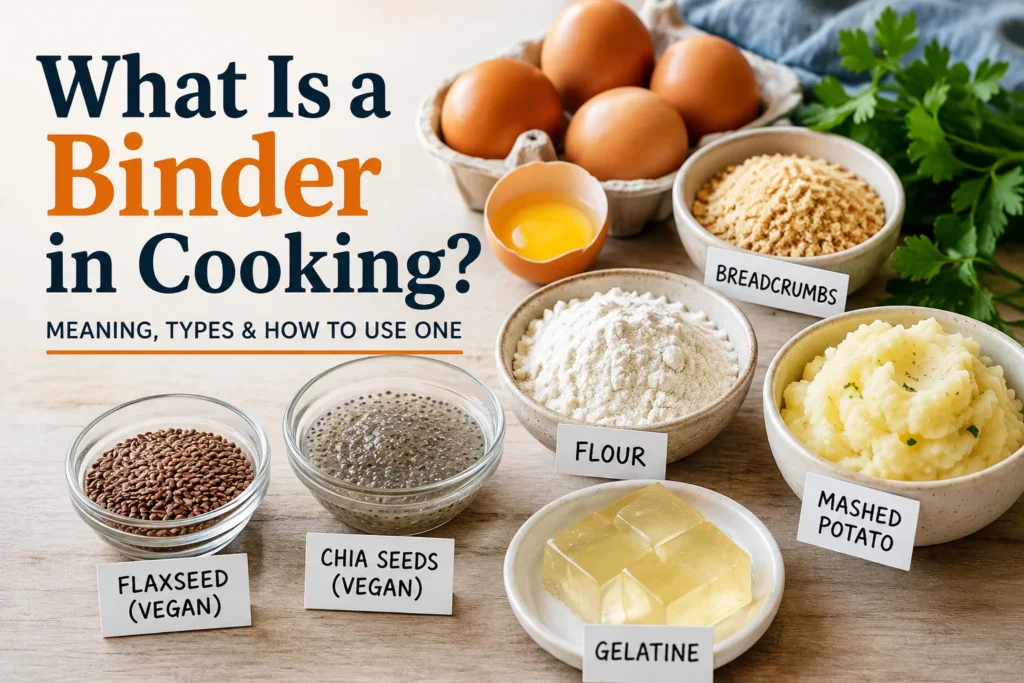
When I first look at the structure of a recipe, I pay close attention to the ingredients that help everything stay together. One of the most useful concepts behind that structure is the cooking binder. A binder is an ingredient that helps other ingredients hold together, thicken, stabilize, or maintain their intended shape during preparation and cooking. Depending on the recipe, that role can be performed by eggs, breadcrumbs, flour, starches, gelatin, mashed vegetables, ground seeds, dairy products, or other ingredients.
In my analysis, the easiest way to understand a binder is to think about what would happen if it were removed. A meatball might crumble, a veggie patty might break apart, a sauce might remain too thin, or a baked product might lack the structure needed to hold its shape. The exact result depends on the food, but the basic principle remains the same: the binder helps create cohesion.
The term can sound more technical than it really is. I believe most home cooks already use binders regularly without thinking of them by that name. An egg added to meatloaf, breadcrumbs mixed into a patty, cornstarch added to gravy, or flour incorporated into a sauce can all perform binding or closely related structural functions.
We can also see that the word “binder” does not always describe exactly the same process. Some binders work primarily by forming a protein network when heated. Others absorb liquid and swell, while some create gels as they cool. Certain ingredients can also help ingredients adhere to a surface rather than physically holding a mixture together.
Understanding these differences makes cooking much easier. Instead of treating a binder as a mysterious ingredient that a recipe happens to require, I can look at the desired result and choose an ingredient according to its specific function.
Key Takeaways About Binders in Cooking
A binder is generally used to improve cohesion, structure, thickness, or stability in a food mixture. The exact mechanism depends on the ingredient and the cooking method.
Eggs are among the most versatile binders because their proteins can coagulate with heat. They can help ingredients hold together while also contributing moisture, richness, and structure.
Breadcrumbs and oats are particularly useful in patties, meatballs, meatloaf, and similar mixtures because they absorb moisture and provide physical structure.
Flour and starches such as cornstarch and potato starch are especially useful when the goal is to thicken a liquid. They can also contribute structure to solid foods.
Plant-based cooks have several options, including ground flaxseed, chia seeds, mashed beans, mashed potatoes, and certain starches. The best substitute depends on what the original binder was supposed to accomplish.
I have found that the biggest mistake is thinking that every binder is interchangeable. Two ingredients may both “hold food together” but produce completely different textures, flavors, and levels of firmness.
The amount matters as much as the ingredient. Too little binder can leave food fragile, while too much can make a dish dense, gummy, dry, rubbery, or excessively firm.
What Is a Binder in Cooking?
In cooking, I define a binder as an ingredient that helps separate components of a recipe become a cohesive mixture or helps a food maintain its intended structure. The term is broad because different foods require different forms of binding.
The U.S. Department of Agriculture’s Food Safety and Inspection Service uses the term in a broader food-production context as well:
“BINDER – a substance that may be added to foods to thicken or improve texture.”
U.S. Department of Agriculture, Food Safety and Inspection Service
This definition matters because it shows that binding is not limited to an egg holding a meatball together. A binder can also be involved in thickening and improving texture. In my view, that broader definition is useful when we encounter the term on ingredient lists or in food-processing discussions.
For everyday home cooking, however, I usually think about binders in three major categories. The first group helps solid ingredients stick together. The second thickens liquids or semi-liquid mixtures. The third provides structure by creating a network or gel.
The same ingredient can sometimes perform more than one of these functions. Eggs are an excellent example. They can bind a meat mixture, thicken a custard, contribute structure to baked goods, and help stabilize an emulsion.
Land O’Lakes provides a straightforward culinary definition:
“Bind/Binder: To add a thickening ingredient such as an egg, flour or cornstarch, to hold ingredients together in soups, sauces or gravy.”
Land O’Lakes culinary glossary
I think this illustrates why context is so important. If a recipe says to add an egg as a binder to meatballs, the purpose is different from adding an egg yolk to a custard. Both involve binding, but the physical process and desired final texture are different.
How Binders Actually Work
The science of binding becomes easier to understand when I separate the main mechanisms instead of treating all binders as culinary glue.
Protein-Based Binding
Eggs are one of the clearest examples of protein-based binding. When an egg is heated, its proteins change structure and form a network. That network can turn a loose liquid mixture into a more solid structure.
Harold McGee explains the structural role of egg proteins in On Food and Cooking:
“This is the key to its great versatility as a structure builder in complex mixtures.”
Harold McGee, On Food and Cooking
The quotation is particularly relevant because eggs are not simply sticky ingredients. Their value comes from what happens to their proteins during cooking. When incorporated into a mixture and heated, those proteins can contribute to a stable structure.
A practical example is meatloaf. Ground meat already has its own proteins and fat, but additional ingredients such as breadcrumbs, vegetables, seasonings, and liquid can make the mixture more difficult to shape. Egg can help the overall mixture develop cohesion as it cooks.
However, I would not assume that adding more egg automatically produces a better result. Excess egg can make some dishes firmer or more rubbery than intended. The binder must be balanced with the rest of the recipe.
Starch-Based Binding
Starches work differently. Cornstarch, potato starch, tapioca starch, and similar ingredients interact with water and heat. Their granules absorb water, swell, and contribute to thickening.
This is why cornstarch is commonly used in sauces, gravies, fillings, and soups. Rather than creating a protein network like an egg, the starch changes the physical properties of the liquid.
For example, imagine a fruit filling containing a substantial amount of juice. Without sufficient thickening, the filling may remain runny after cooking. A suitable starch can absorb and immobilize some of that liquid, giving the filling enough body to remain in place.
The Alimentarium explains that starch grains absorb water and swell during heating, producing a thickening effect.
In my view, this is one of the most important distinctions to remember: an ingredient that works well as a starch thickener in a sauce may not be the best choice for binding a burger patty.
Moisture-Absorbing Binders
Breadcrumbs, oats, and some ground grains can bind mixtures partly by absorbing moisture. They can also create physical bulk that makes a mixture easier to shape.
Consider a hypothetical meatball mixture containing ground meat, grated onion, herbs, and a small amount of liquid. If the mixture is excessively wet, it may be difficult to form and may break apart during cooking. Breadcrumbs can absorb some of that moisture and provide additional structure.
This does not mean breadcrumbs simply act as culinary glue. Their contribution also depends on how much moisture they absorb and how the surrounding ingredients behave.
Gel-Forming Binders
Gelatin, pectin, and some seed-based ingredients can create gels. These ingredients are useful when the desired structure develops as the mixture cools or as liquid becomes immobilized.
Gelatin is particularly different from an egg or starch because its behavior can be important in cold preparations. Pectin is central to many jams and jellies, where it contributes to the characteristic set.
Ground flaxseed and chia seeds can also become useful plant-based binders because they form a gel when combined with water. This makes them valuable in some egg-free recipes.
Common Types of Binders Used in Cooking
The best binder depends on the food being prepared. I would not select a binder simply because it is available. Instead, I would ask what function the recipe actually needs.
Eggs as Binders
Eggs are among the most familiar binders in home cooking. They can help meatballs, meatloaf, patties, casseroles, baked goods, and other mixtures develop structure.
Their advantage is versatility. Eggs contain proteins that set with heat, while the yolk also contributes fat and emulsifying components.
A hypothetical example would be a vegetable fritter made from shredded vegetables, flour, herbs, and seasoning. Adding an egg can help the mixture become more cohesive as it cooks.
Eggs can also play multiple roles simultaneously. They may provide moisture, richness, emulsification, thickening, and structure. That is why replacing an egg in a recipe is not always as simple as finding another ingredient that merely “sticks.”
Breadcrumbs as Binders
Breadcrumbs are particularly common in meatballs, meatloaf, fishcakes, croquettes, and vegetable patties.
I consider breadcrumbs useful when a recipe needs both moisture management and physical structure. They can absorb liquid and become integrated into the mixture instead of remaining as separate particles.
Different breadcrumbs can behave differently. Fine dried crumbs, coarse crumbs, fresh breadcrumbs, and panko do not necessarily produce the same texture.
For a soft mixture, fine crumbs may integrate more thoroughly. Coarser crumbs can provide a different texture and may be particularly useful in recipes where some contrast is desirable.
Flour as a Binder
Flour can provide structure through its proteins and starches. Wheat flour is especially significant in baking because gluten development can contribute elasticity and strength.
When flour is mixed with water, wheat proteins can form gluten. This is one reason bread dough can develop a stretchy structure rather than behaving like a simple paste.
Flour can also thicken sauces. A classic roux combines flour with fat and is then used as a foundation for thickened sauces.
The important point is that flour is not performing only one job. In one recipe it may contribute structural development, while in another it may primarily thicken a liquid.
Cornstarch as a Binder or Thickener
Cornstarch is commonly associated with thickening rather than the solid binding of meatballs or patties.
I would choose cornstarch when I want a relatively neutral starch-based thickening effect. It can be mixed with cold liquid to form a slurry before being incorporated into hot food.
A common mistake is adding dry cornstarch directly to a hot liquid without dispersing it properly. This can create lumps. Preparing a slurry first allows the starch to distribute more evenly.
Cornstarch is especially useful in gravies, sauces, stir-fry sauces, custards, and pie fillings, although the exact technique varies according to the recipe.
Oats as Binders
Oats can be useful in vegetable patties, meat mixtures, breakfast recipes, and baked foods. They can absorb moisture and contribute bulk.
Their flavor is generally mild, making them practical when I want binding without introducing a strong additional taste.
Oat-based binding can be particularly helpful when someone wants an alternative to breadcrumbs. However, the texture will not necessarily be identical.
Mashed Potatoes as a Binder
Mashed potatoes contain starch and moisture, allowing them to contribute cohesion to foods such as croquettes, fishcakes, and vegetable patties.
This is an excellent example of a binder that can also contribute flavor and body. Instead of simply holding ingredients together, mashed potato becomes part of the identity of the finished dish.
Ground Flaxseed
Ground flaxseed mixed with water can form a gel-like mixture often used as an egg alternative in certain recipes.
I believe this is most useful when the goal is to replace some of the binding function of an egg rather than reproduce every property of an egg.
A hypothetical example would be an egg-free vegetable patty. Ground flaxseed and water could contribute cohesion, while mashed beans or oats could provide additional body.
Chia Seeds
Chia seeds can also absorb liquid and form a gel. Ground chia may be used in certain egg-free recipes where binding is needed.
The flavor and texture are different from eggs, so I would consider chia a functional substitute rather than a perfect one-to-one replacement.
Gelatin
Gelatin can create a firm gel when cooled. It is useful in certain desserts, terrines, aspics, marshmallow-style preparations, and other foods where a set structure is desirable.
Because gelatin is animal-derived, it is not suitable for vegan cooking. This makes ingredient selection particularly important when dietary restrictions are involved.
Dairy-Based Ingredients
Cheese, cream-based mixtures, and certain dairy preparations can contribute cohesion and structure.
Melted cheese can hold ingredients together in casseroles or baked dishes. However, cheese behaves differently from egg, starch, or breadcrumbs because its fat and protein composition creates its own texture when heated.
I would therefore choose dairy as a binder when its flavor and texture are compatible with the recipe rather than treating it as a universal replacement.
Choosing the Right Binder for Different Foods
The following table helps me compare common binders according to the job they are generally suited to.
| Binder | Main Function | Common Uses | Texture Contribution | Important Consideration |
|---|---|---|---|---|
| Egg | Protein binding and structure | Meatballs, meatloaf, baking, custards | Firm, cohesive | Can become rubbery if overused |
| Breadcrumbs | Moisture absorption and structure | Meatballs, fishcakes, patties | Soft to moderately firm | Different crumb types behave differently |
| Flour | Structure and thickening | Baking, sauces, doughs | Firm or thick | Wheat flour can develop gluten |
| Cornstarch | Thickening | Gravies, sauces, fillings | Smooth and thick | Needs proper dispersion |
| Oats | Moisture absorption | Patties, meatloaf, baked foods | Hearty and soft | Adds a mild grain texture |
| Mashed potato | Starch-based cohesion | Croquettes, fishcakes | Soft and dense | Adds moisture and flavor |
| Flaxseed | Gel formation | Egg-free patties and baking | Soft, cohesive | Needs liquid and time to hydrate |
| Chia | Gel formation | Egg-free recipes | Gel-like | Can affect texture noticeably |
| Gelatin | Gel formation | Desserts and cold preparations | Firm and elastic | Animal-derived |
| Pectin | Gel formation | Jams and fruit preparations | Firm or spreadable | Works with suitable sugar and acidity |
The most important takeaway from this comparison is that “binder” describes a function rather than a single ingredient. I would select the binder based on whether I need firmness, moisture absorption, thickening, elasticity, or gel formation.
When Should I Use a Binder?
Not every recipe needs an ingredient specifically added as a binder. Many foods already contain natural structures that provide cohesion.
Ground meat, for example, can form a cohesive mixture when handled correctly. Wheat flour can develop gluten. Potatoes contain starch. Eggs contain proteins that set when heated.
A binder becomes more important when additional ingredients interfere with that natural structure or when the recipe requires a specific texture.
For example, a vegetable patty contains chopped or shredded components that may not naturally hold together. A binder can help transform those loose components into something that can be shaped and cooked.
The same reasoning applies to fishcakes, croquettes, fritters, meatballs, and certain gluten-free baked goods.
I believe the best question is not “What binder should I use?” but “What structural problem am I trying to solve?”
How to Use a Binder Step by Step
Step 1: Identify the Structural Problem
First, I would examine the mixture before adding anything. Is it too wet? Too dry? Crumbly? Runny? Does it refuse to hold its shape?
That diagnosis matters because a binder should solve a specific problem rather than simply being added automatically.
If a mixture is already very dry, adding a moisture-absorbing binder may make the final dish excessively dry. If it is very wet, additional absorbent material may be useful.
Step 2: Identify the Desired Texture
Next, I would decide what the finished food should feel like.
A delicate fishcake needs a different structure from a firm meatball. A sauce should become pourable and thick rather than solid. A cookie should hold its shape without becoming dense.
The desired texture should guide the binder choice.
Step 3: Choose a Compatible Binder
After identifying the problem, I would choose an ingredient that naturally addresses it.
For moisture absorption, breadcrumbs or oats may be suitable. For protein-based structure, egg may be useful.
Step 4: Add the Binder Gradually
I prefer gradual adjustment when a recipe permits it. Adding too much binder at once can be difficult to correct.
A hypothetical example is a vegetable patty mixture that feels slightly wet. Rather than adding a large quantity of breadcrumbs immediately, I would add a small amount, mix, allow it to hydrate if appropriate, and reassess the consistency.
Step 5: Allow Hydration or Rest When Necessary
Some binders need time to interact with liquid. Breadcrumbs can absorb moisture, while ground flax and chia need time to develop their gel-like consistency.
Skipping this stage can make a mixture appear weaker than it actually is.
Step 6: Test a Small Portion
For a mixture that will be shaped into multiple pieces, I believe a small test portion is extremely useful.
A hypothetical scenario would be a batch of vegetable patties. Instead of shaping the entire mixture and discovering that the patties break apart during cooking, I can cook one small portion first. If it falls apart, I can adjust the mixture before preparing the rest.
Step 7: Cook According to the Recipe
A binder may not reach its full structural potential until the food is heated or cooled.
Egg proteins need appropriate cooking to set. Starches need sufficient heat and moisture. Gelatin needs cooling to establish its gel.
This means I should judge the binder not only by the raw mixture but also by how the finished food behaves.
Binders in Meatballs, Meatloaf, and Patties
Meat-based mixtures are among the clearest examples of binding.
When I combine ground meat with breadcrumbs, vegetables, herbs, eggs, and seasoning, I am creating a mixture containing components with different physical properties. The binder helps the mixture maintain cohesion.
Eggs can provide protein-based setting, while breadcrumbs can absorb moisture. Together, they can produce a stable mixture.
However, binding is only one part of the result. Handling also matters. Excessive mixing can change the texture of ground meat preparations, while insufficient mixing may leave ingredients unevenly distributed.
For a hypothetical meatball mixture, I might notice that it feels extremely loose because of grated vegetables or added liquid. Instead of immediately adding several eggs, I would first consider whether breadcrumbs or another absorbent ingredient would address the moisture problem more appropriately.
This illustrates why the strongest approach is to diagnose the mixture rather than blindly increase the binder.
Binders in Baking
Baking presents a more complicated picture because several structural processes can occur simultaneously.
Eggs can bind flour particles and contribute structure as they coagulate. Flour contributes starch and, in wheat-based products, gluten-forming proteins. Sugar affects moisture and structure, while fats can tenderize and influence the final texture.
Harold McGee describes the role of eggs in cookies as follows:
“Eggs generally provide most of the water in a cookie mix, as well as proteins that help bind the flour particles together and coagulate during baking to add solidity.”
Harold McGee, On Food and Cooking
I find this particularly useful because it demonstrates that one ingredient can perform several functions at once. An egg in baking is not necessarily there only as a binder.
This also explains why egg substitutions can be complicated. Replacing an egg may change moisture, fat, emulsification, binding, and structure simultaneously.
In gluten-free baking, the challenge can be even more noticeable because wheat gluten is absent. Depending on the recipe, ingredients such as xanthan gum, psyllium, starches, eggs, or other structural ingredients may be used to compensate for the missing network.
Binders in Sauces, Soups, and Gravies
In liquids, “binding” often overlaps with thickening.
Flour, cornstarch, potato starch, arrowroot, and other starches can increase viscosity. Egg yolks can also thicken certain sauces through protein coagulation.
The technique matters greatly. For example, cornstarch is often dispersed in cold liquid before being added to hot food. Flour can be incorporated through a roux or other methods.
Egg-based sauces require particular temperature control because excessive heat can cause proteins to coagulate too aggressively.
This is one reason I would not use the same mental model for every binder. The word may be identical, but the cooking process can be completely different.
Vegan and Egg-Free Binder Alternatives
For people avoiding eggs, several ingredients can provide binding functions.
Ground flaxseed mixed with water is one option. Chia can also form a gel. Mashed beans can add both moisture and structural cohesion to vegetable patties. Mashed potato can work well in croquettes and similar preparations. Oats and breadcrumbs may also contribute useful structure.
Aquafaba, the liquid associated with cooked chickpeas, can perform several functions in cooking and baking, although its behavior depends heavily on the recipe.
I believe the most important consideration is to identify what the egg was doing in the original recipe. If the egg was primarily binding a patty, a gel-forming seed mixture may help. If the egg was emulsifying a sauce, a simple starch may not reproduce the same result.
Gluten-Free Binder Options
Gluten-free cooking requires particular attention to structure because wheat flour cannot always be used in its traditional role.
Cornstarch, potato starch, tapioca starch, ground flaxseed, chia, psyllium, and gluten-free oats can all have useful applications.
However, these ingredients are not interchangeable. Starches can thicken, while psyllium can provide a different type of elasticity and moisture retention. Flax can create gel-like cohesion, while oats provide both structure and bulk.
A practical example would be gluten-free cookies. If the original recipe depends heavily on wheat flour for structure, simply replacing wheat flour with a single gluten-free starch may produce a very different result. The recipe may need a combination of ingredients to reproduce the desired texture.
Common Binder Mistakes and Misconceptions
Mistaking a Thickener for a Universal Binder
One of the most common conceptual mistakes is assuming that every thickener can replace every binder.
Cornstarch can make a sauce thick, but that does not mean it will automatically produce the same texture as an egg in a meatball.
The function may overlap, but the mechanism is different.
Adding Too Much Binder
More is not necessarily better.
Excess egg can create a dense or rubbery texture. Too much starch can make a sauce overly thick or gummy. Too many breadcrumbs can make a meat mixture dry.
The ideal quantity depends on the moisture and structure of the complete recipe.
Ignoring Moisture Balance
A binder does not exist independently from liquid.
If I add breadcrumbs to a dry mixture, I may create a crumbly result. If I add them to an excessively wet mixture, they may improve cohesion.
This is why I consider moisture balance one of the most important factors in successful binding.
Expecting Substitutes to Behave Identically
An egg substitute may bind successfully but still change flavor, moisture, color, or texture.
I would therefore describe most substitutions as functional alternatives rather than exact duplicates.
Choosing a Binder Without Considering Flavor
A binder becomes part of the finished dish. Mashed potato, cheese, oats, flaxseed, and breadcrumbs can all affect taste.
A technically effective binder may still be a poor culinary choice if its flavor conflicts with the recipe.
Forgetting Dietary Restrictions
Eggs, dairy, gluten-containing flour, and gelatin each have dietary implications.
Before selecting a binder, I would consider allergies, intolerances, dietary preferences, and religious or ethical restrictions where relevant.
How to Fix a Mixture That Will Not Hold Together
If a mixture falls apart, I would avoid immediately adding large quantities of binder.
First, I would examine whether the mixture is too wet, too dry, too coarse, or insufficiently hydrated.
If it is excessively wet, a suitable dry ingredient may absorb some moisture. Breadcrumbs, oats, or an appropriate starch could help depending on the recipe.
If it is dry, adding more dry binder is likely to make the problem worse. A small amount of moisture may be more appropriate.
If the ingredients simply have not been distributed evenly, additional mixing may help, although overmixing should be avoided where it negatively affects texture.
Chilling can also help certain mixtures become easier to handle, especially when fat or other ingredients firm up with lower temperatures.
For a hypothetical vegetable patty, I might shape one test patty and cook it before adjusting the entire batch. If it cracks because the mixture is too dry, I can add moisture. If it spreads because it is too wet, I can add an appropriate absorbent ingredient.
This small-test approach reduces waste and makes adjustment more controlled.
Binder Selection by Cooking Goal
The second table focuses on the practical decision rather than the ingredient itself.
| Cooking Goal | Suitable Binder Examples | Why It Can Help | Potential Problem |
|---|---|---|---|
| Keep meatballs together | Egg, breadcrumbs, oats | Adds cohesion and controls moisture | Too much can make them dense |
| Hold veggie patties together | Flax, chia, oats, mashed beans, egg | Creates cohesion among loose ingredients | Texture can become heavy |
| Thicken gravy | Flour, cornstarch, potato starch | Increases viscosity | Excess can create lumps or gumminess |
| Set a custard | Egg yolks, whole eggs | Protein coagulates with heat | Excessive heat can cause curdling |
| Bind fishcakes | Egg, mashed potato, breadcrumbs | Combines moisture absorption with structure | Too much dry material can cause dryness |
| Structure cakes | Eggs, flour, starches | Builds and stabilizes the baked structure | Substitution can change texture |
| Set jam | Pectin | Forms a gel with the appropriate conditions | Requires suitable recipe balance |
| Make an egg-free patty cohesive | Flax, chia, mashed beans, starch | Provides non-egg structural support | May alter flavor and texture |
| Create a cold-set preparation | Gelatin, pectin | Forms a gel during cooling | Not all options suit dietary requirements |
The main lesson I take from this comparison is that the cooking goal should come before the ingredient choice. If I need a thick gravy, I think about thickening behavior. If I need a sturdy patty, I think about cohesion and moisture.
Expert Recommendations for Better Binding
From my perspective, the best binder is rarely the strongest binder. The best binder is the one that provides enough structure while preserving the texture the recipe is supposed to have.
I recommend starting with the recipe’s intended function. Ask whether the binder is supposed to absorb liquid, create a protein network, thicken a sauce, stabilize an emulsion, or form a gel.
Next, consider the ingredients already present. A recipe may already contain enough natural starch, protein, or gluten that only a small additional binder is needed.
I also recommend paying attention to hydration. Dry ingredients often need time to absorb liquid before their true binding ability becomes apparent.
For substitutions, I recommend replacing functions rather than ingredients. If an egg is being used for binding, identify another ingredient that can provide cohesion. If it is being used for emulsification, look for an emulsifying solution instead.
Temperature is another major consideration. Egg proteins respond to heat. Starches depend on heat and moisture. Gelatin depends strongly on cooling. The same ingredient can therefore behave differently depending on the cooking process.
Finally, I believe small-batch testing is one of the most practical techniques available. When modifying a recipe, testing one portion allows me to identify problems before committing the entire mixture.
Binder Versus Thickener: Are They the Same?
The terms overlap, but I would not treat them as perfect synonyms.
A binder generally emphasizes cohesion and the ability to hold components together. A thickener emphasizes increasing the viscosity of a liquid or semi-liquid food.
Cornstarch is an obvious thickener. Egg can be a binder and a thickener. Breadcrumbs can bind solid mixtures while also controlling moisture.
This distinction is useful when reading recipes because it helps explain why one ingredient is selected instead of another.
If a recipe calls for a binder in a patty, I would focus on structural cohesion. If it calls for a thickener in gravy, I would focus on viscosity.
The terminology becomes broader in commercial food production, where binders can include food starches, cellulose, carrageenan, whey protein concentrate, and other ingredients used to influence texture and stability. The USDA specifically identifies several such substances in meat and poultry products.
How Much Binder Should I Use?
There is no single universal amount because binder requirements depend on the ingredients, moisture level, cooking method, and desired texture.
A meatball containing a high proportion of moist vegetables may require a different amount of dry binder from one made primarily from meat.
Similarly, a sauce requiring slight thickening needs much less starch than a preparation intended to become substantially thicker.
I would therefore avoid universal ratios unless they come from a specific tested recipe. Instead, I would use the recipe’s instructions as the starting point and adjust cautiously when necessary.
The most useful practical sign is consistency. A patty mixture should generally be cohesive enough to shape without becoming excessively sticky or dense. A sauce should reach the intended consistency without becoming paste-like.
Can You Use Two Binders Together?
Yes, recipes can use multiple binding mechanisms at the same time.
Egg and breadcrumbs are a familiar combination. The egg provides protein-based setting while breadcrumbs absorb moisture and add structure.
A fishcake might use mashed potato, egg, and breadcrumbs, with each ingredient contributing something different.
Baking recipes can also depend on multiple structural ingredients. Eggs, flour, starches, and fats may all influence the final result.
I believe using multiple binders makes sense when each one has a distinct purpose. It becomes less useful when ingredients are added redundantly without considering their combined effect.
What Happens When You Use Too Much Binder?
Excess binding can be just as problematic as insufficient binding.
Too much egg can produce a firm or rubbery texture. Too much flour can make baked foods dense. Excess starch can make a sauce gummy. Too many breadcrumbs can absorb so much moisture that a meat mixture becomes dry.
The practical lesson is simple: binding should support the food, not dominate it.
A good binder should become part of the recipe’s intended structure without making its presence obvious as an unwanted texture.
Why Understanding Binders Makes Cooking Easier
Once I understand what a binder does, recipes become easier to troubleshoot.
Instead of seeing a crumbling patty as a mysterious failure, I can ask whether the mixture lacks cohesion or contains too much moisture.
Instead of adding random ingredients to a thin sauce, I can identify whether I need a starch or another thickening mechanism.
This way of thinking turns cooking from a process of blindly following instructions into a process of understanding ingredients.
We can reasonably conclude that binding is not one single culinary technique. It is a family of related mechanisms that help food maintain structure, consistency, and texture.
Conclusion
In my view, understanding what is a binder in cooking gives me a much more useful way to think about recipes. A binder is not simply an ingredient that makes food “stick.” Depending on the recipe, it can absorb moisture, create a protein network, thicken a liquid, form a gel, or help several ingredients maintain a stable structure.
I believe the most important practical lesson is to choose the binder according to the problem I am trying to solve. Eggs can provide protein-based structure, breadcrumbs and oats can manage moisture, starches can thicken liquids, and plant-based ingredients such as flaxseed and chia can provide useful alternatives in suitable recipes.
We should also remember that more binder does not automatically mean better food. Too much can change texture, flavor, and moisture balance.
My recommendation is to identify the binder’s intended function before substituting or increasing it. When experimenting, I would test a small portion first and adjust gradually. That approach makes it easier to produce food that holds together while still retaining the texture and character the recipe is meant to deliver.
Frequently Asked Questions
What Is a Binder in Cooking?
A binder in cooking is an ingredient that helps components of a recipe stay together, thicken, stabilize, or maintain structure. Common examples include eggs, breadcrumbs, flour, cornstarch, oats, mashed potatoes, gelatin, flaxseed, and chia seeds. The exact function depends on the recipe. Eggs can create a protein network when heated, while starches absorb liquid and thicken mixtures. When I choose a binder, I consider the desired texture and the specific structural problem the recipe needs to solve.
What Is the Most Common Cooking Binder?
Eggs are among the most common cooking binders because they can perform several functions at once. Their proteins set when heated, helping ingredients become cohesive, while the yolk also contributes fat and emulsifying properties. Breadcrumbs are another common choice, particularly for meatballs, meatloaf, fishcakes, and patties. The most appropriate binder depends on the dish, however. I would not automatically consider egg the best choice simply because it is widely used.
Can I Use Breadcrumbs Instead of Eggs as a Binder?
Breadcrumbs can sometimes replace part of the binding function provided by eggs, but they do not behave identically. Breadcrumbs primarily absorb moisture and add physical structure, while eggs provide proteins that coagulate during cooking. For some patties, meat mixtures, or fishcakes, breadcrumbs can work very well as part of an egg-free approach. The correct substitution depends on the recipe’s moisture level and the texture you want to achieve.
What Is a Good Egg Substitute for Binding?
Several ingredients can provide egg-free binding, including ground flaxseed, chia seeds, mashed beans, mashed potatoes, oats, and certain starches. Ground flaxseed and chia become gel-like when combined with water, making them useful in some patties and baked recipes. However, they do not reproduce every function of an egg. If an egg was also providing moisture, fat, emulsification, or leavening, a single substitute may not reproduce the complete result.
Is Cornstarch a Binder or a Thickener?
Cornstarch is primarily used as a thickener, particularly in sauces, gravies, soups, and fruit fillings. It can contribute to binding in certain applications because it absorbs liquid and increases the mixture’s viscosity. However, I would distinguish this from the structural binding provided by an egg in a meatball. Cornstarch is generally selected when the main goal is to thicken a liquid or semi-liquid mixture.
Can I Use Flour as a Binder?
Yes, flour can act as a binder or thickener depending on the recipe. Wheat flour can contribute structure through gluten development, while its starch content also contributes to thickening. Flour is used in doughs, batters, sauces, gravies, and other preparations. The result depends on the type of flour, the amount of liquid, and the cooking method. I would always consider whether gluten is desirable or acceptable before choosing wheat flour.
Why Do My Meatballs Fall Apart Even With a Binder?
Meatballs can fall apart for several reasons, including excessive moisture, insufficient structural ingredients, inadequate mixing, or an unsuitable cooking method. Adding more binder is not always the correct solution. If the mixture is already dry, additional breadcrumbs could make it worse. I would first examine the moisture balance and texture, then test a small portion. The correct adjustment may involve changing the binder, changing its quantity, or changing how the mixture is handled.
Can You Use More Than One Binder in a Recipe?
Yes. Many recipes effectively use multiple binding mechanisms. A meatball may contain egg and breadcrumbs, while a fishcake might contain mashed potato, egg, and breadcrumbs. Each ingredient can contribute a different property. One may absorb moisture while another creates a protein network. I believe combining binders works best when each ingredient has a clear purpose rather than simply adding more structural ingredients without considering the overall texture.
Sources and References
- U.S. Department of Agriculture, Food Safety and Inspection Service, information on additives in meat and poultry products.
- Harold McGee, On Food and Cooking, sections discussing egg proteins, structure, and cooking chemistry.
- Land O’Lakes, culinary glossary definition of “Bind/Binder.”
- Alimentarium, culinary information on starches, protein-based thickeners, and binding mechanisms.
Disclaimer
This article is provided for general culinary education and should not be treated as a substitute for the instructions of a specific tested recipe, professional culinary training, or food-safety guidance. Binder performance can vary according to ingredients, proportions, cooking temperature, preparation method, and dietary requirements. When cooking for someone with a food allergy or medically required dietary restriction, I recommend checking the ingredients and preparation method carefully before serving.