When I first examine reports about the United Airlines Flight UA82 emergency, I think the most important task is separating the confirmed facts from the speculation that can quickly spread after an aviation incident. A flight declaring an emergency naturally attracts attention, especially when the aircraft is operating a long international route between the United States and India. However, an emergency declaration does not by itself tell us that an aircraft suffered catastrophic damage, an engine failure, or an imminent crash.
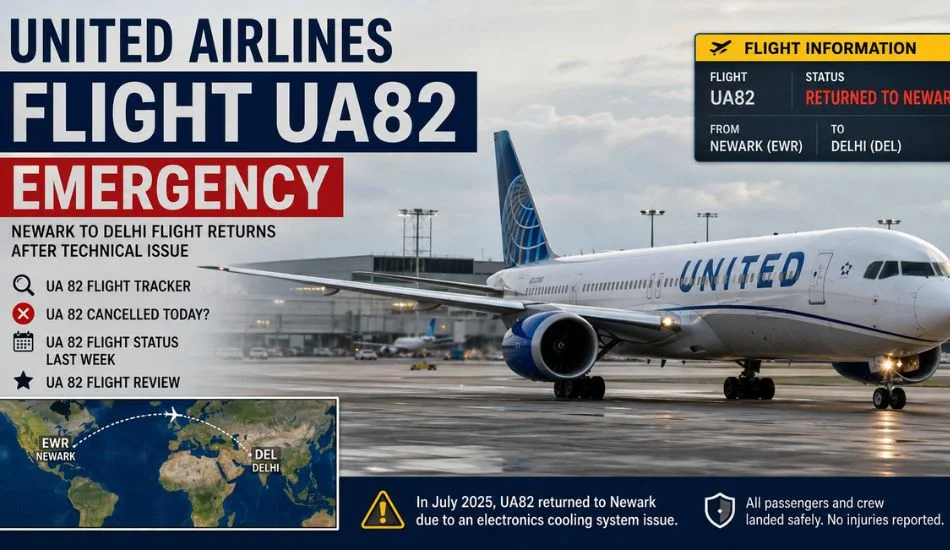
The UA82 event examined in this article occurred in July 2025, when a United Airlines Boeing 787-9 operating from Newark Liberty International Airport to Delhi returned to Newark after the crew reported a technical problem. AIRLIVE reported that the aircraft climbed to approximately 33,000 feet before the crew declared an emergency and turned back toward Newark. The aircraft subsequently landed safely.
In my analysis, the strongest publicly available technical clue is an ACARS message reproduced by Aviation A2Z. That message included the wording “EE COOLING OPS (1),” which points toward an electronics-equipment cooling-related indication. I believe it is important, however, not to turn that indication into a claim about a specific failed component when the public evidence does not establish one.
Another point deserves attention from the beginning. Current flight information should not be confused with the historical emergency. Flight-tracking information available for August 28, 2026 shows UA82 scheduled to operate from Newark to Delhi, meaning a reader searching for “United Airlines Flight UA82 emergency” today may actually be looking for information about the earlier incident rather than a current emergency.
Key Takeaways About the United Airlines Flight UA82 Emergency
I believe the simplest way to understand the incident is to focus on what the available evidence actually supports rather than on the most dramatic interpretations.
- United Airlines Flight UA82 was operating from Newark Liberty International Airport to Delhi.
- The aircraft involved in the July 2025 emergency was a Boeing 787-9 registered as N23983, according to aviation reporting.
- The crew reported a technical issue after departure and declared an emergency.
- Flight tracking reports indicate that the aircraft used transponder code 7700 and returned to Newark.
- The aircraft landed safely at Newark after roughly two hours in the air.
- Public reporting indicated no reported injuries.
- An ACARS message reproduced in aviation reporting contained an electronics-cooling-related indication.
- The public record I reviewed does not establish the exact component that generated the warning.
- The July 2025 event should not automatically be interpreted as evidence that every current UA82 flight is unsafe.
- Current flight status must be checked separately because the historical emergency and present-day operations are different questions. Current tracking data shows UA82 continuing to be scheduled on the Newark–Delhi route.
From my perspective, these points provide a much more useful starting point than simply repeating the word “emergency.” They tell us what happened while also recognizing the limits of what can be established from public information.
What the United Airlines Flight UA82 Emergency Actually Involved
United Airlines Flight UA82 operates between Newark and Delhi, one of the airline’s long-haul international services. Current flight-tracking records identify the route as Newark Liberty International Airport to Indira Gandhi International Airport and list the Boeing 787-9 among the aircraft used for the service.
The July 2025 incident began after UA82 departed Newark. AIRLIVE reported a departure at approximately 21:21 Eastern Daylight Time and stated that the aircraft reached approximately 33,000 feet before the emergency was declared. The report identified the aircraft as Boeing 787-9 registration N23983 and said the aircraft made a U-turn over the Gulf of Maine because of a technical issue.
Aviation A2Z separately reported that UA82 departed Newark at approximately 21:30 local time and returned safely at approximately 23:15. It also identified N23983 as the aircraft involved.
The small difference in reported departure times illustrates why I prefer to avoid presenting one minute as absolutely definitive when sources use different tracking datasets. The broader sequence is consistent: the aircraft departed Newark, climbed normally, encountered a technical concern, declared an emergency, turned around and returned to Newark.
The technical clue becomes more interesting when we examine the ACARS record. Aviation A2Z reproduced a message carrying a July 7, 2025 UTC timestamp and containing the phrase “EE COOLING OPS (1).” The publication interpreted this as an electronics-equipment cooling-related message.
I would describe that as evidence of a cooling-system indication rather than proof of a particular mechanical failure. There is a meaningful difference between those statements. A maintenance message can identify an abnormal system condition without telling an outside observer exactly which component ultimately caused it.
That distinction is especially important because modern aircraft contain numerous interconnected systems, sensors and monitoring functions. A warning can result from a component problem, a sensor indication, an operational condition or another system-level issue. Without a complete maintenance investigation, I would not identify a particular fan, valve, sensor, wiring path or controller as the confirmed cause.
Why the Crew Declared an Emergency and Turned Back
One of the most misunderstood aspects of aviation reporting is the word “emergency.” I often see readers interpret that word as meaning that the aircraft was necessarily minutes from disaster. Aviation procedures are more nuanced.
The Federal Aviation Administration explains that pilots experiencing a distress or urgency condition have procedures for obtaining assistance. The FAA’s guidance specifically addresses the use of transponder code 7700 in emergency situations.
The FAA states:
“Code 7700/Emergency”
Federal Aviation Administration, Aeronautical Information Manual
This short designation matters because it explains why tracking websites can suddenly display 7700 and why air traffic controllers treat the aircraft differently. The code is an alert to ATC that the flight is experiencing an emergency condition.
The FAA also explains:
“Code 7700 when the pilot declares an emergency”
Federal Aviation Administration, Air Traffic Control guidance
I think this is one of the most useful pieces of context for understanding UA82. The emergency squawk should be taken seriously, but it should not automatically be translated into “the aircraft was about to crash.” Instead, it tells us that the crew considered the situation sufficiently important to activate the emergency procedure.
In UA82’s case, returning to Newark also made operational sense. The aircraft had departed from a major international airport capable of handling a Boeing 787. Returning to the departure airport can provide access to maintenance personnel, emergency services, spare aircraft, airport infrastructure and other resources.
A hypothetical example of why turning back can be prudent
Consider a hypothetical long-haul flight from North America to Asia that develops an abnormal indication involving an important aircraft system shortly after departure. The aircraft may technically be capable of continuing, but the crew has to consider what could happen if the problem worsens several hours later over an area with fewer convenient diversion airports.
If the aircraft is still relatively close to its departure airport, returning may provide a larger safety margin. That does not necessarily mean the aircraft is in immediate danger. It can mean that the crew is managing uncertainty conservatively.
From my perspective, that is a better way to interpret the UA82 return. The crew did not need to wait for a system to fail catastrophically before taking action.
Understanding the Electronics Cooling System Issue
The phrase associated with the UA82 incident, “EE COOLING OPS (1),” requires some technical context.
Modern passenger aircraft rely heavily on electronics. Flight management equipment, communication systems, navigation equipment, monitoring systems and other avionics require controlled operating conditions. Cooling systems help manage the heat generated by electronic equipment.
That does not mean that a cooling warning automatically means the aircraft will immediately lose flight controls. Modern transport aircraft are designed with layers of monitoring, redundancy and procedures. Nevertheless, an abnormal indication affecting equipment cooling can be important enough for a crew to reassess whether continuing a long international flight is appropriate.
The available public evidence does not establish exactly what happened inside UA82’s cooling architecture. I therefore think phrases such as “the cooling fan definitely failed” or “the valve definitely broke” go beyond what the accessible evidence proves.
Aviation A2Z reproduced the ACARS message and interpreted the “EE COOLING OPS (1)” reference as an electronics cooling-related alert.
Why cooling matters to aircraft electronics
Electronics generate heat during operation. If temperatures move outside approved ranges, equipment performance can be affected. Aircraft designers therefore use cooling and monitoring systems to keep sensitive equipment within appropriate operating conditions.
We can think about the principle with a simple hypothetical example. Imagine a computer server operating continuously in a data center. If its cooling system reports a fault, the server might continue working for a period of time. But an operator would not necessarily ignore the warning and allow the system to operate indefinitely. The prudent response could be to reduce the risk by switching to backup equipment or investigating the problem.
Aircraft systems are obviously much more sophisticated than ordinary servers, but the basic concept of protecting critical electronics from abnormal thermal conditions is useful for understanding why a cooling indication can deserve attention.
The Timeline of the UA82 Emergency
The available reports provide enough information to construct a broad timeline without pretending that every timestamp is perfectly identical across sources.
| Stage | Approximate timing | What the evidence indicates | Why it matters |
|---|---|---|---|
| Departure | Around 21:21–21:30 EDT | UA82 left Newark for Delhi | The flight began normally |
| Climb | Within the first part of the flight | Aircraft climbed toward approximately 33,000 feet | The aircraft was established on its international route |
| Technical indication | After departure | Crew encountered a technical issue | The flight’s operational plan changed |
| Emergency declaration | During the return sequence | 7700 was reportedly selected | ATC was alerted to the emergency |
| Turnback | During early cruise | Aircraft reversed course toward Newark | Crew chose the departure airport as the return point |
| Landing | Around 23:15 local time | Aircraft landed safely at Newark | The emergency airborne phase ended |
| After landing | Following the return | Aircraft was inspected and passenger arrangements followed | Maintenance and operational recovery began |
AIRLIVE reported that the aircraft touched down on runway 22L almost two hours after takeoff. Aviation A2Z similarly reported a safe return to Newark at about 23:15 local time.
The important takeaway is that the emergency developed relatively early in a flight that would otherwise have lasted many hours. From my view, that timing helps explain why returning to Newark was a reasonable operational decision.
Why the July 6 and July 7 Dates Can Both Appear
I think date confusion is one of the easiest ways to misunderstand the UA82 story.
The flight departed Newark during the evening in local time. Meanwhile, the ACARS message reproduced by Aviation A2Z carries a July 7, 2025 timestamp in UTC.
This is not necessarily evidence of two different incidents.
Newark operates on Eastern Time, while UTC is a separate time standard used extensively in aviation. An event occurring late in the evening in New York or New Jersey can already be dated the following day in UTC.
For a reader, the practical lesson is simple: whenever an aviation incident is reported around midnight, I recommend checking the time zone before assuming that different dates represent separate flights.
This is especially important with UA82 because the historical emergency has been discussed in articles published under different dates. A search engine may also combine the July 2025 emergency with current UA82 flight-status pages.
First Major Comparison: Historical Emergency vs Current Flight Operations
The next comparison is useful because it prevents a historical incident from being mistaken for a present-day safety alert.
| Question | July 2025 UA82 incident | Current 2026 UA82 operation |
| Is this the same event? | Historical emergency | Current scheduled service |
| Route | Newark to Delhi | Newark to Delhi |
| Aircraft | Boeing 787-9 N23983 reported for the incident | Aircraft assignment can change by date |
| Emergency declaration | Yes, according to aviation reporting | A historical declaration does not establish a current emergency |
| Return to Newark | Yes | Must be checked separately for each current flight |
| Current status relevance | Background information | Requires live flight-status sources |
| Main lesson | Crew responded to a technical indication | Travelers need current operational information |
Current tracking information for August 28, 2026 lists UA82 as scheduled from Newark to Delhi, with a planned 21:15 EDT departure and a 21:30 IST arrival the following day.
That current listing is important, but I would not interpret a scheduled status as a guarantee that conditions cannot change. Flight schedules can change because of weather, aircraft availability, maintenance, air traffic restrictions or other operational factors.
What the 7700 Emergency Code Means
The number 7700 often attracts more attention than the underlying problem. I believe understanding it is essential.
The FAA’s emergency procedures explain that pilots may use Code 7700 to alert ground radar facilities when they encounter a distress or urgency condition.
The FAA also notes that radar facilities are equipped so that Code 7700 normally triggers an alarm or special indicator at control positions.
This means that when UA82 reportedly squawked 7700, the code was doing exactly what it was designed to do: communicating the seriousness of the situation to the air traffic system.
A useful distinction is that 7700 does not identify the cause of an emergency. A technical issue, medical emergency or other urgent condition can result in emergency handling.
That is why I would never infer “engine failure” solely from the appearance of 7700 on a flight tracker.
What We Can and Cannot Confirm About the Cause
Based on the evidence I reviewed, I would divide the technical information into three levels.
The first level is well supported: the crew encountered a technical issue and returned to Newark. AIRLIVE and Aviation A2Z both report this sequence.
The second level is also supported by the publicly reproduced maintenance message: the aircraft transmitted a message containing “EE COOLING OPS (1).”
The third level is not established: the exact component that caused the indication. I have not found a sufficiently authoritative public document that identifies a particular fan, sensor, valve, wiring connection or controller as the confirmed root cause of the UA82 event.
That distinction is not merely academic. If I were writing a technical incident report, I would not call an individual component the “cause” without evidence from a maintenance investigation or official report.
Claims I would avoid
I would avoid saying that UA82 suffered an engine failure because the accessible evidence does not establish that.
I would avoid saying that the aircraft experienced a cabin decompression because I found no reliable evidence supporting that description.
The aircraft returned safely, and available reporting indicates no reported injuries.
I would also avoid claiming that the incident proves the Boeing 787 has a fleetwide cooling defect. A single technical event cannot establish that conclusion.
How Emergency Procedures Protect Passengers
Aviation safety depends not only on aircraft design but also on disciplined procedures. When something abnormal happens, pilots have checklists, communication procedures, aircraft systems information and access to air traffic control.
The FAA describes emergency assistance procedures that include communicating the nature of the problem, the aircraft’s position and altitude, fuel information and other relevant details.
The FAA guidance states:
“Nature of distress or urgency.”
Federal Aviation Administration, Distress and Urgency Procedures
For a long-haul aircraft like UA82, the response involves multiple layers. The flight crew assesses the aircraft. Air traffic controllers coordinate the flight’s route and priority. Airport emergency services can prepare for the arrival. Airline ground teams then deal with maintenance and passenger arrangements after landing.
A successful outcome therefore should not be attributed to one action alone. It reflects a system designed to manage abnormal situations.
What Happened to Passengers After the Return?
Aviation A2Z reported that passengers and crew disembarked safely at Terminal C after the aircraft returned to Newark.
Other secondary reports have described rebooking and passenger assistance following the incident, but I would be cautious about repeating precise claims concerning compensation, hotel arrangements or meal benefits unless they are supported by a primary airline statement or applicable passenger-rights documentation.
For passengers, the immediate practical problem after a return is usually that the original aircraft cannot simply continue the journey. Maintenance personnel need to inspect the aircraft, and the airline needs to determine whether it can return to service or whether another aircraft is required.
Hypothetical passenger scenario
Imagine a passenger who planned to arrive in Delhi the next afternoon for a connecting trip. The unexpected return to Newark could affect the entire itinerary, including hotels, onward flights and work commitments.
In that situation, I would separate two questions:
- Was the aircraft emergency handled safely?
- What transportation solution will get the passenger to the final destination?
The first question is about aviation safety. The second is about airline operations and passenger recovery. Confusing the two can make it difficult for travelers to understand what they should actually do next.
Why a Safe Emergency Return Is an Important Outcome
The word “emergency” can make a story sound like a failure, but I think aviation safety should also be judged by how effectively an abnormal situation is managed.
UA82 did not continue toward Delhi after the technical issue was identified. The crew returned to Newark, and the aircraft landed safely.
That does not make the technical problem irrelevant. It means the operational response appears to have contained the situation.
A useful hypothetical comparison is a vehicle that displays a serious warning light shortly after leaving a repair shop. The safest outcome may be to return immediately rather than continue a long journey and hope the warning disappears.
Aircraft operations are much more regulated and technically complex, but the decision-making principle is similar: an abnormal indication can justify a conservative response before the situation becomes worse.
How I Interpret the Safety Significance of the Incident
From my perspective, I would not use the UA82 event alone to make a broad judgment about the safety of United Airlines or the Boeing 787.
Aviation safety should be assessed using much broader evidence, including accident rates, incident trends, regulatory findings, maintenance records, fleet directives, operational procedures and other reliable data.
One emergency return tells us something about one flight on one occasion. It can show how a crew and airline responded to an abnormal condition, but it cannot independently establish a fleetwide trend.
The same caution applies to the cooling system. The available evidence supports saying that a cooling-related indication was associated with the incident. It does not justify claiming that all Boeing 787 aircraft have the same defect.
I believe this is where responsible aviation reporting differs from sensational reporting. The objective should be to explain what happened without minimizing the event or exaggerating what it proves.
What Travelers Should Do If They Are Flying UA82
For a passenger preparing to travel on UA82, I would focus on current operational information rather than relying on articles about the 2025 emergency.
The first step is to check the flight’s current status close to departure. Current tracker information can show scheduled and actual departure details, aircraft information and operational changes. FlightStats currently lists UA82 as a Newark-to-Delhi service and identifies Boeing 787-9 equipment for the route.
The second step is to allow flexibility for a long international journey. If an aircraft develops a technical problem, the airline may delay departure, substitute another aircraft, return to the gate or change the itinerary.
The third step is to keep important travel documents and essential items accessible rather than placing everything in checked baggage.
The fourth step is to pay attention to the crew’s instructions. If an abnormal situation occurs, passengers should follow the directions provided by trained cabin and flight crews rather than relying on social media speculation.
Finally, I would not cancel a trip solely because I encountered a historical article about the UA82 emergency. A past technical event is not automatically evidence of a present emergency.
Common Misconceptions About the UA82 Emergency
Misconception 1: 7700 means the aircraft was about to crash
This is not a safe conclusion. Code 7700 indicates an emergency condition requiring attention, but it does not specify the cause or predict the outcome. FAA procedures explicitly associate 7700 with emergency aircraft.
UA82 ultimately returned to Newark and landed safely.
Misconception 2: The emergency proves an engine failed
I found no reliable evidence that an engine failure caused the July 2025 UA82 event. The publicly reproduced ACARS message instead contains a cooling-related indication.
Misconception 3: The exact failed part is known
The public evidence does not establish that. It identifies a cooling-related message, but an ACARS indication is not the same thing as a complete engineering investigation.
Misconception 4: The flight is currently in an emergency
Current flight information is a separate matter. As of August 28, 2026, available flight-status information showed UA82 scheduled for Newark-to-Delhi service rather than documenting the 2025 emergency as a current event.
Misconception 5: Every UA82 incident has the same cause
The flight number has appeared in different historical operational situations. A weather diversion in 2016, for example, is not evidence of the 2025 cooling-related event. The aircraft type and circumstances also differed. Treating every event under the same flight number as one continuous problem would be misleading.
A Practical Evidence-Based Way to Read Aviation Emergency Reports
I have found that the best way to evaluate an aviation incident is to separate direct evidence from interpretation.
Direct evidence includes flight-tracking records, official regulatory documents, airline statements, aircraft registration information and authenticated maintenance records.
Secondary reporting can help reconstruct a timeline, but it may contain errors or assumptions.
Social media can provide useful observations, especially from passengers, but individual accounts should not automatically be treated as authoritative technical evidence.
Search-engine snippets are even more limited. A snippet can repeat a claim without showing its original context, and multiple websites can copy the same inaccurate statement.
For UA82, this method leads to a relatively stable conclusion: a Boeing 787-9 operating from Newark to Delhi encountered a technical issue, the crew declared an emergency and returned to Newark, and the aircraft landed safely. Public reporting connects the incident with an electronics-cooling indication, but the precise component-level root cause is not established by the evidence I reviewed.
Second Comparison: Evidence Strength for Major UA82 Claims
The following table shows how I would classify the main claims associated with the incident.
| Claim | Evidence level | My assessment |
| UA82 operated Newark to Delhi | Strong | Confirmed by flight-status and tracking records |
| Aircraft was a Boeing 787-9 | Strong | Supported by aviation and tracking records |
| Aircraft registration was N23983 | Strong for the 2025 event | Reported by aviation sources |
| Crew declared an emergency | Strong | Reported by multiple aviation sources |
| 7700 was used | Strong | Reported in incident coverage and consistent with emergency procedures |
| Aircraft returned to Newark | Strong | Supported by flight-tracking reports |
| Aircraft landed safely | Strong | Reported by multiple sources |
| No reported injuries | Supported | Reported in incident coverage |
| Electronics cooling indication occurred | Moderate to strong | Supported by reproduced ACARS message |
| Specific fan caused the incident | Weak/unconfirmed | Not established in reviewed evidence |
| Specific valve caused the incident | Weak/unconfirmed | Not established in reviewed evidence |
| Engine failure caused the incident | Unsupported | No reliable evidence reviewed establishes this |
| Fleetwide Boeing 787 cooling defect | Unsupported | One incident cannot establish a fleetwide defect |
| Current UA82 flight is in emergency | False based on current status reviewed | Current data showed scheduled service on August 28, 2026 |
The key takeaway from this table is that the broad sequence is much more certain than the detailed mechanical explanation.
What I Think the UA82 Incident Teaches Us
In my view, the most useful lesson is not simply that a technical issue occurred. The larger lesson is how important it is to distinguish detection, decision-making and outcome.
The detection stage involved identifying an abnormal technical condition.
The decision stage involved the crew determining that returning to Newark was the appropriate response.
The communication stage involved emergency procedures and ATC coordination.
The outcome stage involved the aircraft returning safely and the passengers and crew disembarking.
When I look at the incident this way, the emergency becomes easier to understand. It was not merely a dramatic moment captured by a flight tracker. It was an example of an abnormal aircraft condition being managed through aviation procedures.
The incident also demonstrates why redundancy and precaution matter. A system does not necessarily have to fail completely before pilots decide that continuing a long international flight is not the best option.
What We Should Watch for in Future Reporting
If additional official documentation becomes available, I would pay particular attention to whether it identifies the exact component responsible for the cooling indication.
I would also look for information about whether the problem was isolated to the aircraft involved or connected to a broader maintenance issue.
Another useful question would be whether any regulatory action followed specifically because of the incident. An airworthiness directive, service bulletin or official safety notice would provide much stronger evidence of a broader technical concern than repeated media stories.
Until such documentation is available, I believe the responsible position is to avoid overclaiming.
We can reasonably conclude that the crew treated the technical indication seriously. We can also conclude that returning to Newark produced a safe landing. What we cannot reasonably conclude is that the incident proves a generalized design flaw or that a specific component definitely failed.
Expert-Style Recommendations for Readers
Although I am not presenting myself as an aircraft engineer or investigator, I can offer a practical evidence-based reading framework.
First, check the date. Aviation incidents are often reposted months or years later.
Second, check the route. UA82 has a recognizable Newark-to-Delhi identity, but the same flight number can appear in historical records involving different aircraft and circumstances.
Third, check the aircraft registration when available. The registration helps distinguish one aircraft event from another.
Fourth, distinguish a technical indication from a confirmed failure.
Fifth, treat 7700 as an emergency signal rather than a diagnosis.
Sixth, look for the actual outcome. An aircraft returning safely is materially different from an aircraft suffering an accident.
Seventh, check current flight-status information separately from historical news.
These steps can prevent a reader from reaching conclusions that the available evidence does not support.
Why Current UA82 Status Matters More to Travelers Than the Historical Incident
Someone searching for “United Airlines Flight UA82 Emergency” may have a very practical question: “Is my flight safe today?”
That question cannot be answered by describing what happened in 2025.
Current flight data available on August 28, 2026 showed UA82 scheduled to depart Newark at 21:15 EDT and arrive in Delhi at 21:30 IST the following day.
Flight history also shows UA82 continuing to operate on the Newark–Delhi route in August 2026, with several recent flights completing the journey.
I consider this distinction essential. Historical incident reporting provides context, while live flight-status information provides the information a traveler needs for a particular departure.
If someone is booked on UA82 today, I would therefore recommend checking the latest airline and airport information immediately before traveling rather than assuming that the 2025 emergency remains an active condition.
Conclusion
In my view, the United Airlines Flight UA82 emergency is best understood as a serious but successfully managed technical event rather than as evidence of an unexplained aviation catastrophe. The July 2025 flight from Newark to Delhi, operated by a Boeing 787-9, encountered a technical problem after departure, declared an emergency and returned safely to Newark. Aviation reporting and a reproduced ACARS message connect the event with an electronics-cooling indication.
The most important limitation is that the public evidence does not establish the exact component responsible for the warning. I therefore would not describe a specific fan, valve, sensor or engine as the confirmed cause without stronger documentation.
The practical lesson I take from the United Airlines Flight UA82 emergency is that travelers should separate historical incident reports from current flight information. Current UA82 operations in August 2026 should be evaluated using current flight-status information, not a year-old emergency report.
My recommendation is straightforward: if you are researching the incident, focus on verified timelines and technical evidence; if you are traveling on UA82, check the current flight status before leaving for the airport.
Frequently Asked Questions
What happened during the United Airlines Flight UA82 emergency?
United Airlines Flight UA82 was flying from Newark to Delhi in July 2025 when the crew encountered a technical problem after departure. Aviation reporting states that the Boeing 787-9 climbed to approximately 33,000 feet before the crew declared an emergency and turned back toward Newark. The aircraft landed safely after roughly two hours. A reproduced ACARS message contained an electronics-cooling-related indication, although the exact failed component was not established in the public evidence reviewed.
Did United Airlines Flight UA82 land safely?
Yes. The aircraft returned to Newark Liberty International Airport and landed safely. AIRLIVE reported that the aircraft touched down on runway 22L after nearly two hours, while Aviation A2Z also reported a safe landing and safe disembarkation of passengers and crew. Available reporting indicated no injuries associated with the incident.
What caused the United Airlines Flight UA82 emergency?
The strongest public technical clue is an ACARS message containing the wording “EE COOLING OPS (1),” which indicates a cooling-related operational message involving aircraft electronics. However, I would not claim that a particular fan, valve, sensor or other component was definitely responsible because the accessible evidence does not establish the final component-level root cause.
What does squawk 7700 mean on UA82?
Squawk 7700 is the standard emergency transponder code used to alert air traffic control that an aircraft is experiencing an emergency condition. The FAA explains that Code 7700 is associated with emergency aircraft and that pilots can use the code to alert ground facilities. It does not identify the exact cause of the emergency.
Was UA82 experiencing an emergency on August 28, 2026?
The historical emergency discussed in this article occurred in July 2025. Current flight-status information available for August 28, 2026 listed UA82 as scheduled for the Newark-to-Delhi route, rather than documenting the 2025 emergency as a current event. Because flight status can change, travelers should always verify their individual flight shortly before departure.
Is the Boeing 787-9 unsafe because of the UA82 incident?
I would not draw that conclusion from one incident. The UA82 event demonstrates that a technical issue occurred and that the crew responded by returning to Newark, but it does not by itself establish a fleetwide safety defect. A broader safety assessment would require regulatory records, fleet-level maintenance data, incident trends and other evidence.
Why did UA82 return to Newark instead of continuing to Delhi?
Returning to Newark gave the crew access to the airport from which the flight had departed and allowed the aircraft to be inspected after the technical issue. In a hypothetical long-haul situation, returning relatively early can be a prudent risk-management decision because it avoids continuing thousands of miles with an unresolved technical indication. The actual crew’s decision should be understood within the aircraft’s procedures and operational circumstances.
Does the UA82 emergency mean passengers were in immediate danger?
An emergency declaration indicates that the crew considered the situation sufficiently important to require emergency handling, but it does not automatically mean that the aircraft was on the verge of an accident. UA82 returned to Newark and landed safely. I believe the safe outcome and the crew’s decision to turn back are important parts of the incident’s interpretation.
How should I check United Airlines Flight UA82 before traveling?
I recommend checking the current flight status close to departure and confirming the departure airport, terminal, timing and any operational updates. Historical articles can explain what happened in 2025, but they cannot tell a passenger whether a particular UA82 flight will depart on time or operate with a particular aircraft in 2026.
Sources and References
Federal Aviation Administration, Aeronautical Information Manual, Emergency Procedures and transponder emergency operation.
Federal Aviation Administration, Air Traffic Control guidance concerning emergency Code 7700.
AIRLIVE, “United flight UA82 is declaring an emergency after departure from New York,” July 7, 2025.
Aviation A2Z, “United Newark to Delhi Flight with 787 Makes Emergency Landing,” July 7, 2025.
FlightStats, United Airlines UA82 Newark–Delhi flight-status information.
Flightradar24, United Airlines UA82 flight-history information.
Disclaimer
This article is intended for general informational and educational purposes. I have based the discussion on publicly available aviation reporting, flight-status information and Federal Aviation Administration guidance available during the research process. Aviation incidents can be updated as additional information becomes available, and secondary reports may contain conflicting details. The technical discussion should not be treated as an official accident investigation, maintenance diagnosis, regulatory determination or professional aviation advice. Travelers should rely on current information from the airline, airport and relevant aviation authorities when making decisions about a specific flight.