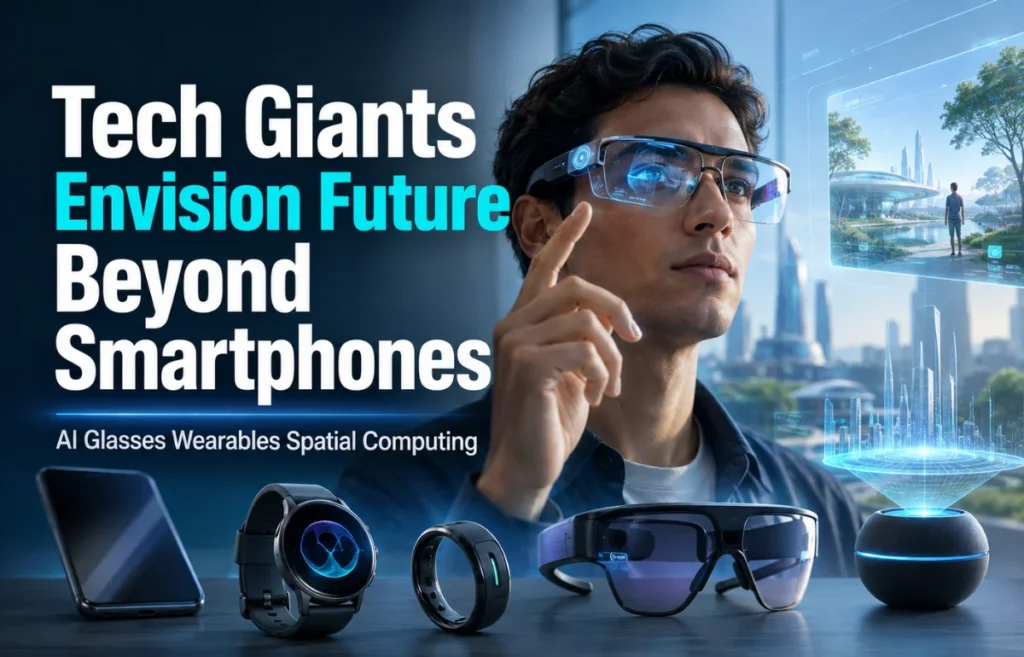
I believe the smartphone remains one of the most influential consumer technologies ever created, but I also think its position at the center of digital life is beginning to face a serious challenge. For more than a decade, we have used smartphones to communicate, navigate, work, shop, photograph, entertain ourselves, manage finances, and interact with artificial intelligence. The device has become so deeply integrated into everyday life that imagining computing without it can feel almost impossible.
Yet the technology industry rarely remains satisfied with a successful platform. The largest technology companies are now investing heavily in devices that could move computing away from the traditional rectangular screen we carry in our pockets. Artificial intelligence is making that transition more practical because AI can interpret speech, images, surroundings, and context rather than requiring users to interact with every function through menus and touchscreens.
In my analysis, this is the most important change taking place. The discussion is no longer simply about creating a smaller smartphone or a more powerful smartwatch. Companies are exploring a different relationship between humans and computers—one in which technology can accompany us, understand our surroundings, respond conversationally, and sometimes operate without requiring us to stare at a screen.
Smart glasses are particularly important in this shift. Meta has expanded its AI-glasses portfolio, while Google is developing Android XR experiences for intelligent eyewear. Google says its future glasses will include both audio-only and display-equipped designs, with Gemini providing hands-free assistance.
I do not think this means smartphones will suddenly disappear. A more realistic possibility is that smartphones gradually become less central. Just as desktop computers remained important after smartphones became dominant, phones could eventually become powerful supporting devices while other interfaces handle more everyday interactions.
The central question, therefore, is not whether smartphones will vanish overnight. The more interesting question is what technology companies are building to reduce our dependence on them—and whether consumers will actually want those alternatives.
Key Takeaways About the Post-Smartphone Future
I see several important trends emerging from the current technology race.
First, AI is becoming the bridge between people and hardware. Instead of forcing users to understand complicated menus and applications, companies increasingly want computers to understand natural language and context.
Second, smart glasses are emerging as one of the strongest candidates for the next personal-computing interface. Meta is explicitly positioning glasses as a major hardware category for the AI era, while Google is building Android XR around glasses and headsets.
Third, spatial computing remains important even though bulky headsets are unlikely to replace smartphones for ordinary daily tasks. Headsets can provide enormous virtual workspaces, immersive entertainment, training environments, and specialized professional applications.
Fourth, screen-free and low-interaction wearables may become more important. Recent wearable trends show growing interest in devices that quietly collect information and provide assistance without demanding constant attention.
Finally, privacy may determine whether these technologies succeed. A smartphone is usually pointed toward the person holding it. A camera embedded in glasses can observe the surrounding environment continuously, creating a very different social and ethical problem.
From my perspective, the companies that solve the usability and privacy problems—not merely the companies that build the most technically impressive hardware—will have the strongest opportunity to shape the next era of computing.
What “Beyond Smartphones” Actually Means
When I use the phrase “beyond smartphones,” I do not mean that smartphones are about to become obsolete products. Instead, I am describing a shift in where computing happens and how people interact with it.
The smartphone concentrates computing into a single physical object. We pick it up, unlock it, look at its display, open an application, perform an action, and put it away. This model is remarkably efficient, but it also requires deliberate attention.
The emerging model is more distributed. Computing can happen through glasses, watches, earbuds, vehicles, home devices, headsets, and AI assistants. The smartphone may remain the central processor, connection point, or personal data hub, while other devices become the interfaces we use most frequently.
This distinction matters because a post-smartphone world does not necessarily mean a phone-free world.
A person could wear AI glasses that connect to a smartphone in their pocket. The glasses might provide directions through audio, recognize an object, translate a conversation, capture a photograph, or summarize information. The phone could quietly handle networking, storage, authentication, and heavier computing in the background.
Google’s Android XR strategy illustrates this approach. The company has described glasses that work alongside phones and provide access to applications while keeping users’ hands free. Its prototypes combine cameras, microphones, speakers, and optional displays with Gemini.
In my view, this is more plausible than the idea that one magical device will replace everything.
Why Artificial Intelligence Changes the Hardware Equation
I believe AI is the key reason the post-smartphone discussion is becoming more serious now rather than ten years ago.
Earlier generations of smart glasses faced a fundamental problem: what exactly should users do with them? Adding a camera, speaker, or small display did not automatically create a compelling computing platform.
Generative AI changes the equation because it creates a more flexible interface.
Google has demonstrated this concept with Android XR glasses that combine cameras, microphones, speakers, and Gemini. Its demonstrations have included messaging, directions, photography, appointments, and live translation.
The important development here is multimodality. AI can increasingly work with multiple forms of information at once: text, voice, images, video, location, and conversational context.
That makes wearable devices much more useful.
Consider a hypothetical scenario. I am walking through an unfamiliar city and see a historic building. With a traditional smartphone, I might photograph the building, open a search application, upload the photograph, read the results, and then look back at the building. With an AI-enabled wearable, I could potentially ask what I am seeing and receive an answer while continuing to look at the environment.
That difference may sound small, but repeated thousands of times, it could fundamentally change how we interact with computers.
Why Smart Glasses Have Become the Leading Post-Smartphone Candidate
Among the emerging categories, smart glasses have a particularly strong advantage: they are positioned in front of the user’s eyes and ears without requiring the user to hold anything.
That creates three opportunities.
The first is hands-free interaction. People can cook, walk, repair equipment, exercise, or work while accessing information.
The second is contextual awareness. Cameras and microphones can give an AI system information about what the user is seeing and hearing.
The third is reduced interruption. Instead of looking down at a phone, the user can potentially receive short pieces of information while remaining engaged with the physical world.
Meta has made this argument particularly strongly. When introducing its 2026 Meta Glasses, the company described glasses as an important hardware category for AI because they can provide an assistant that understands the world from the user’s perspective.
The statement is significant because it reveals the strategic logic behind the hardware race. The goal is not simply to make another wearable. The goal is to put AI into a position where it can observe context and assist at the moment assistance is needed.
A useful example is accessibility. Meta says its AI wearables are being used in initiatives supporting people with disabilities, including applications for people who are blind or have low vision and people with mobility disabilities.
I believe this is one of the strongest arguments for wearable AI. Technology becomes more valuable when it reduces a barrier rather than simply adding another entertainment feature.
The Major Technologies Competing Beyond Smartphones
We can understand the emerging landscape more clearly by separating the major categories rather than treating every new device as the same thing.
AI Glasses
AI glasses are currently among the most practical candidates because they can preserve ordinary eyewear while adding computing functions.
Meta has continued expanding its glasses strategy, including Ray-Ban Meta and Oakley Meta products, while its newer Meta-branded glasses integrate Meta AI. The company announced a new line in 2026 starting at $299 in the United States.
Google is pursuing a somewhat different ecosystem strategy through Android XR. Its 2026 plans distinguish between audio glasses and display glasses. Audio glasses can provide spoken assistance, while display glasses can place information within the user’s visual field.
Spatial Computing Headsets
Headsets offer something glasses currently cannot provide as easily: large, immersive virtual environments.
They can create multiple virtual displays, immersive games, training simulations, design environments, and virtual collaboration spaces. Google has continued developing Android XR for headsets, including features that allow users to pin applications into physical spaces and interact with immersive content.
I see headsets as complementary rather than direct smartphone replacements.
A headset might replace a laptop monitor for certain tasks, while glasses might handle short interactions throughout the day.
Smartwatches and Health Wearables
Smartwatches are another part of the transition because they already move certain functions away from the phone.
A watch can provide notifications, navigation cues, payments, fitness information, calls, and other short interactions without requiring the user to take out a phone.
The next stage could involve more AI-based interpretation. Rather than simply displaying data, a wearable might explain patterns, summarize information, or provide recommendations.
However, battery life, sensor accuracy, comfort, and privacy remain important limitations.
Earbuds and Ambient Audio
I believe earbuds are an underappreciated part of the post-smartphone ecosystem.
They already sit close to our ears, making them naturally suited to voice assistants, translation, navigation, calls, and personalized audio.
If glasses provide visual context and earbuds provide private audio, the combination could become more powerful than either device alone.
Cars as Computing Platforms
Vehicles are also becoming increasingly digital.
Modern cars already integrate navigation, entertainment, voice assistants, driver information, cameras, sensors, and connectivity. In the future, AI could make the car a more conversational computing environment.
A person might move seamlessly from home to car to workplace while their AI assistant maintains context across different devices.
This is another reason I do not expect one physical device to replace the smartphone. The future may instead consist of an interconnected personal-computing environment.
How Different Devices Could Divide the Work
The following comparison helps explain why several device categories can coexist instead of competing in a simple winner-takes-all market.
| Technology | Primary Strength | Likely Everyday Role | Main Limitation |
|---|---|---|---|
| Smartphone | Powerful general computing | Complex tasks, apps, authentication, creation | Requires attention and handheld interaction |
| AI glasses | Contextual, hands-free assistance | Directions, translation, quick questions, capture | Battery, privacy, social acceptance |
| Display glasses | Information in the user’s field of view | Navigation, prompts, contextual information | Display size, power consumption |
| Smartwatch | Fast glanceable interaction | Health, notifications, payments, short actions | Small display and limited input |
| Earbuds | Private audio interaction | Calls, AI responses, translation, media | Limited visual feedback |
| XR headset | Immersive computing | Workspaces, entertainment, training | Size, comfort, social isolation |
| AI-enabled vehicle | Mobility-centered computing | Navigation, communication, assistance | Restricted to vehicle environment |
The key takeaway is that no single category currently matches the smartphone’s combination of versatility, portability, battery life, mature software, and familiarity.
That is why I believe the transition will be gradual.
What Users Could Actually Do With Post-Smartphone Technology
Technology becomes meaningful when we move beyond specifications and ask what people can actually accomplish.
Navigation Without Constantly Looking at a Screen
Navigation is one of the clearest examples.
Today, many people repeatedly look down at their phones while walking. Audio glasses could instead provide spoken directions while keeping the user visually engaged with the street.
Display glasses could go further by showing directional information directly within the field of view.
Google has specifically highlighted directions as one of the capabilities being developed for intelligent eyewear.
In my view, navigation is likely to be one of the earliest everyday applications because the benefit is immediately understandable.
Real-Time Translation
Language translation may become another major application.
Imagine a traveler speaking with someone who uses another language. Instead of passing a phone back and forth, an AI wearable could listen, translate, and deliver the response through audio or a display.
Google has demonstrated live translation concepts through Android XR, while its 2026 announcements indicate expanded language support for its intelligent-eyewear strategy.
This could be especially valuable in travel, education, international business, and customer service.
Hands-Free Learning
AI glasses could also change how we learn.
A student looking at a mechanical component could ask what it does. A trainee could receive step-by-step instructions while keeping both hands available. A visitor could ask about an object in a museum.
The important difference is that information becomes contextual rather than simply searchable.
Workplace Assistance
Workplace applications may ultimately be more important than consumer entertainment.
A technician could receive repair instructions while working. A warehouse employee could receive location information without carrying a device. A field worker could document an issue through voice commands.
Meta has highlighted applications involving workforce safety, construction trades, roadside mechanics, agriculture, and other areas through its AI Glasses Impact Grants.
These examples demonstrate why I think the post-smartphone transition should not be judged only by social-media or entertainment features.
A Practical Scenario: From Phone-Centered to Ambient Computing
Let us consider a hypothetical example.
Imagine a person named Sara beginning a normal working day.
Under a smartphone-centered model, Sara checks her phone for weather, messages, calendar appointments, navigation, and reminders. She repeatedly unlocks the device and moves between applications.
Under an ambient-computing model, some of those interactions could happen through multiple devices.
Her glasses could provide a short weather update through audio. Her earbuds could announce an urgent message.
The important point is that Sara has not stopped using computing.
Computing has simply moved around her.
I believe this is the most realistic interpretation of the phrase “future beyond smartphones.”
The Business Race Behind the Hardware
The post-smartphone competition is also a battle over ecosystems.
A successful computing platform is rarely just a device. It includes an operating system, developers, applications, cloud infrastructure, artificial intelligence, payments, advertising, identity, content, and services.
This explains why companies such as Meta and Google are investing in both hardware and software.
Google is building Android XR as a platform that can support headsets and glasses while connecting to the broader Android ecosystem.
Meta, meanwhile, is integrating AI across its applications and wearable products. Its Muse Spark model is being rolled into Meta AI experiences and AI glasses, demonstrating the company’s attempt to make its AI system available across multiple interfaces.
The strategic objective is clear: whoever controls the next interface may gain influence over the next generation of digital services.
What Makes the Smartphone Difficult to Replace
Despite all the excitement surrounding glasses and AI, I think it is important to avoid declaring the smartphone obsolete too early.
The smartphone has several enormous advantages.
It has a relatively large screen.
It supports sophisticated applications.
Most importantly, people already know how to use it.
Smart glasses have to overcome physical limitations that smartphones do not face.
A pair of glasses must remain lightweight. It must look acceptable. It must have enough battery capacity. Cameras must fit into a small frame. Speakers must work without disturbing the wearer. Displays must be bright enough but not distracting. Heat must be controlled.
These are difficult engineering problems.
I therefore believe the smartphone will remain essential for many demanding tasks even if glasses become the preferred interface for simpler interactions.
Privacy Could Determine the Success of AI Glasses
The biggest obstacle may not be hardware.
It may be trust.
AI glasses can potentially see and hear the environment around the wearer. That creates an unusual privacy problem because other people may be recorded without consciously interacting with the device.
A smartphone camera is visible when someone holds the phone up. Glasses can be much less obvious.
This raises questions about consent, recording indicators, data storage, facial recognition, workplace policies, schools, restaurants, hospitals, and public spaces.
Google has said privacy is an important consideration in its Android XR development and has described gathering feedback from trusted testers while developing prototypes.
Meta has also faced broader public debate around AI glasses and privacy. Recent reporting has highlighted concerns about covert recording and potential surveillance.
From my perspective, companies should treat privacy as a core product feature rather than an optional policy document.
A successful wearable should make recording obvious, give surrounding people reasonable expectations, minimize unnecessary data collection, and provide meaningful controls over what AI can access.
The Social Question: Will People Actually Want Computers on Their Faces?
Technical feasibility does not guarantee adoption.
Google Glass demonstrated this lesson years ago. A device can be technically interesting while remaining socially uncomfortable.
People have different expectations about glasses. They are fashion objects, medical devices, protective equipment, and personal accessories. Turning them into computers changes the social meaning of the object.
I think design will therefore matter as much as specifications.
Meta’s partnership with established eyewear companies demonstrates this logic. Its 2026 Meta Glasses launch was built around multiple styles and prescription compatibility, while Google has partnered with eyewear brands including Gentle Monster and Warby Parker for Android XR glasses.
The message is straightforward: people will not wear advanced technology all day simply because engineers want them to.
The product has to look and feel like something people already want to wear.
What the Major Technology Companies Are Signaling
The industry’s own language provides useful evidence about where executives think computing is heading.
Meta’s current strategy is especially direct. The company has described glasses as a major AI-era hardware category and is expanding from camera-and-audio glasses toward more advanced display-equipped devices.
Google is building Android XR around a broader ecosystem of headsets and glasses and is preparing intelligent eyewear that can provide both audio and visual assistance.
These strategies do not prove that smartphones will be replaced.
They do prove that the largest companies are treating alternative interfaces as strategically important.
That distinction is important. I would not describe the post-smartphone future as inevitable. I would describe it as a major technological bet.
A Verified View From Meta
Meta’s own description captures why glasses are attractive as an AI interface. I find the statement useful because it explains the company’s strategy in its own words.
“Glasses are the most exciting hardware category of the AI era — the ideal device to experience an all-day AI assistant that understands the world from your perspective.”
Meta, 2026.
I interpret this statement as more than a marketing slogan. The phrase “understands the world from your perspective” points toward contextual AI. The company is imagining a system that can potentially understand what the wearer is seeing and hearing rather than waiting for the user to type a detailed prompt.
That is a fundamentally different interface philosophy.
Google’s Vision for Intelligent Eyewear
Google uses similarly direct language when describing its Android XR plans.
“Glasses that deliver help in the moment without taking you out of it.”
Google, Android XR, 2026.
I believe this short description captures one of the strongest arguments for wearable computing.
The smartphone often requires us to leave the physical activity we are performing. We stop walking, pull out the phone, look at the screen, interact with it, and then return to the environment.
Glasses attempt to reverse that relationship.
The technology becomes secondary to the activity rather than the activity becoming secondary to the screen.
Mark Zuckerberg’s Argument for a New Computing Platform
Mark Zuckerberg has repeatedly described glasses as a candidate for the next major computing platform. In a 2025 discussion of Meta’s vision, he emphasized that glasses could change how users interact with computers by replacing traditional input methods with new forms of interaction.
One particularly useful explanation from Zuckerberg focuses on presence and contextual AI:
“Glasses are the ideal form factor for AI.”
Mark Zuckerberg, discussing Meta’s glasses strategy.
The broader argument is that glasses can remain with the user while allowing AI to access the user’s perspective.
In my view, the strength of this argument depends entirely on whether privacy and reliability can keep pace with capability. An AI assistant that understands context could be extremely useful. An AI assistant that misunderstands context or records too much could become extremely intrusive.
Comparing the Main Post-Smartphone Strategies
The next table summarizes the strategic differences between the major approaches. I find this comparison useful because it shows that “the future beyond smartphones” is not a single technology.
| Strategy | What It Tries to Achieve | Strongest Advantage | Biggest Challenge | My Assessment |
|---|---|---|---|---|
| AI audio glasses | Hands-free assistance | Natural voice interaction | Limited visual feedback | Strong near-term potential |
| AI display glasses | Contextual information in view | Immediate visual guidance | Battery and display constraints | High long-term potential |
| XR headsets | Immersive computing | Large virtual workspace | Weight and social acceptance | Strong for specialized uses |
| AI watches | Quick personal assistance | Already familiar | Small interface | Likely to remain complementary |
| AI earbuds | Private conversational computing | Excellent audio access | Lack of visual context | Useful companion technology |
| AI cars | Computing during travel | Large sensors and displays | Limited to vehicle use | Important ecosystem component |
| Smartphones | General-purpose computing | Mature, flexible platform | Requires attention | Likely to remain important |
The most important conclusion from this comparison is that I do not see a single replacement device emerging immediately.
Instead, I see computing becoming more distributed.
How Consumers Should Evaluate the New Technology
If readers are considering AI glasses or another emerging device, I recommend looking beyond promotional demonstrations.
The first question should be whether the device solves a genuine problem.
If a wearable only duplicates notifications that already exist on a phone, I would question its long-term value.
The second question is battery life.
A device that is theoretically useful but needs frequent charging may not become part of everyday routines.
The third question is privacy.
Users should understand what sensors are active, what information is processed, what is stored, and how recordings are indicated.
The fourth question is ecosystem compatibility.
A great device can become frustrating if it works poorly with the services a person already uses.
The fifth question is durability and comfort.
Anything intended for all-day use must work physically as well as digitally.
Step-by-Step: How the Transition Could Happen
I see the transition from smartphone-centered computing to ambient computing developing in several stages.
Step 1: Companion Devices Become More Useful
The first stage is already underway. Watches, earbuds, and smart glasses handle small tasks while smartphones remain central.
Users learn that not every interaction requires a phone.
Step 2: AI Takes Over More Short Tasks
The next stage involves conversational AI.
Instead of opening applications, users increasingly ask an assistant to perform actions or retrieve information.
Step 3: Context Becomes More Important
AI systems begin using information from cameras, microphones, location, calendars, and other sensors to understand what the user is doing.
This makes wearables more valuable because they are physically close to the user.
Step 4: Displays Become More Capable
Display glasses can eventually provide directions, translations, notifications, and contextual information without requiring a phone screen.
Step 5: Smartphones Become Background Infrastructure
At this stage, the phone may still exist but become less visible in daily interactions.
It could serve as a secure computing hub, storage device, connectivity system, and backup interface.
Step 6: Multiple Devices Work as One Personal System
The long-term vision is not necessarily “no phone.”
It is “less phone.”
The user moves through different environments while devices cooperate around them.
Common Misconceptions About the Post-Smartphone Future
Misconception: Smartphones Will Disappear Suddenly
I do not believe that is realistic.
Technology transitions rarely happen overnight. Older computing platforms often remain useful for many years after newer platforms become dominant.
The desktop computer did not vanish when smartphones became popular. Similarly, smartphones may remain important even if glasses become the primary interface for some activities.
Misconception: AI Glasses Are Just Phones on Your Face
They are not.
A smartphone is designed around a display and touchscreen. Glasses are better suited to contextual, visual, audio, and hands-free interaction.
That makes their purpose fundamentally different.
Misconception: More AI Automatically Means Better Technology
It does not.
An AI assistant can become annoying if it interrupts too frequently, gives inaccurate answers, consumes too much battery, or creates privacy concerns.
I believe usefulness must remain the primary measurement.
Misconception: Augmented Reality and AI Glasses Are the Same Thing
They overlap, but they are not identical.
AI glasses can operate primarily through cameras, microphones, speakers, and cloud or on-device intelligence without placing graphics over the user’s vision.
Augmented-reality glasses generally emphasize visual digital information integrated with the physical environment.
Some future products will combine both approaches.
What I Believe Will Matter Most
After examining the current direction of the industry, I believe five factors will determine whether the post-smartphone vision becomes mainstream.
Reliability
AI assistance must work consistently.
People will not trust an important wearable if it frequently misunderstands speech or visual context.
Comfort
A device intended to stay on someone’s face all day cannot behave like a heavy computer.
Weight, balance, heat, battery size, prescription compatibility, and appearance all matter.
Privacy
Users and bystanders need confidence that the technology is not silently collecting excessive information.
Social Acceptance
People have to feel comfortable wearing the device in public.
The more ordinary the hardware looks, the easier widespread adoption may become.
Real Utility
Finally, the device must solve problems better than existing alternatives.
This is the hardest requirement.
Technology enthusiasts may tolerate novelty for a while, but mainstream consumers usually demand practical value.
Why Accessibility May Accelerate Adoption
One area where I see especially strong potential is accessibility.
Wearable AI can provide information in ways that do not require conventional screen interaction.
For someone with limited mobility, hands-free control can reduce physical effort. For someone with low vision, AI-powered descriptions can provide additional contextual information.
Meta has reported initiatives involving AI glasses and accessibility, including support for people who are blind or have low vision and people with mobility disabilities.
I believe these applications deserve serious attention because they illustrate a broader principle: the best emerging technology may not be the technology that looks most futuristic, but the one that removes the most meaningful obstacles.
The Role of Developers in the Post-Smartphone Era
Hardware alone will not create a new computing platform.
Developers need tools for building applications that understand the strengths of each interface.
A smartphone application cannot simply be copied onto glasses.
A wearable application should be concise, contextual, voice-friendly, and respectful of attention.
Imagine a navigation application redesigned for glasses. Instead of presenting a large map, it could provide a short directional cue only when needed.
A productivity application could summarize an incoming message rather than displaying a long conversation.
A translation application could operate conversationally.
The interface becomes smaller because the intelligence behind it becomes larger.
Google’s Android XR strategy emphasizes a platform approach that allows developers and device makers to build experiences across different XR hardware.
I think this ecosystem approach will be crucial.
The Economic Stakes for Technology Giants
The companies pursuing post-smartphone computing are not simply chasing futuristic gadgets.
There is enormous economic value in controlling a major computing platform.
The smartphone era created powerful ecosystems around operating systems, app stores, advertising, cloud services, payments, hardware, subscriptions, and accessories.
If glasses or another wearable becomes the next major interface, the company controlling that platform could influence how people access information and services for another generation.
That explains why technology companies are investing before the market is fully mature.
They are competing not only for current sales but for strategic positioning.
In my view, this is why the competition between technology giants should be watched carefully. The winner may not be determined by who sells the most glasses in the first few years. It may be determined by who builds the most useful ecosystem around them.
The Biggest Risks Beyond Smartphones
The future also carries genuine risks.
One is surveillance.
If cameras become normal on people’s faces, society will need clearer rules about recording.
Another is dependency.
If people delegate too many decisions to AI, they may lose confidence in their own judgment.
A third is information overload.
Ironically, technology designed to reduce screen time could still produce constant digital interruptions.
A fourth is inequality.
Advanced devices may initially be expensive, leaving their benefits concentrated among wealthier consumers.
A fifth is security.
Wearables can contain microphones, cameras, location data, personal conversations, and potentially sensitive biometric information. Protecting that information will be essential.
These concerns do not mean the technology should be rejected.
They mean that responsible design must develop alongside technical capability.
The Future May Be Less About Devices and More About Interfaces
The most important shift may ultimately be invisible.
For decades, we have thought about computing in terms of devices: desktop, laptop, tablet, smartphone, watch.
AI encourages us to think instead about interfaces.
The same AI assistant could exist across a phone, glasses, car, computer, and home device.
What changes is the interface through which we interact with it.
I believe that is the deeper meaning of the post-smartphone era.
The future may not belong to one new physical object. It may belong to systems that allow people to move between physical environments while maintaining a continuous digital layer.
Conclusion
I believe the future beyond smartphones will be evolutionary rather than revolutionary. Smartphones are unlikely to disappear overnight, and I do not think consumers will abandon a mature platform simply because a new device looks futuristic. Instead, we can expect computing to become increasingly distributed across AI glasses, watches, earbuds, vehicles, headsets, and other connected devices.
The strongest candidate for changing everyday interaction is AI-powered eyewear. Meta is expanding its glasses ecosystem, while Google is developing Android XR around intelligent eyewear and headsets. The technology still has major challenges involving privacy, battery life, comfort, reliability, cost, and social acceptance.
From my perspective, the practical lesson is to focus less on predictions about the death of the smartphone and more on how computing is becoming ambient. The smartphone may remain an important foundation while becoming less visible in everyday interactions.
If readers want to understand this transition, I recommend watching the development of AI glasses, privacy standards, and real-world applications rather than judging the category solely by demonstrations. The future beyond smartphones will ultimately be determined by usefulness, trust, and whether technology can genuinely make everyday activities easier.
Frequently Asked Questions
Will smartphones become obsolete because of AI glasses?
Smartphones are unlikely to become obsolete immediately because they remain better suited to many complex tasks, including detailed content creation, large-screen applications, intensive computing, and extensive multitasking. I believe AI glasses are more likely to become complementary devices first. Over time, people may use phones less frequently for short interactions while continuing to rely on them for demanding tasks. The more realistic scenario is a gradual redistribution of computing rather than a sudden replacement of smartphones.
Why are tech giants investing in smart glasses?
Tech giants are investing in smart glasses because the devices can provide hands-free access to AI while remaining close to the user’s senses. Meta has positioned glasses as an important AI-era hardware category, while Google is developing Android XR glasses that can provide audio assistance, displays, navigation, messaging, photography, and translation. Companies also recognize that controlling a new computing interface could create a major ecosystem opportunity.
What can AI glasses do today?
Current AI glasses can provide functions such as voice-based AI assistance, photography, calls, audio playback, and certain contextual features. Capabilities vary considerably by model and market. Meta’s current glasses ecosystem includes Meta AI features, while Google’s Android XR work points toward glasses capable of navigation, messaging, translation, and contextual assistance. I expect capabilities to expand as AI models, sensors, batteries, and wearable hardware improve.
Are AI glasses the same as augmented-reality glasses?
No. AI glasses can provide artificial-intelligence assistance through cameras, microphones, speakers, and sometimes displays without necessarily overlaying digital objects onto the physical environment. Augmented-reality glasses emphasize integrating digital information visually with the real world. The categories can overlap, and future devices may combine AI assistance with sophisticated augmented-reality displays. I therefore consider AI glasses and AR glasses related but distinct technologies.
What are the biggest privacy concerns with AI glasses?
The major concern is that glasses can potentially capture audio and video while the wearer is moving through public or private environments. This can affect people who are not wearing the device and may not realize they are being recorded. Facial recognition, data storage, cloud processing, and unauthorized access create additional concerns. In my view, visible recording indicators, strong privacy controls, limited data retention, and clear social rules will be essential if AI glasses are to become widely accepted.
Could AI glasses help people with disabilities?
Yes. AI glasses have significant potential for accessibility because they can provide hands-free and contextual assistance. Meta has reported applications involving people who are blind or have low vision and people with mobility disabilities. Potential uses include describing surroundings, providing spoken information, helping with navigation, and supporting task completion. The exact usefulness will depend on the quality and reliability of each device and AI system.
Will AI glasses need a smartphone connection?
Some AI glasses can operate with substantial functionality while relying on a connected phone or network infrastructure for certain capabilities. Google’s Android XR demonstrations have described glasses working with a phone to provide access to applications while keeping the phone in a pocket. I expect future devices to become more independent as processors, batteries, connectivity, and on-device AI improve, but smartphones may remain important companion devices for years.
What should consumers consider before buying AI glasses?
I recommend evaluating practical usefulness first. Consumers should consider battery life, comfort, camera and microphone behavior, AI capabilities, privacy controls, compatibility with existing devices, software support, repairability, and total cost. A fashionable device with impressive demonstrations may still be unsuitable if its battery does not last through normal use or if its AI functions are unreliable. The best purchase is the one that solves a genuine problem rather than simply offering novelty.
Sources and References
- Google, Android XR and intelligent-eyewear announcements, including 2024–2026 platform and product updates.
- Meta, announcements concerning Meta Glasses, AI glasses, accessibility, and wearable AI initiatives.
- Meta, Muse Spark and its integration with Meta AI and AI glasses.
- Reuters, reporting on Meta’s AI strategy and organizational transformation in 2026.
- Financial Times, reporting on the growth and privacy debate surrounding AI glasses.
- WIRED, reporting on the growing interest in screen-free and low-interaction wearable technology.
Disclaimer
This article is intended for general informational and educational purposes. Technology products, capabilities, prices, availability, software features, privacy policies, and company strategies can change over time and may differ by country or device. I have relied on publicly available information and attributed direct quotations and factual claims to their reported sources. Readers should verify current product specifications, pricing, availability, privacy terms, and other important details with the relevant companies before making purchasing, business, or technology decisions.