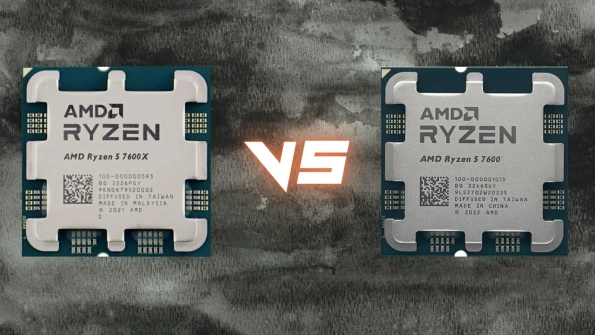
When I compare the AMD Ryzen 5 7500X3D vs Ryzen 5 7600X, I see two processors aimed at different priorities even though both use six Zen 4 cores and twelve threads. The Ryzen 5 7600X is the older, higher-clocked conventional Zen 4 processor, while the Ryzen 5 7500X3D adds AMD’s 3D V-Cache technology and focuses much more heavily on gaming performance.
In my analysis, this is what makes the comparison particularly interesting. The 7600X can reach a boost clock of up to 5.3 GHz, while the 7500X3D reaches up to 4.5 GHz. On paper, that clock-speed difference looks significant. However, the 7500X3D compensates with 96 MB of L3 cache compared with 32 MB on the 7600X. Both processors contain six cores and twelve threads, but their design priorities are clearly different.
We therefore should not judge these CPUs simply by looking at frequency. Some games respond strongly to additional cache, while many productivity workloads benefit more from higher clock speeds. That distinction becomes central when deciding which processor deserves a place in a new AM5 gaming PC.
From my perspective, the Ryzen 5 7500X3D is primarily a gaming-focused choice, whereas the Ryzen 5 7600X remains a more traditional all-purpose Zen 4 processor. The right option depends on what the computer will actually be used for, the graphics card installed, the resolution being played, and the prices available in your market.
Key Takeaways From My Ryzen 5 7500X3D vs Ryzen 5 7600X Analysis
The Ryzen 5 7500X3D and Ryzen 5 7600X share several important characteristics. Both are AM5 desktop processors, both have six cores and twelve threads, both support DDR5 memory, and both use AMD’s Zen 4 architecture.
The biggest difference is cache. The 7500X3D provides 96 MB of L3 cache, while the 7600X has 32 MB. The 7500X3D also has a much lower official default TDP of 65W compared with 105W for the 7600X.
In gaming, that extra cache can be extremely valuable. TechSpot’s testing found the 7500X3D substantially ahead of the 7600X across its twelve-game average, with the exact advantage depending on the title and graphics settings. In its medium-setting results, the 7500X3D averaged about 16% higher performance than the 7600X, while the advantage at ultra settings was about 13%.
The difference becomes especially interesting in games that are sensitive to CPU cache. TechSpot measured the 7500X3D about 31% ahead of the 7600X in Assetto Corsa Competizione and about 34% ahead in Baldur’s Gate 3 in its tested configurations. In other games, the difference was much smaller.
For general applications, the situation reverses. The 7600X’s higher operating frequencies can give it an advantage in workloads that do not benefit significantly from the large 3D V-Cache. TechSpot specifically found the 7500X3D to be much less impressive in productivity testing, including shader compilation and Cinebench.
My short recommendation is therefore straightforward: I would favor the 7500X3D for a gaming-first computer, while I would consider the 7600X more seriously for a mixed-use system when its price is substantially lower.
What the Ryzen 5 7500X3D and Ryzen 5 7600X Actually Are
Both processors belong to AMD’s Ryzen 7000 desktop family and are based on Zen 4. They use the AM5 socket and require DDR5 system memory. Neither includes a bundled CPU cooler according to AMD’s specifications.
The Ryzen 5 7600X launched in September 2022 as a mainstream enthusiast Zen 4 processor. AMD lists six CPU cores, twelve threads, a 4.7 GHz base clock, a maximum boost clock of 5.3 GHz, 32 MB of L3 cache, and a 105W default TDP.
The Ryzen 5 7500X3D arrived much later, in November 2025. AMD lists six cores, twelve threads, a 4.0 GHz base clock, a maximum boost clock of 4.5 GHz, 96 MB of L3 cache, and a 65W default TDP.
That specification sheet immediately shows the philosophy behind the two processors.
The 7600X emphasizes frequency. Its 5.3 GHz maximum boost clock is 800 MHz higher than the 7500X3D’s official maximum boost clock.
The 7500X3D emphasizes cache. Its 96 MB L3 cache is three times the 7600X’s 32 MB.
We can think of the difference in simple terms. The 7600X attempts to complete work very quickly through higher clock speeds, while the 7500X3D gives the processor a much larger pool of frequently accessed data close to the CPU cores.
That does not mean one design is universally better. The workload determines which characteristic matters more.
Ryzen 5 7500X3D vs Ryzen 5 7600X Specifications Compared
The following table brings the most important official specifications together so we can see exactly where the processors differ.
| Specification | Ryzen 5 7500X3D | Ryzen 5 7600X |
|---|---|---|
| Architecture | Zen 4 | Zen 4 |
| Cores | 6 | 6 |
| Threads | 12 | 12 |
| Base clock | 4.0 GHz | 4.7 GHz |
| Max boost clock | Up to 4.5 GHz | Up to 5.3 GHz |
| L2 cache | 6 MB | 6 MB |
| L3 cache | 96 MB | 32 MB |
| Default TDP | 65W | 105W |
| Socket | AM5 | AM5 |
| Memory | DDR5 | DDR5 |
| PCIe | PCIe 5.0 | PCIe 5.0 |
| Integrated graphics | Radeon Graphics | Radeon Graphics |
| Maximum operating temperature | 89°C | 95°C |
| Launch date | November 12, 2025 | September 27, 2022 |
Source: AMD specifications.
The table makes the fundamental trade-off obvious. Core and thread counts are identical, but clock speed, cache capacity, TDP, and launch timing are different.
The 7500X3D’s 96 MB L3 cache is the feature that most clearly separates it from the 7600X. AMD also lists a 65W default TDP for the 7500X3D, considerably below the 7600X’s 105W specification.
I would not interpret TDP as a direct measurement of actual gaming power consumption. Real power draw depends on workload, motherboard settings, BIOS behavior, cooling, and other factors. Still, the official ratings provide useful context for the processors’ intended operating envelopes.
Why 3D V-Cache Matters in Gaming
The most important technical feature of the 7500X3D is AMD’s 3D V-Cache.
Instead of relying only on the conventional amount of cache available to the processor, AMD adds a large additional cache layer using its 3D packaging technology. The result is 96 MB of L3 cache on the 7500X3D.
Why can this improve gaming?
Games frequently access the same kinds of data repeatedly. If more of that information can remain close to the CPU cores, the processor may need to make fewer trips to slower parts of the memory hierarchy.
This does not make every game dramatically faster. Some games are limited primarily by the graphics card, while others may be constrained by CPU execution speed, game-engine behavior, memory latency, or other system components.
The strongest improvements tend to appear when the CPU is an important limitation.
AMD has been developing 3D V-Cache for several generations. When AMD originally demonstrated the technology, CEO Lisa Su highlighted the gaming potential of the larger cache. In a 2021 presentation, she said:
“That’s 15 percent, which is an entire architectural generation’s worth of gaming performance just from the 3D V-cache technology.”
Lisa Su, AMD CEO, Computex 2021.
I think this quotation is useful because it illustrates why AMD continued developing the technology. The purpose was not simply to make a specification sheet look impressive. AMD was targeting workloads where additional local cache could produce meaningful performance improvements.
The modern 7500X3D is obviously a different processor from the prototype discussed in that 2021 presentation, so I would not apply the old 15% figure directly to this CPU. Instead, I treat the quotation as historical context for the underlying technology.
Ryzen 5 7500X3D vs Ryzen 5 7600X Gaming Performance
Gaming is where the 7500X3D makes its strongest argument.
TechSpot tested the 7500X3D against several other CPUs and found that the additional cache allowed it to outperform the 7600X in many games. Across a twelve-game average, TechSpot measured the 7500X3D approximately 16% faster at medium settings and approximately 13% faster at ultra settings.
These numbers are more useful than simply saying that the X3D processor is “faster,” because they show that the advantage varies with the workload.
For example, Assetto Corsa Competizione showed a particularly large advantage for the 7500X3D. TechSpot recorded approximately 31% higher performance than the 7600X at the tested medium settings. Baldur’s Gate 3 produced an even larger difference of roughly 34%.
Cyberpunk 2077: Phantom Liberty produced a smaller advantage. TechSpot reported approximately 12% higher performance for the 7500X3D at medium settings and about 9% with ray tracing at the Ultra setting.
This is exactly why I would avoid using one benchmark as the entire basis for a buying decision.
A CPU that is 30% faster in one game may be only a few percent faster in another. When the graphics card becomes the main bottleneck, CPU differences can shrink substantially.
A Practical Gaming Scenario
Imagine two otherwise identical systems using a powerful graphics card and a high-refresh-rate monitor.
With the Ryzen 5 7600X, the processor may become a limiting factor in a CPU-heavy competitive game. Replacing it with the 7500X3D can increase average frame rates and, in some cases, improve frame-time consistency.
Now consider the same two processors paired with a graphics card that is already operating at its maximum capacity in a visually demanding game at 4K resolution. The graphics card may become the dominant bottleneck, meaning the CPU difference becomes much less important.
In my view, this is why the 7500X3D makes the most sense for gamers who are actually able to exploit its CPU performance.
Why Higher Clock Speed Still Makes the 7600X Relevant
It would be a mistake to treat the 7600X as obsolete simply because it lacks 3D V-Cache.
Its maximum boost frequency reaches 5.3 GHz, compared with 4.5 GHz for the 7500X3D. It also starts at a much higher 4.7 GHz base clock compared with 4.0 GHz on the 7500X3D.
Higher frequency can be valuable in workloads that depend heavily on raw CPU execution speed rather than large cache capacity.
TechSpot’s testing demonstrates this clearly. The 7500X3D was significantly weaker than the 7600X in some productivity-oriented measurements, and its lower clock speed contributed to that result. Shader compilation, for example, took approximately 14–16% longer on the 7500X3D than on the 7600X in TechSpot’s testing.
The result is an important reminder: X3D does not automatically mean “faster at everything.”
The 7500X3D is designed around a specific performance objective. Its strengths are particularly relevant to games, while the 7600X remains competitive for workloads where frequency is more important.
Productivity Performance: Which Processor Makes More Sense?
For productivity, I would lean toward the 7600X unless the price difference makes the 7500X3D unusually attractive.
Applications such as rendering, encoding, compilation, compression, and content creation can respond differently from games. Some benefit from cache, but many workloads depend heavily on sustained CPU throughput and frequency.
The 7500X3D retains six cores and twelve threads, so it is not a weak processor in absolute terms. However, its lower clock speeds mean that it does not always capitalize on the same workload characteristics as the 7600X.
TechSpot’s Cinebench 2024 result illustrates the point. The review describes the 7500X3D’s score as particularly low compared with the modern processors tested, while its gaming performance was much more impressive.
A hypothetical content creator who spends most of the day rendering videos and only occasionally plays games should therefore look beyond the X3D branding.
By contrast, a user whose primary workload is gaming and whose secondary tasks are web browsing, office applications, media playback, and ordinary desktop use can take much greater advantage of the 7500X3D’s gaming-oriented design.
Power Efficiency and Cooling Considerations
The Ryzen 5 7500X3D has an official 65W default TDP, while the 7600X is rated at 105W. AMD also lists a maximum operating temperature of 89°C for the 7500X3D and 95°C for the 7600X.
These specifications make the 7500X3D interesting for efficiency-conscious builds.
PC Gamer described the 7500X3D as a processor that runs cool and does not draw much power in its review.
However, I would still choose the cooler based on the complete system rather than relying exclusively on the TDP number. Case airflow, ambient temperature, motherboard settings, fan curves, and sustained workloads all influence actual temperatures.
For a compact gaming computer, lower power characteristics can be particularly useful because reducing heat output can simplify the overall cooling challenge.
For a conventional mid-tower gaming PC, the difference is less critical, but lower power consumption can still be desirable.
Integrated Graphics and Platform Compatibility
Both processors include basic integrated Radeon graphics, so neither requires a discrete graphics card merely to produce a display signal under normal supported configurations. AMD lists two graphics cores operating at up to 2.2 GHz for both processors.
For a gaming system, however, I would still expect a discrete graphics card to handle serious 3D gaming.
Both CPUs use the AM5 socket and support DDR5 memory. AMD lists support across a broad range of AM5 chipsets, including A620, B650, B650E, X670, X670E, B850, B840, X870, and X870E.
That shared platform is a major advantage of the comparison.
If you already own an AM5 motherboard that supports the relevant processor and BIOS version, the decision can be much easier because you may not need to replace the motherboard.
How Much Does the Graphics Card Matter?
The graphics card can completely change the practical difference between these processors.
At lower resolutions and high refresh rates, the CPU frequently becomes more important because the GPU can render frames quickly enough that the processor becomes a limiting component.
At 1080p competitive settings, for example, a high-end graphics card may expose differences between the 7500X3D and 7600X.
At 1440p, the difference can still matter, particularly with a powerful GPU.
At 4K with demanding graphical settings, however, the GPU often becomes the dominant bottleneck.
This does not mean the 7500X3D is useless at 4K. Instead, it means that the extra CPU performance may not translate into the same proportional increase in visible frame rate.
Example: Three Different Gaming Builds
Consider three hypothetical systems.
Scenario A: 1080p high-refresh esports PC
A powerful GPU, 240 Hz monitor, and competitive game settings create a situation where CPU performance can be extremely important. I would favor the 7500X3D if the price premium is reasonable.
Scenario B: 1440p enthusiast gaming PC
Here the decision depends heavily on the graphics card and games. The 7500X3D remains attractive because many CPU-sensitive games can benefit from its cache.
Scenario C: 4K cinematic gaming PC
If the GPU is the primary bottleneck, spending substantially more on the CPU may provide smaller visible benefits. In this situation, I would compare total system cost rather than choosing the fastest CPU automatically.
Which Processor Has the Better Value?
Value is one of the hardest parts of this comparison because CPU prices change by country and retailer.
TechSpot’s January 2026 review listed the 7500X3D at around $260 at the time of its testing and noted that its value depended strongly on price.
The 7600X is an older processor, and its market price can therefore fluctuate considerably. AMD’s own store has listed a $299 MSRP for the 7600X, although actual selling prices can be considerably different depending on market conditions and availability.
Because of that, I would not recommend making a purchase based on an old launch MSRP.
The better approach is to compare the actual current CPU prices in your market and then calculate the complete platform cost.
If the 7500X3D costs only modestly more than the 7600X, the gaming performance advantage can justify it.
If the 7500X3D costs dramatically more, the 7600X may become the better overall value, especially for mixed workloads.
Ryzen 5 7500X3D vs Ryzen 5 7600X: Advantages and Disadvantages
The next table summarizes the practical trade-offs rather than simply repeating specifications.
| Category | Ryzen 5 7500X3D | Ryzen 5 7600X |
|---|---|---|
| Gaming | Excellent | Very good |
| CPU-heavy gaming | Strong advantage | Good |
| Cache-sensitive games | Excellent | Good |
| Productivity | Adequate to good | Better |
| Clock speed | Lower | Higher |
| L3 cache | 96 MB | 32 MB |
| Default TDP | 65W | 105W |
| Efficiency | Strong | Good |
| High-refresh gaming | Excellent | Very good |
| General-purpose use | Very good | Excellent |
| Overclocking focus | More restricted X3D design | Unlocked |
| Best audience | Gaming-focused buyers | Mixed-use buyers |
The most important takeaway is that the processors should not be judged using a single category.
The 7500X3D wins the argument when gaming is the priority. The 7600X becomes more attractive when productivity, frequency-sensitive applications, and potentially lower purchase cost are more important.
A Step-by-Step Method for Choosing Between Them
Step 1: Identify Your Main Workload
I would first ask what the computer will do most often.
If gaming represents the overwhelming majority of usage, start with the 7500X3D.
If gaming is only one part of a workload that includes frequent CPU rendering, compression, software compilation, or other sustained productivity tasks, the 7600X deserves closer consideration.
Step 2: Identify Your Graphics Card
Next, look at the GPU.
A high-end graphics card paired with a 1080p high-refresh display can benefit much more from a fast gaming CPU than a modest GPU operating at 4K.
This is why CPU recommendations without considering the GPU can be misleading.
Step 3: Check Your Target Resolution
Resolution affects the balance between CPU and GPU.
For 1080p competitive gaming, I would place more emphasis on the 7500X3D.
For 1440p, I would still consider it a strong option, especially with a high-end graphics card.
For 4K, I would examine the price difference carefully before spending extra money on the processor.
Step 4: Compare Real Local Prices
Do not rely on launch pricing.
Compare the actual cost of the 7500X3D and 7600X in your market, including any difference in motherboard bundles, memory packages, or cooling requirements.
Step 5: Consider Your Upgrade Path
Both processors use AM5, which means platform considerations are similar. AMD lists support for both chips across numerous AM5 chipsets.
If you already have an AM5 motherboard, that can make either processor substantially easier to adopt.
Step 6: Choose Based on the Bottleneck
Finally, I would identify the component most likely to limit performance.
If the CPU is the bottleneck in your games, the 7500X3D is compelling.
If your applications depend more on raw frequency, the 7600X may be more appropriate.
If the GPU is already the limiting component, spending more on the CPU may not provide the improvement you expect.
Common Mistakes When Comparing the 7500X3D and 7600X
One common mistake is assuming that a 5.3 GHz processor must be faster than a 4.5 GHz processor.
Clock speed matters, but it is not the only determinant of performance.
Another mistake is assuming that 96 MB of cache automatically produces a 3x gaming performance improvement simply because the cache capacity is three times larger. Cache does not scale performance linearly with capacity.
A third mistake is comparing CPUs using only synthetic benchmarks.
Synthetic benchmarks can be useful for understanding CPU behavior, but gaming performance depends on game engines and workloads. TechSpot’s testing demonstrates how dramatically the 7500X3D’s advantage varies from one game to another.
A fourth mistake is ignoring the graphics card.
If a GPU is already limiting frame rates, switching processors may produce only a modest change.
Finally, I would avoid assuming that every X3D processor is automatically the best choice for every user. The 7500X3D is a particularly interesting gaming processor, but the 7600X’s higher clock speeds can still make it the better fit for certain workloads.
What Review Testing Tells Us About the 7500X3D
Independent testing gives us a useful picture of where the 7500X3D succeeds and where it compromises.
TechSpot’s testing found strong gaming performance across a broad selection of titles. The processor was approximately 17% faster than the 7600X in Rainbow Six Siege X at the tested medium settings, around 10% faster in Marvel Rivals, around 10% faster in Assassin’s Creed Shadows, and approximately 12% faster in Cyberpunk 2077 at medium settings.
Other games produced different results. Mafia: The Old Country, for example, showed the 7500X3D roughly matching the 7600X in the reported testing, illustrating that additional cache does not guarantee a large improvement everywhere.
The 1% low results are also worth considering.
In The Last of Us Part II Remastered, TechSpot found only about a 6% average-frame-rate advantage for the 7500X3D over the 7600X, but the 7500X3D’s 1% lows were about 25% better.
From my perspective, this is one of the more important lessons from the comparison. Average FPS is not the entire gaming experience. Frame-time consistency and 1% lows can affect how smooth a game feels, especially in CPU-sensitive scenarios.
Verified Perspective on 3D V-Cache
A second historical quotation helps explain why AMD considers cache a major part of its gaming strategy. During AMD’s early 3D V-Cache demonstrations, Lisa Su explained the technology’s gaming potential:
“It averages 15 per cent improvement at 1080p just from 3D V-cache.”
Lisa Su, AMD CEO, as reported during the 2021 3D V-Cache demonstration.
I would again treat this as historical evidence about the technology rather than a promise about the 7500X3D. The quoted demonstration involved a different Ryzen processor and an earlier implementation.
The useful point is that AMD’s development strategy has consistently recognized gaming as a workload where additional cache can create meaningful gains.
That design philosophy is visible in the 7500X3D today.
When I Would Choose the Ryzen 5 7500X3D
I would choose the Ryzen 5 7500X3D when gaming is the main purpose of the computer and the processor is reasonably priced.
It is particularly attractive for a high-refresh gaming system where CPU performance matters.
I would also consider it when pairing the processor with a strong graphics card. The more capable the GPU, the more likely it is that CPU limitations can become visible in CPU-sensitive games.
The processor’s 96 MB L3 cache is its defining advantage, and independent testing shows that this advantage can translate into substantial gaming improvements in suitable workloads.
Its 65W default TDP is another positive characteristic for efficiency-oriented systems.
When I Would Choose the Ryzen 5 7600X
I would choose the Ryzen 5 7600X when the computer has a broader workload and the 7600X is meaningfully cheaper.
Its 5.3 GHz maximum boost clock gives it a substantial frequency advantage over the 7500X3D, and that can matter in applications where the large cache does not provide much benefit.
I would also consider it for users who frequently perform CPU-intensive productivity tasks but still want a capable gaming processor.
The 7600X is not a poor gaming CPU. It remains a six-core, twelve-thread Zen 4 processor with strong clock speeds and AM5 compatibility.
Its weakness in this comparison is simply that the 7500X3D is specifically optimized to attack one of the most important gaming performance variables: CPU cache.
Ryzen 5 7500X3D vs Ryzen 5 7600X: Final Buying Decision
The following table gives my practical recommendations for different types of buyers.
| User Type | My Choice | Main Reason |
|---|---|---|
| Competitive 1080p gamer | Ryzen 5 7500X3D | Strong CPU-focused gaming performance |
| 1440p enthusiast gamer | Ryzen 5 7500X3D | Excellent cache-sensitive gaming performance |
| 4K gamer on a limited budget | Ryzen 5 7600X if much cheaper | GPU is often the main bottleneck |
| Gaming-first AM5 build | Ryzen 5 7500X3D | 3D V-Cache advantage |
| Video/content creator | Ryzen 5 7600X | Higher clocks can help productivity |
| General home PC | Ryzen 5 7600X | Balanced performance and potentially lower cost |
| Small efficient gaming PC | Ryzen 5 7500X3D | 65W default TDP |
| Mixed gaming/productivity PC | Depends on price | Workload balance matters |
| Existing AM5 upgrade | Either | Motherboard compatibility can simplify upgrade |
| Maximum gaming value | Ryzen 5 7500X3D when price premium is reasonable | Strong gaming performance per CPU tier |
The central lesson from the table is that price can change the winner.
If the 7500X3D costs only a little more, I believe its gaming advantage makes it the stronger choice for a gaming-focused PC.
If the price difference becomes large, the 7600X can become a more sensible purchase because it still offers six Zen 4 cores, twelve threads, high clock speeds, and AM5 compatibility.
Conclusion
After examining the Ryzen 5 7500X3D vs Ryzen 5 7600X, I believe the 7500X3D is the stronger choice for a gaming-first AM5 computer, while the 7600X remains an attractive all-purpose processor when its price is substantially lower. The 7500X3D’s 96 MB of L3 cache gives it a major architectural advantage in many games, and independent testing shows meaningful gains over the 7600X across numerous titles.
At the same time, I would not dismiss the 7600X simply because it lacks 3D V-Cache. Its higher 4.7 GHz base clock and up to 5.3 GHz boost clock make it particularly relevant to productivity workloads and applications that respond strongly to frequency.
In my view, the practical next step is to compare the actual prices of both CPUs in your market and consider your graphics card and target resolution. If gaming dominates your usage and the price premium is reasonable, I would select the Ryzen 5 7500X3D. If you want a balanced system or find the 7600X at a significantly lower price, the 7600X can still be a very sensible AM5 choice.
Frequently Asked Questions
Is the Ryzen 5 7500X3D faster than the Ryzen 5 7600X for gaming?
Yes, the Ryzen 5 7500X3D is generally faster for gaming because its 96 MB of L3 cache can significantly benefit CPU-sensitive games. TechSpot’s twelve-game testing showed an average advantage of roughly 16% at medium settings and about 13% at ultra settings compared with the 7600X. However, the size of the improvement varies considerably between games.
Does the Ryzen 5 7600X have a higher clock speed?
Yes. AMD specifies a 4.7 GHz base clock and up to a 5.3 GHz boost clock for the Ryzen 5 7600X. The Ryzen 5 7500X3D has a 4.0 GHz base clock and up to a 4.5 GHz boost clock. This higher frequency is one reason the 7600X can perform well in productivity workloads even though the 7500X3D has substantially more L3 cache.
Why does the Ryzen 5 7500X3D have more cache?
The 7500X3D uses AMD’s 3D V-Cache technology, which adds additional L3 cache to the processor package. AMD lists 96 MB of L3 cache for the 7500X3D compared with 32 MB for the 7600X. The larger cache can reduce the need to access slower levels of the memory hierarchy in workloads that benefit from it, particularly certain games.
Which processor is better for productivity, the 7500X3D or 7600X?
I would generally favor the Ryzen 5 7600X for productivity when pricing is similar. Its higher clock speeds can be advantageous in applications that do not benefit significantly from 3D V-Cache. Independent testing has also shown the 7500X3D falling behind the 7600X in some productivity-oriented workloads.
Is the Ryzen 5 7500X3D good for a 1440p gaming PC?
Yes. I consider the 7500X3D a strong option for 1440p gaming, particularly when paired with a powerful graphics card. At 1440p, the GPU can become an important bottleneck, but CPU-sensitive games can still benefit from the additional cache. The exact improvement depends on the game, graphics card, settings, and desired frame rate.
Which CPU should I buy for a budget gaming PC?
The answer depends primarily on the price difference. If the Ryzen 5 7500X3D is only moderately more expensive than the 7600X, I would favor the 7500X3D for a gaming-focused build. If the 7600X is significantly cheaper, it can provide excellent value and leave more of the budget available for the graphics card, which is often the most important component for gaming performance.
Does the Ryzen 5 7500X3D use the same socket as the 7600X?
Yes. Both processors use AMD’s AM5 socket and DDR5 memory. AMD lists support for both processors across several AM5 chipset families, although motherboard BIOS support should always be confirmed before installing a specific CPU.
Does the Ryzen 5 7500X3D consume less power than the 7600X?
AMD specifies a 65W default TDP for the 7500X3D and 105W for the 7600X. These figures should not be treated as direct measurements of real-world power consumption in every workload, but they show that AMD gives the 7500X3D a lower default thermal-power target.
Is the Ryzen 5 7500X3D worth buying over the 7600X?
For a gaming-focused system, I believe it can be worth buying when the price premium is reasonable. The additional 3D V-Cache provides measurable gaming advantages in many titles. For a mixed-use computer, however, I would compare prices carefully because the 7600X’s higher clock speeds can make it more attractive for productivity. The final decision should therefore consider workload, GPU, resolution, and actual local pricing.
Sources and References
The technical specifications in this article are based primarily on AMD’s official Ryzen 5 7500X3D and Ryzen 5 7600X product information.
Gaming and productivity comparisons are based on independent testing from TechSpot and additional review information from PC Gamer and PCGamesN.
Historical information about AMD’s 3D V-Cache technology and the quoted statements from Lisa Su are supported by contemporary reporting and AMD presentation material.
Disclaimer
This article is provided for general informational purposes. CPU performance can vary according to motherboard configuration, BIOS version, memory settings, cooling, graphics card, operating system, applications, game versions, and other system variables. Prices and availability can also change by country, retailer, and date. I recommend checking current specifications, compatibility information, and local pricing before purchasing hardware.