I believe one of the most frustrating parts of Old School RuneScape is watching kill count rise while the unique item you want refuses to appear. You know the advertised drop rate, you know roughly how many kills other players have completed, and yet your collection log remains empty. At that point, the question usually becomes: How dry am I actually?
That is where an OSRS dry calculator becomes useful. Rather than simply telling me that an item is listed at 1/500 or 1/1,000, a proper calculation shows the probability that I could have reached my current kill count without receiving the item. That distinction is extremely important because a drop rate describes an individual roll, while a dry calculation describes the result of many independent rolls.
In my analysis, the most useful way to think about dry streaks is through probability rather than emotion. If an item has a 1/500 drop rate, every eligible kill normally gives a 1/500 chance unless a special mechanic changes that probability. The fact that I missed the item 499 times does not automatically make kill 500 more likely.
We can use a simple mathematical model to answer several practical questions. What is my chance of still being dry after 100 kills? How unusual is 1,000 kills without a 1/500 item? What kill count represents a 50% chance of having received the drop? How many kills should I expect before obtaining it? And, perhaps most importantly, does being extremely dry mean the next kill is “due”?
For ordinary independent drop rolls, the answer to that final question is no. The next eligible roll has the same probability as the previous one unless the game uses a mechanic that changes the effective odds.
Key Takeaways
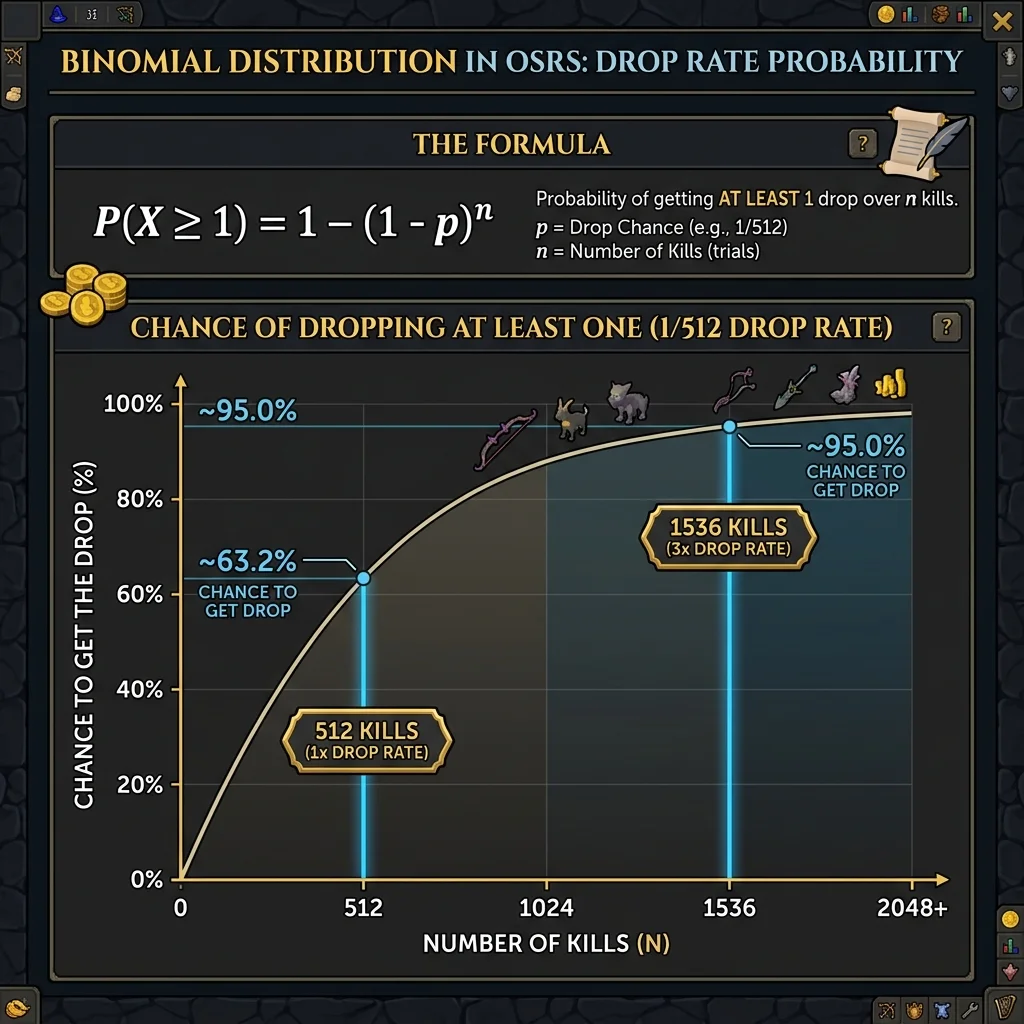
The central formula I use for an ordinary independent drop is straightforward. If the drop chance on each kill is (p), then the probability of not receiving the item on one kill is (1-p). After (n) independent kills, the probability of still having no drop is:
[
P(\text{no drop after }n\text{ kills})=(1-p)^n
]
The probability of receiving at least one drop within those (n) kills is therefore:
[
P(\text{at least one drop})=1-(1-p)^n
]
For a 1/500 drop, the single-kill probability is 0.2%. After 500 independent kills, the cumulative chance of having received at least one item is about 63.3%, while the chance of remaining dry is about 36.7%.
That surprises many players because “500 kills at a 1/500 rate” does not mean that the item is guaranteed by 500 kills. The 1/500 figure describes each roll, not a guaranteed deadline.
My main practical lessons are these:
- An OSRS dry calculator should distinguish between drop rate, cumulative chance, and chance of remaining dry.
- A 1/N drop rate does not guarantee the item after N attempts.
- At N attempts, the cumulative probability is approximately 63.2% when N is large and the probability is exactly 1/N.
- The expected number of attempts for a simple geometric drop is N, but that does not mean most players receive the item exactly at N.
- A dry streak can be statistically unusual without being impossible.
- Past failures do not normally increase the next independent roll.
- Special mechanics can make simple calculations inaccurate, so the underlying drop system matters.
- I should always check whether the listed rate is affected by player state, item eligibility, mechanics, or game mode before calculating.
What an OSRS Dry Calculator Actually Measures
When I describe an OSRS dry calculator, I am referring to a probability calculation that starts with an item’s drop chance and a player’s current number of unsuccessful eligible attempts.
Suppose a boss has a unique item listed at 1/100. The chance on a single eligible kill is 1%, assuming the relevant drop table and mechanics really do operate that way.
After one kill, my chance of getting the item is 1%.
After two kills, my chance of getting at least one copy is:
[
1-(0.99)^2
]
That equals approximately 1.99%.
After 100 kills:
[
1-(0.99)^{100}
]
The result is approximately 63.4%.
This illustrates the difference between individual probability and cumulative probability. I am not saying that the player has a 100% chance at 100 kills. Instead, I am saying that a player starting from zero would have approximately a 63.4% probability of seeing at least one item during those 100 independent attempts.
The remaining 36.6% would still be dry.
That remaining percentage is exactly what a dry calculator is useful for measuring.
Drop Rate, Expected Kills, and Cumulative Probability Are Different
One of the biggest sources of confusion in OSRS comes from treating these three concepts as if they mean the same thing.
They do not.
The drop rate describes an individual roll. A 1/500 rate means a probability of 1/500 on each eligible roll under the assumed mechanics.
The expected number of kills is the mathematical average for a simple geometric process. For a 1/N chance, the expected waiting time is N attempts.
The cumulative probability tells me the chance of having received at least one drop by a particular number of attempts.
These values answer different questions.
Consider a hypothetical 1/500 item:
| Question | Mathematical answer |
|---|---|
| Chance on one eligible kill | 1 in 500 |
| Percentage chance per kill | 0.20% |
| Expected waiting time | 500 kills |
| Chance of at least one drop by 100 kills | About 18.15% |
| Chance of at least one drop by 500 kills | About 63.30% |
| Chance of still being dry after 500 kills | About 36.70% |
| Chance of at least one drop by 1,000 kills | About 86.53% |
| Chance of still being dry after 1,000 kills | About 13.47% |
The important takeaway is that 500 kills is an average, not a guarantee.
If I stopped a large group of players at exactly 500 attempts, many would have the item and many would not. Some would receive it early, while others would go considerably beyond 500.
The mathematics does not promise fairness on an individual timeline. It describes probabilities across repeated trials.
Why 1/500 Does Not Mean You Are Guaranteed the Drop at 500
Let us consider a hypothetical boss with a 1/500 unique.
A common misconception is that the first 500 kills somehow fill a progress bar toward the item. Under an ordinary independent roll system, that is not how probability works.
Each eligible kill is another trial.
The first kill has a 1/500 chance.
The second kill has a 1/500 chance.
The 499th kill has a 1/500 chance.
The 500th kill also has a 1/500 chance.
There is no mathematical debt created by the previous failures.
That does not mean the overall experience is random in an unlimited or meaningless way. Probability still allows us to calculate exactly how unusual a streak is. What changes is the interpretation.
If I reach 500 dry kills, I should not say, “I was guaranteed to get it.” Instead, I can say, “Under the simple independent-roll model, about 36.7% of players would still be dry at this point.”
That is a much more accurate statement.
A Practical OSRS Dry Calculator Formula
For a basic independent drop, I use the following formula.
Let:
- (N) = denominator of the drop rate
- (n) = number of eligible kills
- (p = 1/N)
Then:
[
P(\text{dry})=(1-\frac{1}{N})^n
]
And:
[
P(\text{drop by }n)=1-(1-\frac{1}{N})^n
]
If I want the result as a percentage, I multiply by 100.
For example, suppose an item has a hypothetical 1/250 drop rate and I have completed 250 kills.
[
P(\text{dry})=(1-\frac{1}{250})^{250}
]
That produces a dry probability of roughly 36.7%.
Therefore, the cumulative probability of receiving at least one copy by 250 kills is roughly 63.3%.
This pattern occurs for any simple 1/N rate when the number of attempts equals N.
The exact value approaches:
[
1-e^{-1}
]
which is approximately 63.2% for large N.
How I Interpret Different Levels of Dryness
Not every dry streak deserves the same interpretation.
Going 20 kills dry on a 1/500 item is completely ordinary. Going 500 kills dry is also not particularly shocking from a statistical perspective. Going several thousand kills dry can become genuinely rare.
I prefer to describe dryness using the probability of still having no drop rather than using emotional labels.
| Example drop rate | Kills completed | Approx. chance of still being dry |
|---|---|---|
| 1/100 | 100 | 36.6% |
| 1/100 | 300 | 4.9% |
| 1/100 | 500 | 0.66% |
| 1/250 | 250 | 36.7% |
| 1/250 | 500 | 13.5% |
| 1/250 | 1,000 | 1.83% |
| 1/500 | 500 | 36.7% |
| 1/500 | 1,000 | 13.5% |
| 1/500 | 2,000 | 1.83% |
| 1/1,000 | 1,000 | 36.8% |
| 1/1,000 | 2,000 | 13.5% |
| 1/1,000 | 5,000 | About 0.67% |
These values assume simple independent rolls and are intended to demonstrate the mathematics rather than represent every OSRS drop system.
The most important pattern is easy to miss: doubling the expected number of kills does not make the drop guaranteed. For a 1/N item, reaching approximately 2N attempts leaves roughly 13.5% of players dry under the simple model.
That is unlucky, but it is nowhere near impossible.
How Many Kills Give Me a 50% Chance?
Another useful calculation asks when the cumulative chance reaches 50%.
I solve:
[
1-(1-p)^n=0.5
]
Rearranging gives:
[
n=\frac{\ln(0.5)}{\ln(1-p)}
]
For a 1/500 item, this is approximately 346.3 attempts.
That means the median waiting time is around 347 kills, not 500.
This distinction is extremely useful.
The mean is 500 kills.
The median is around 347 kills.
Those are not contradictory.
A small number of very long dry streaks can pull the average upward. Consequently, the point at which half of players have received the item occurs earlier than the average waiting time.
I believe this is one of the best ways to explain why “the drop is 1/500” should never be interpreted as “most people get it at 500.”
What Does It Mean to Be 2x, 3x, or 5x Dry?
Players often describe their streak using multiples of the listed rate.
For a 1/500 item:
- 1x dry means 500 unsuccessful kills.
- 2x dry means 1,000 unsuccessful kills.
- 3x dry means 1,500 unsuccessful kills.
- 5x dry means 2,500 unsuccessful kills.
- 10x dry means 5,000 unsuccessful kills.
These descriptions are useful shorthand, but the multiple alone does not tell me the actual probability.
For a simple 1/N model, the approximate dry probability after (kN) attempts is:
[
(1-\frac{1}{N})^{kN}
]
For large N, this is close to:
[
e^{-k}
]
That means:
- 1x rate: about 36.8% dry
- 2x rate: about 13.5% dry
- 3x rate: about 5.0% dry
- 4x rate: about 1.8% dry
- 5x rate: about 0.67% dry
- 6x rate: about 0.25% dry
- 7x rate: about 0.091% dry
- 8x rate: about 0.034% dry
- 10x rate: about 0.0045% dry
These are approximations for large N, but they provide a useful mental model.
At five times the nominal rate, I would consider a player exceptionally unlucky under the simple model. Yet “exceptionally unlucky” is not the same as impossible.
Why the Next Kill Is Not Normally More Likely
This is where the concept of independent probability becomes especially important.
Imagine that I am hunting a 1/500 item and have gone 999 kills without seeing it.
On kill 1,000, the simple model still gives me a 1/500 chance.
The previous 999 failures affect how unusual my overall streak is, but they do not automatically change the next roll.
This is an example of what is often called the gambler’s fallacy: assuming that a random event must compensate for previous outcomes.
A fair coin does not become more likely to land heads simply because it has landed tails several times. Likewise, an independent OSRS drop does not normally become more likely merely because I have failed repeatedly.
There is an important qualification, however. Some game mechanics can deliberately alter probabilities, introduce pity systems, use thresholds, or change how rewards are generated. In those cases, I should not blindly apply the basic formula.
When the Basic OSRS Dry Calculator Can Be Wrong
A calculator is only as accurate as the assumptions behind it.
This matters because OSRS contains many different reward systems and special mechanics. A simple 1/N formula may not represent every possible item.
Before calculating dryness, I would check several questions.
Is the Drop Rate Actually 1/N?
Some rewards are presented through multiple tables or conditions. An item may have a listed probability that depends on another roll occurring first.
If the reward is generated through multiple stages, I may need to calculate the complete process rather than treating the headline number as a simple independent chance.
Does the Item Have Multiple Sources?
If I receive the item from more than one eligible source, I need to know which kills actually count toward the calculation.
A combined kill count can become misleading if some activities have different rates.
Are There Player-Specific Modifiers?
Some game modes or mechanics can modify drop rates. Jagex has explicitly described Leagues as featuring boosted progression and drop-rate effects, demonstrating why a normal-world calculation should not automatically be transferred to a temporary game mode. (Jagex)
Is the Reward Guaranteed or Threshold-Based?
A guaranteed reward is fundamentally different from a random independent drop. If a mechanic guarantees a reward after a particular condition, the geometric formula is not the correct model for the entire process.
Are We Counting Eligible Attempts?
This is an underrated issue.
If I say I have completed 1,000 kills, but only 900 of those kills were eligible for the particular reward, then using 1,000 in the formula exaggerates my statistical dryness.
The calculation should use the number of relevant rolls, not simply a convenient kill-count number.
Practical Example: Calculating a 1/500 Drop
Let us consider a hypothetical player who has completed 750 eligible kills for a 1/500 unique.
The chance of remaining dry is:
[
(499/500)^{750}
]
This is approximately 22.3%.
Therefore, the cumulative probability of receiving at least one copy by 750 kills is approximately:
[
1-0.223=0.777
]
or about 77.7%.
That means the player’s 750-kill dry streak is certainly unlucky, but the simple model says roughly 22 out of every 100 comparable players could still be dry at that point.
From my perspective, this is a much more informative description than simply saying, “750 dry is terrible.”
It tells me exactly how unusual the streak is under the assumptions.
Practical Example: A 1/100 Item at 500 Kills
Now consider a hypothetical 1/100 item with 500 unsuccessful attempts.
The probability of remaining dry is:
[
(0.99)^{500}
]
That is approximately 0.66%.
The cumulative chance of having received at least one item is approximately 99.34%.
Here, the same number of kills produces a completely different interpretation because the drop rate is much more common.
This demonstrates why kill count alone cannot determine whether someone is dry. I always need the rate and the number of eligible attempts.
How to Calculate Your Own Dry Streak
I recommend using a simple process instead of relying on intuition.
Step 1: Identify the Exact Drop Rate
Write the rate as 1/N.
For example:
1/500
Step 2: Count Eligible Attempts
Determine how many kills actually produced an eligible reward roll.
Call that number (n).
Step 3: Calculate the Dry Probability
Use:
[
(1-\frac{1}{N})^n
]
Step 4: Convert It to a Percentage
Multiply by 100.
Step 5: Calculate the Cumulative Drop Chance
Use:
[
1-(1-\frac{1}{N})^n
]
Step 6: Interpret the Result Carefully
A 10% dry probability means the streak is unusual, but not extraordinary.
A 1% dry probability is much rarer.
A 0.1% dry probability is extremely unusual under the model.
However, none of these values creates a guarantee for the next kill.
A Worked Calculator Example
Suppose I have a hypothetical 1/750 drop and 1,500 eligible kills.
The dry probability is:
[
(1-\frac{1}{750})^{1500}
]
Using the large-N approximation:
[
e^{-2}\approx0.1353
]
So the chance of still being dry is roughly 13.5%.
The cumulative chance of having received the item is therefore roughly 86.5%.
This means the player is approximately 2x the nominal drop rate without a drop, but the streak is still within the range that probability predicts for a noticeable minority of players.
I would describe that player as unlucky rather than statistically unbelievable.
How to Find the Kill Count for a Target Probability
An advanced OSRS dry calculator can work in reverse.
Instead of asking, “How dry am I?” I can ask:
How many kills do I need for a 90% cumulative chance?
The formula is:
[
n=\frac{\ln(1-C)}{\ln(1-p)}
]
where (C) is the desired cumulative probability.
For a 1/500 item and a 90% target:
[
n=\frac{\ln(0.10)}{\ln(499/500)}
]
This gives approximately 1,151 kills.
So under the simple independent-roll model, I need roughly 1,151 eligible attempts to reach a 90% chance of having received at least one copy.
Even then, there is still a 10% chance of being dry.
For a 99% target, the required kill count rises to roughly 2,300 attempts.
This is a useful reminder that probabilities become increasingly expensive as I push toward certainty.
Understanding the Difference Between 90% and 99%
Players sometimes ask why a 99% chance requires so many more kills than a 90% chance.
The answer comes from the diminishing nature of probability.
At 90%, I am allowing a 10% failure group.
At 99%, I am trying to eliminate all but 1% of that failure group.
At 99.9%, I am trying to eliminate all but 0.1%.
There is no finite kill count that creates mathematical certainty in an ordinary independent model.
This is why I prefer to talk about confidence levels rather than guarantees.
Why Community Drop Logs Can Be Misleading
OSRS players frequently share screenshots showing exceptionally lucky or exceptionally dry streaks. Those examples are interesting, but I would not use them alone to estimate a drop rate.
A community naturally notices extremes.
Nobody is likely to make a dramatic post titled “I got the 1/500 item on kill 497.”
A player who receives it on the first kill may post about it.
A player who reaches 5,000 dry may also post about it.
The ordinary middle of the distribution is less memorable.
This creates a selection effect in community discussions. The most visible examples are not necessarily representative of the underlying probability.
From my perspective, the mathematical drop table should remain the starting point, while community logs can provide useful supplementary context.
What Jagex Says About the Nature of Old School RuneScape
I find the broader design philosophy relevant because OSRS is built around long-term progression and repeated activities.
Jagex describes Old School RuneScape as:
“The timeless, player-shaped MMO where every grind matters and every achievement is earned.”
Jagex, official RuneScape description (Jagex)
That wording helps explain why long grinds are such a recognizable part of the game. The calculation tells me how probability works, but the player experience is still shaped by the emotional impact of repeating the same activity hundreds or thousands of times.
A dry calculator does not remove that frustration. What it can do is put the frustration into context.
If my streak has a 30% dry probability, I can reasonably recognize that many other players would experience the same outcome.
If my streak has a 0.01% dry probability, the statistical story is very different.
How Game Modes Can Change Drop Calculations
I also think it is important to separate the standard game from special modes.
Jagex has described Leagues as a faster-paced version of Old School RuneScape with boosted progression and mechanics that can affect rewards. (Jagex)
Kieren Charles, Creative Director for Old School RuneScape, described Leagues this way:
“Faster progression, a level playing field for all, and new gameplay mechanics provide a fresh take on the Old School experience.”
Kieren Charles, Creative Director, Old School RuneScape (Jagex)
The quote matters because it reinforces a practical rule: I should identify the exact game mode before applying a drop calculation.
A formula based on a standard-world drop rate can produce the wrong answer if a temporary mode, relic, passive effect, or other mechanic modifies the effective probability.
Common OSRS Dry Calculation Mistakes
Mistake 1: Treating the Rate as a Guarantee
A 1/500 rate does not mean the item must appear by kill 500.
The expected waiting time is 500, but individual results vary.
Mistake 2: Assuming Dryness Creates Pity
Under an independent system, previous failures do not automatically improve the next roll.
Mistake 3: Using the Wrong Kill Count
Only eligible attempts should normally be included.
Mistake 4: Ignoring Drop-Rate Modifiers
A temporary mode or special mechanic can alter the effective chance.
Mistake 5: Confusing “Chance of Getting It” With “Chance of Still Being Dry”
These are complementary probabilities:
[
P(\text{drop})+P(\text{dry})=1
]
assuming the calculation covers the same event and conditions.
Mistake 6: Treating Expected Kills as the Most Common Kill Count
The expected value is an average, not necessarily the median and not necessarily the mode.
Mistake 7: Assuming a Community Screenshot Proves a Drop Rate
One lucky or unlucky player cannot establish the true probability.
How I Recommend Using an OSRS Dry Calculator
I think the best calculator should provide more than one number.
At minimum, I want to see:
- The listed drop rate.
- The number of eligible attempts.
- The chance of remaining dry.
- The cumulative chance of receiving the item.
- The expected number of attempts.
- The kill count for useful probability milestones such as 50%, 90%, and 99%.
For more advanced analysis, I would also want the ability to account for different rates, multiple reward sources, or special mechanics.
The calculator should also explain its assumptions. A number without an explanation can easily be misunderstood.
Interpreting Your Results Without Overreacting
Probability can tell me whether a result is unusual, but it cannot tell me how I should feel about it.
If I am 1,500 kills dry on a 1/500 item, the calculation can tell me that the event is uncommon. It cannot make the grind feel shorter.
That distinction matters because statistical language can sometimes become detached from the player experience.
A 13.5% event is not rare enough to be shocking, but experiencing it personally can still be frustrating.
Likewise, receiving an item at extremely low kill count can feel amazing even though it does not prove that the game’s underlying odds changed.
I believe the healthiest interpretation is to separate probability from expectation.
Probability describes what can happen.
Expectation describes the long-run average.
Neither one promises what will happen to me on the next kill.
Second Comparison: How Dry Streaks Scale
The following table gives a useful mental model for a simple 1/N drop.
| Multiple of listed rate | Approx. dry probability | Approx. cumulative chance |
|---|---|---|
| 0.5× | 60.7% | 39.3% |
| 1× | 36.8% | 63.2% |
| 1.5× | 22.3% | 77.7% |
| 2× | 13.5% | 86.5% |
| 3× | 5.0% | 95.0% |
| 4× | 1.8% | 98.2% |
| 5× | 0.67% | 99.33% |
| 6× | 0.25% | 99.75% |
| 8× | 0.034% | 99.97% |
| 10× | 0.0045% | 99.9955% |
These are approximate values based on the large-N form of the independent-roll model. For an exact result, I would use the actual denominator rather than the approximation.
The practical lesson is striking. Reaching the nominal rate leaves more than one-third of players dry in the simple model. Reaching five times the nominal rate makes the streak much more unusual, but even that is still a probability rather than a mathematical impossibility.
Using a Dry Calculator for Different Goals
An OSRS dry calculator can answer several different questions depending on what I enter.
Goal: “How Unlucky Am I?”
Enter the exact drop rate and current eligible kill count. Read the remaining dry probability.
Goal: “What Is My Chance of Having the Item by 1,000 Kills?”
Use the cumulative probability formula.
Goal: “How Many Kills Give Me a 50% Chance?”
Use the inverse formula with 0.50 as the target.
Goal: “How Many Kills Give Me a 95% Chance?”
Use the same inverse formula with 0.95.
Goal: “How Rare Is My 3,000-Kill Dry Streak?”
Calculate the probability of remaining dry after 3,000 eligible attempts.
These are different questions, even though they all involve the same underlying drop rate.
A Useful Mental Shortcut for Large Drop Denominators
For a large 1/N drop, I can often estimate the result quickly using:
[
P(\text{dry})\approx e^{-n/N}
]
This is especially convenient when the denominator is large.
For example, if I am 3N attempts dry:
[
e^{-3}\approx0.0498
]
So I can immediately estimate that roughly 5% of players would remain dry.
At 5N:
[
e^{-5}\approx0.0067
]
or about 0.67%.
This shortcut is not necessary when I have a calculator, but it gives me a useful intuition for interpreting OSRS dry streaks.
What I Would Check Before Trusting a Calculator Result
Before accepting a result, I would verify five things.
First, I would confirm the exact item and its current drop source.
Second, I would confirm the current rate rather than relying on an old screenshot or remembered number.
Third, I would determine whether the activity uses a simple independent roll.
Fourth, I would check whether any game-mode or item-specific modifier applies.
Finally, I would make sure the kill count represents actual eligible attempts.
That verification step is especially important because a mathematically perfect calculation can still produce the wrong answer when the input is wrong.
Why Drop Calculations Are Useful for Long OSRS Grinds
I think the biggest benefit of an OSRS dry calculator is not predicting the next kill. It is improving how I understand the grind.
Without a calculation, “1,200 dry on a 1/500 item” can sound either completely normal or impossibly unlucky depending on who I ask.
With the calculation, I can quantify the result.
I can also compare different grinds more fairly. A player who is 800 kills dry on a 1/200 item is in a very different statistical position from a player who is 800 kills dry on a 1/1,000 item.
The raw kill count is not enough.
The rate provides the context.
This is why I would always evaluate dryness as a ratio and probability rather than using kill count alone.
Frequently Asked Questions
What is an OSRS dry calculator?
An OSRS dry calculator estimates how unlikely it is to receive no copy of a particular item after a given number of eligible attempts. For a simple independent 1/N drop, it uses the formula ((1-1/N)^n) to calculate the probability of remaining dry after (n) attempts. It can also calculate the complementary probability of receiving at least one copy. I find this more informative than simply comparing a kill count with the listed drop-rate denominator because it shows how unusual the streak actually is.
Does a 1/500 OSRS drop mean I should get the item by 500 kills?
No. A 1/500 rate normally describes the probability on an individual eligible roll, not a guarantee at 500 attempts. Under a simple independent model, the probability of remaining dry after 500 attempts is about 36.7%, while the probability of receiving at least one copy is about 63.3%. Therefore, going 500 kills without the item is not statistically extraordinary. The expected waiting time is 500 attempts, but individual players can receive the item much earlier or much later.
Does going dry make my next OSRS drop more likely?
Not under a simple independent drop system. If the chance is 1/500 on every eligible kill, being 1,000 kills dry does not automatically change the probability of kill 1,001. The overall streak has become increasingly unusual, but the next independent roll remains 1/500. I would only expect the next-roll probability to change if a specific game mechanic modifies the reward system, such as a guaranteed reward, pity mechanic, threshold, or other special rule.
How do I calculate my OSRS dry streak?
I first identify the exact drop rate and express it as 1/N. Then I count the number of eligible unsuccessful attempts, represented by (n). The dry probability is ((1-1/N)^n). For example, with a 1/500 item and 1,000 eligible attempts, the probability of remaining dry is approximately 13.5%. The cumulative probability of having received at least one copy is therefore approximately 86.5%. The calculation assumes independent rolls and accurate input data.
What does 5x dry mean in OSRS?
Five times dry means completing approximately five times the listed drop-rate denominator without receiving the item. For a simple 1/500 drop, that would mean 2,500 unsuccessful eligible attempts. Under the large-N approximation for independent rolls, the probability of remaining dry at 5N is about 0.67%. That makes the streak very unlucky, but it does not make it impossible. The exact percentage depends on the actual drop denominator and mechanics involved.
What is the difference between expected kills and median kills?
Expected kills describe the mathematical average number of attempts in a simple geometric distribution. For a 1/N drop, the expected waiting time is N attempts. The median is the point where approximately half of players have received the item and half have not. For a 1/500 drop, the median is around 347 attempts, while the expected waiting time is 500. This difference occurs because long dry streaks pull the average upward.
Can I use the same dry calculation for every OSRS item?
No. The basic formula is appropriate only when the reward behaves like an independent probability on each relevant attempt. Some OSRS rewards can involve multiple tables, conditional rolls, modifiers, guarantees, or special game-mode mechanics. Before using an OSRS dry calculator, I would verify how the particular reward is generated. If the listed rate is not equivalent to a simple independent 1/N roll, the calculation may need to be adjusted.
Is being 1,000 kills dry on a 1/500 item extremely rare?
It is unlucky but not extraordinarily rare under the simple independent model. The probability of remaining dry after 1,000 attempts is approximately 13.5%. In other words, roughly 13 or 14 out of 100 comparable players could theoretically still be waiting at that point. That is why I would avoid calling a 1,000-kill dry streak impossible or extraordinarily rare. The statistical interpretation changes considerably at much larger multiples of the drop rate.
Sources and References
I based the mathematical explanation in this article on standard probability theory for independent Bernoulli trials and geometric waiting times. For current OSRS context, I also referred to official Jagex material describing Old School RuneScape, Leagues, boosted drop-rate mechanics, and the game’s evolving systems. Jagex’s official description identifies Old School RuneScape as a community-shaped MMORPG launched from the 2007 version of the game, while its Leagues announcements document that temporary modes can introduce accelerated progression and altered mechanics. (Jagex)
Jagex’s official rules are also relevant when evaluating third-party tools or services surrounding OSRS. The company warns players about cheating software and other prohibited activities, so I would always distinguish a harmless probability calculator from software that interacts with the game client or game world. (Jagex Legal)
Disclaimer
This article explains probability using simplified independent-drop assumptions and is intended for informational purposes. Actual OSRS reward mechanics can vary by activity, item, game mode, reward table, and special mechanic. I recommend verifying the current drop mechanics and eligibility conditions for the specific item before treating a calculated percentage as definitive. A probability result describes statistical likelihood; it does not guarantee what will happen on the next kill.