I have noticed that the phrase “BrandRank.ai normalization transformation rules” is appearing frequently in discussions about AI search, brand visibility, entity optimization, and answer engine optimization. At first glance, the phrase sounds like the name of a formal technical specification published by BrandRank.AI. However, based on my review of the company’s publicly available materials, I would be careful about treating it that way.
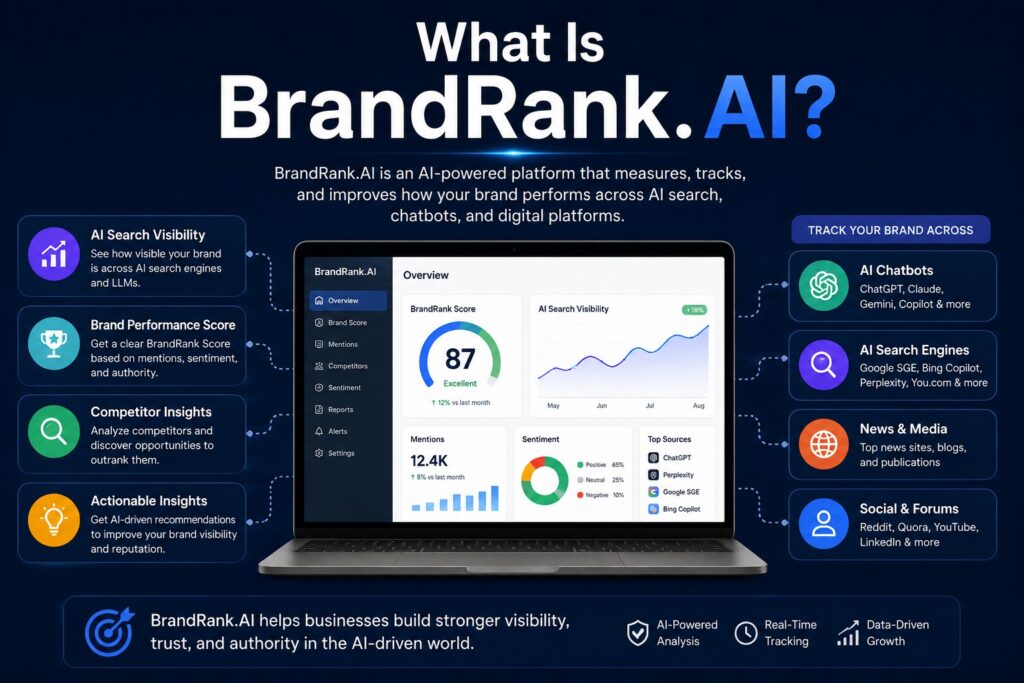
BrandRank.AI is a real SaaS platform focused on measuring and improving how brands appear in AI-generated answers. Its public materials describe areas including AI search visibility, brand vulnerability, content readiness, recommendation share, competitive benchmarking, source attribution, and prompt monitoring. I did not find a publicly documented BrandRank.AI technical specification that officially names a proprietary system “normalization transformation rules.”
That distinction matters. In my view, readers searching for this phrase need two things at the same time: an accurate explanation of what BrandRank.AI actually says it does and a practical explanation of what normalization and transformation mean when applied to AI-search data.
We can reasonably connect the concepts without pretending that an unpublished vendor algorithm is publicly known. Normalization can mean bringing inconsistent representations of a brand, product, URL, location, or source into a consistent canonical form. Transformation can mean converting raw information into useful analytical fields such as mentions, citations, topics, sentiment, competitors, or accuracy indicators.
My goal in this guide is therefore not to invent hidden BrandRank.AI formulas. Instead, I will explain the defensible interpretation of the phrase, distinguish verified BrandRank.AI capabilities from broader industry practices, and show how a practical normalization workflow can support AI visibility analysis.
Key Takeaways
The most important point I would make is that “BrandRank.ai normalization transformation rules” should currently be treated as a descriptive industry phrase rather than a publicly verified BrandRank.AI technical standard. BrandRank.AI’s official materials focus on AI visibility, vulnerability, content readiness, and related measurements rather than publishing a rulebook under this exact title.
Normalization is still highly relevant to AI-search measurement. If the same company appears under several spellings, domains, product names, or historical identities, a measurement system needs some way to determine which references belong to the same entity.
Transformation goes a step further. Instead of merely cleaning a string, a system can convert raw AI answers into structured observations. For example, an answer might be transformed into fields identifying the brand mentioned, the question category, whether the brand was recommended, whether a source was cited, which competitor appeared, and whether the answer contained a potentially inaccurate claim.
I believe the practical lesson is simple: businesses should focus less on finding a supposed secret list of BrandRank.AI rules and more on creating a clean, consistent, auditable brand-data system that supports AI visibility measurement.
What BrandRank.AI Actually Does
BrandRank.AI describes itself as a SaaS platform designed to help brands monitor and strengthen their positioning in generative AI. Its platform tracks prompts, analyzes AI-generated answers, provides competitive benchmarking, attributes sources, and reports measures related to visibility, content readiness, and brand vulnerability.
The company’s homepage explains its approach in terms of recommendation behavior. It asks whether AI engines recommend a particular brand when consumers ask buying questions and says its system tracks questions across several AI platforms while comparing brands against competitors. It also describes defensive monitoring for outdated claims, controversies, product confusion, and other vulnerabilities.
This is important because conventional SEO and AI visibility are not identical measurement problems. Traditional SEO often asks where a webpage ranks for a query. AI visibility asks a different question: does a brand appear in an answer, how is it represented, and which sources contribute to that answer?
BrandRank.AI’s FAQ explicitly distinguishes traditional SEO from AI search optimization and says its system focuses on how brands are represented in generated answers, including gaps in authority, content, and visibility.
From my perspective, that makes normalization especially useful as an analytical concept. A platform measuring thousands of generated answers cannot simply count raw text strings and assume every variation represents a separate entity.
Why Normalization Matters in AI Search
Normalization is not a new idea. Data engineers, database administrators, analysts, search systems, and information-retrieval specialists have used different forms of normalization for years.
The basic idea is straightforward: inconsistent representations are converted into a controlled form while meaningful distinctions are preserved.
Imagine that a dataset contains these entries:
- Example Brand
- ExampleBrand
- EXAMPLE BRAND
- Example Brand Inc.
- Example Brand, Inc.
- examplebrand.com
- www.examplebrand.com
A human may immediately understand that several of these references relate to the same organization. A measurement system still needs explicit rules for deciding how those records should be grouped.
The difficulty becomes greater when the variations are not obviously identical. A company may own multiple products, regional subsidiaries, brands, domains, and historical names. A normalization system that merges everything too aggressively can be just as inaccurate as one that fails to merge anything.
That is why I believe good normalization should not mean “make everything identical.” It should mean “make equivalent information comparable while preserving meaningful differences.”
Brand Name Normalization
The first layer is usually the brand name itself.
Suppose a company officially styles its name as “Northstar Analytics.” Public sources might alternatively use “NorthStar Analytics,” “Northstar,” “Northstar Analytics Inc.,” or an abbreviated form.
A practical system can define a canonical name while retaining aliases.
For example:
Canonical entity: Northstar Analytics
Known aliases: NorthStar Analytics, Northstar, Northstar Analytics Inc.
This approach allows the analytical system to recognize related references without pretending that the aliases are literally the same string.
I would also keep a record of why each alias was mapped. That creates an audit trail and makes future corrections easier.
Product Name Normalization
Product normalization is more complicated because a company and its products are related but not identical entities.
Consider a fictional company called BrightDesk that sells a product named BrightDesk Pro. A careless normalization rule might map every occurrence of “BrightDesk” to the product. That would create incorrect reporting.
A better model separates:
- Company: BrightDesk
- Product: BrightDesk Pro
- Product category: Project management software
- Domain: brightdesk.example
- Parent organization: if applicable
This distinction becomes especially important when AI answers discuss both the company and its products.
URL Normalization
URLs create another source of duplication.
A single page may appear as:
or with tracking parameters attached.
For analytics, these may represent one underlying resource. A normalization process can identify the canonical URL while retaining the original URL for audit purposes.
I would not automatically remove every URL variation, though. Redirects, regional domains, language versions, tracking parameters, and genuinely different pages can have different analytical meanings.
The rule should therefore be based on equivalence, not cosmetic similarity.
Normalization and Transformation Are Not the Same Thing
One of the easiest mistakes in this subject is treating normalization and transformation as interchangeable.
Normalization generally focuses on consistency.
Transformation focuses on changing information from one representation into another useful representation.
For example, suppose an AI answer says:
“Brand A is a strong choice for small businesses, although Brand B may offer more advanced enterprise features.”
A normalization process might identify “Brand A” and “Brand B” as canonical entities.
A transformation process could turn the answer into structured observations such as:
- Brand A: mentioned
- Brand A: recommendation context
- Brand B: competitor
- Topic: small-business software
- Topic: enterprise features
- Comparative statement: yes
- Citation: present or absent
- Sentiment/context: favorable toward Brand A
The distinction becomes extremely useful when measuring AI visibility.
A Practical Transformation Example
Let us consider a hypothetical answer:
“Company X is widely used for accounting automation. Company Y is another option, particularly for larger organizations.”
A raw text system simply stores the paragraph.
A transformed analytical record might contain:
| Field | Example value |
|---|---|
| Primary brand | Company X |
| Competitor | Company Y |
| Category | Accounting automation |
| Brand mention | Yes |
| Recommendation context | Positive |
| Competitor mention | Yes |
| Comparative context | Yes |
| Citation | Depends on the generated answer |
| Target audience | Larger organizations mentioned for competitor |
The transformation does not change what the AI answer originally said. Instead, it creates a structured interpretation that can be counted, compared, and reviewed.
That distinction is critical because analytical transformations can introduce errors. I would always preserve the original answer alongside the transformed record.
The Relationship Between Normalization and Brand Entity Resolution
Entity resolution is the process of determining whether different references point to the same underlying entity.
This is where normalization becomes particularly important.
Suppose an AI answer contains:
- Meta
- Meta Platforms
- Facebook’s parent company
- Meta Platforms, Inc.
A system may need to determine whether these references belong to one corporate entity, a product, or a related but separate organization.
Now consider a different situation:
- Apple
- Apple Inc.
- Apple Music
- Apple TV+
- Apple Store
These should not all be collapsed into one generic entity.
A useful normalization architecture therefore needs relationships rather than just substitutions.
This is more informative than replacing every occurrence with “Apple.”
In my view, entity resolution should therefore preserve hierarchy, ownership, product relationships, regional relationships, and historical relationships where those distinctions matter.
How BrandRank.AI Fits Into the Broader AI Visibility Workflow
BrandRank.AI’s official platform materials describe a workflow involving prompt monitoring, visibility measurement, vulnerability analysis, content readiness, and competitive benchmarking.
Normalization can conceptually support each of those areas.
For visibility measurement, normalized brand names make it easier to determine whether a brand appeared in an answer.
For competitive analysis, normalized competitor identities make comparisons more reliable.
I would stress, however, that this is a conceptual connection. It should not be presented as proof that BrandRank.AI internally uses a particular unpublished normalization algorithm.
Why Brand Consistency Matters for AI-Readable Information
AI systems process information from many sources. BrandRank.AI itself emphasizes that AI answer engines draw on multiple information sources and that brand visibility depends on authority, structure, and corroboration.
That creates a practical reason for businesses to maintain consistent information.
Suppose a company’s website calls a product “Acme Cloud Suite,” while several important directories call it “Acme Cloud,” a press release calls it “Acme SaaS,” and an old support article uses a discontinued name.
A person may be able to connect those references.
An automated system has a more difficult job.
The answer is not necessarily to delete every historical variation. Instead, I would create a clear canonical identity and connect legitimate historical and alternative names to it.
This is particularly important during:
- Rebrands
- Acquisitions
- Product renaming
- Domain migrations
- International expansion
- Corporate restructuring
- Product consolidation
A well-maintained identity record can explain those changes rather than leaving them as disconnected fragments.
A Useful Framework for Normalization Transformation Rules
Because the exact phrase is not publicly documented as a BrandRank.AI specification, I would use the following as a practical framework rather than calling it an official BrandRank.AI rulebook.
| Normalization area | What to standardize | What to preserve |
| Brand names | Preferred spelling and capitalization | Legitimate aliases |
| Products | Canonical product names | Versions and discontinued products |
| URLs | Canonical URLs | Redirects and source URLs |
| Locations | Standard location format | Regional distinctions |
| Companies | Legal and preferred names | Parent/subsidiary relationships |
| Categories | Preferred category labels | Meaningful secondary categories |
| Dates | Consistent date format | Original source date |
| Sources | Canonical source identity | Original publication URL |
| Citations | Duplicate citation references | Individual source occurrences |
| Historical names | Current canonical entity | Previous identities and dates |
The main takeaway from this table is that normalization should reduce noise without destroying context.
A system that removes too much information may produce a beautifully clean dataset that is analytically wrong.
Step-by-Step Process for Building a Practical Normalization System
Step 1: Define the Canonical Brand Identity
I would begin with a controlled identity record.
At minimum, this could include:
- Official brand name
- Preferred short name
- Legal entity name
- Primary domain
- Official product names
- Known aliases
- Former names
- Parent organization
- Major subsidiaries
- Geographic variants
The goal is to establish one authoritative reference point.
Step 2: Build an Alias Dictionary
The alias dictionary should contain known variations that genuinely refer to the same entity.
For example:
Canonical: Example Technologies
Aliases:
- Example Tech
- Example Technologies Inc.
- Example Technologies, Inc.
- ExampleTech
The dictionary should also record confidence or verification status where possible.
I would avoid automatically adding every spelling variation discovered online. An accidental typo is not necessarily a legitimate alias.
Step 3: Separate Brands From Products
This step prevents one of the most damaging forms of over-normalization.
Create separate records for:
- Organization
- Brand
- Product
- Service
- Category
- Location
Then define their relationships.
This allows an analytical system to answer more precise questions.
For example, “How often is our company mentioned?” should not necessarily produce the same result as “How often is our flagship product recommended?”
Step 4: Normalize URLs Carefully
Create rules for:
- Protocol differences
- Hostname capitalization
- Trailing slashes
- Tracking parameters
- Redirect destinations
- Canonical tags
- Regional versions
The objective is to identify duplicate representations without merging pages that have different content or strategic purposes.
Step 5: Preserve the Original Data
This is one of my strongest recommendations.
Never replace the original raw record with only the normalized version.
Instead, keep both:
Raw value: “ExampleTech Inc.”
Canonical value: “Example Technologies”
Rule applied: verified corporate alias
Confidence: high
Timestamp: recorded transformation time
That makes the system auditable.
Step 6: Transform AI Answers Into Structured Records
Once identities are normalized, raw AI answers can be analyzed.
Possible fields include:
- Prompt
- AI platform
- Date
- Locale
- Brand mentioned
- Brand position
- Recommendation status
- Competitor mentions
- Citation URLs
- Topic
- Sentiment
- Accuracy status
- Risk category
- Source type
This creates a much more useful dataset than a simple list of AI answers.
Step 7: Review Exceptions Manually
Automation should not eliminate human review.
Ambiguous references should enter an exception queue.
For example, “Mercury” might refer to a company, a vehicle brand, a planet, a chemical element, or another entity depending on context.
A normalization rule based only on the word itself would be dangerous.
Context must matter.
How Normalization Supports AI Visibility Measurement
BrandRank.AI says its platform measures AI search visibility and tracks how brands appear across answer engines. Its homepage describes visibility scores, competitive positioning, and question-level tracking.
To understand why normalization matters, imagine that a company receives 100 AI answers.
Without normalization, the analysis could count:
- 20 exact brand names
- 8 abbreviated names
- 6 legal-name references
- 5 domain references
- 3 product references
- 2 historical-name references
That does not automatically mean the brand appeared 44 times. Some entries could represent the company, while others could represent products or subsidiaries.
Normalization creates a controlled structure in which those distinctions can be analyzed correctly.
This makes comparisons more meaningful.
How Transformation Can Improve Competitive Analysis
Competitive analysis is another area where transformation becomes valuable.
BrandRank.AI says it benchmarks brands against competitors by analyzing the same answer sets and comparing cited sources and trust signals.
A normalized dataset could allow a marketer to compare:
- Recommendation frequency
- Brand mention frequency
- Competitor mention frequency
- Citation frequency
- Citation source types
- Positive and negative contexts
- Topic-specific visibility
- Product-level visibility
Hypothetical Competitive Example
Imagine an AI system is asked 200 questions about project-management software.
A fictional analysis might show:
| Metric | Brand A | Brand B | Brand C |
| Recommendation mentions | 82 | 96 | 61 |
| Competitor mentions | 74 | 69 | 88 |
| Cited answers | 54 | 71 | 43 |
| Negative or cautionary contexts | 11 | 8 | 17 |
| Product-specific mentions | 47 | 58 | 32 |
These numbers are purely hypothetical and are included to demonstrate how transformed data could be organized. They are not BrandRank.AI customer results or published measurements.
The useful lesson is that visibility should not be reduced to one number. A brand can have strong mention frequency but weak citation coverage, or frequent mentions accompanied by unfavorable contexts.
What Content Readiness Has to Do With Normalization
BrandRank.AI describes Content Readiness as a major part of its framework and says its assessment considers factors such as content accessibility, depth, schema, and content liquidity.
I see a natural relationship between this concept and normalization.
If a website contains inconsistent product names, unclear organizational relationships, outdated descriptions, missing structured information, and conflicting claims, an AI system has more ambiguity to resolve.
Normalization does not magically make content authoritative. It does not guarantee citations. It does not replace strong editorial content.
What it can do is improve consistency.
For example, if a company consistently identifies:
- Its official name
- Its products
- Its services
- Its category
- Its locations
- Its ownership
- Its relevant expertise
- Its authoritative URLs
then the information presented to search and AI systems becomes more coherent.
A Verified BrandRank.AI Perspective on Trust
The importance of trust is central to BrandRank.AI’s own positioning. One company publication describes the relationship between transparency and trust in unusually concise terms. The quotation is useful because it connects measurement with the quality of underlying information.
“Transparency is the input; trust is the output.”
Pete Blackshaw, BrandRank.AI
BrandRank.AI published this statement in a discussion of AI, brand trust, and the company’s Visibility, Content Readiness, and Vulnerability framework.
I think this quotation provides a useful way to understand normalization. Cleaning data is not valuable merely because clean data looks better. The purpose is to create a more reliable representation of the underlying entity.
If normalization hides contradictions instead of exposing them, it can actually weaken trust.
Normalization Should Not Become Data Manipulation
This is where I would draw a firm line.
Normalization should not be used to make a brand look better artificially.
Suppose several independent sources describe a company negatively. A legitimate transformation system should not erase those sources simply because the resulting dashboard looks unfavorable.
Likewise, if an AI answer incorrectly associates a brand with a competitor, that incorrect association should be recorded as a vulnerability rather than silently normalized into the desired identity.
BrandRank.AI’s public materials emphasize vulnerability monitoring and accuracy concerns, reinforcing the idea that unfavorable or inaccurate representations are part of what should be monitored rather than hidden.
The objective is therefore accurate measurement, not cosmetic measurement.
Common Mistakes When Applying Normalization Rules
Over-Merging Different Entities
The most obvious mistake is treating related entities as identical.
A parent company is not automatically the same thing as every subsidiary.
A product is not automatically the same thing as its manufacturer.
A domain is not automatically the same thing as the organization that owns it.
A good system maintains relationships rather than flattening everything into one record.
Removing Historical Information
Rebrands create a temptation to delete old names.
I would avoid that.
A historical name can remain important because old articles, reviews, legal documents, and citations may continue using it.
The correct approach is usually to map the historical identity to the current identity while preserving the date and context.
Ignoring Geographic Variations
A multinational company may legitimately use different names, domains, product versions, or legal entities in different countries.
Forcing all of these into one identical record can destroy important information.
Normalization should therefore support regional distinctions.
Treating Every Typo as an Alias
Not every misspelling deserves canonical status.
If someone accidentally writes “Exampel Technologies,” that does not mean the company should add it to its official alias dictionary.
Otherwise, the alias system becomes polluted with noise.
Discarding the Raw Data
This is a technical and analytical mistake.
If the raw value disappears, it becomes much harder to audit the transformation later.
I strongly prefer a model where raw and normalized values coexist.
Assuming Normalization Guarantees AI Citations
This is perhaps the biggest strategic misconception.
Normalization can improve consistency, but it cannot guarantee that ChatGPT, Gemini, Perplexity, or another AI system will cite a particular brand.
BrandRank.AI itself describes AI visibility as dependent on factors such as authority, structure, corroboration, content, and citation presence.
Normalization is therefore one part of a larger AI visibility strategy.
A Practical Checklist for Businesses
I would organize the work into five levels.
Identity
Confirm the official brand name, aliases, legal entity, products, services, and parent relationships.
Digital consistency
Audit websites, directories, profiles, press pages, product pages, and other important public sources for conflicting information.
Structured information
Use appropriate structured data and clear page organization to communicate entities and relationships.
AI monitoring
Test important customer questions across relevant answer engines and record how the brand is represented.
Exception management
Create a process for investigating incorrect, outdated, ambiguous, or contradictory information.
This approach is more sustainable than trying to find a single “magic” normalization rule.
A Second Framework for Choosing the Right Transformation
The following table shows how I would prioritize transformations according to their analytical purpose.
| Transformation | Primary purpose | Risk if done incorrectly | Recommended control |
| Brand alias mapping | Combine legitimate name variants | Different companies merged | Verify domain and entity |
| Product mapping | Group product references | Product and company confused | Maintain product hierarchy |
| URL canonicalization | Reduce duplicate sources | Distinct pages merged | Check redirects and content |
| Citation deduplication | Avoid double-counting sources | Independent sources treated as one | Preserve source IDs |
| Sentiment labeling | Analyze context | Nuance lost | Retain original sentence |
| Competitor matching | Identify competing entities | Unrelated entities classified as competitors | Use category and context |
| Historical mapping | Connect old and new identities | Historical context erased | Preserve dates |
| Location normalization | Compare geographic data | Regional entities merged | Keep country and region fields |
The key point is that every transformation should have a purpose, a rule, and a way to reverse or audit the decision.
A Verified BrandRank.AI Statement About Its Platform
Another useful quotation comes from BrandRank.AI’s launch communications. It describes the platform through the metaphor of navigation rather than traditional rankings.
“Our platform acts like a GPS for brands across AI search.”
Hank Hudepohl, Co-Founder and COO, BrandRank.AI
The statement appeared in BrandRank.AI’s announcement of its SaaS dashboard and was tied to the company’s focus on AI search visibility, vulnerability, and content readiness.
I find the metaphor useful because it emphasizes measurement and direction. A normalization system, viewed in that context, is not the destination. It is part of the measurement infrastructure that helps determine whether different observations belong together and what the data actually represents.
How to Audit Brand Data Before AI Visibility Monitoring
A business does not need an enormous enterprise project to begin.
I would start with a basic spreadsheet containing:
- Canonical brand name
- Known aliases
- Legal name
- Main domain
- Product names
- Product aliases
- Former names
- Parent company
- Key locations
- Official social identities
- Important third-party sources
- Known conflicting information
Next, I would identify the highest-value inconsistencies.
For example, if the company’s homepage says one thing about its flagship product while its documentation says something materially different, that contradiction deserves attention.
If three directory listings use slightly different capitalization but describe the same business accurately, the issue may be lower priority.
This prioritization prevents teams from spending hours correcting harmless formatting while ignoring serious factual contradictions.
Why Source Attribution Matters
BrandRank.AI emphasizes source attribution as part of its platform.
That matters because AI answers are not isolated pieces of text. They can reflect information from websites, reviews, news articles, regulatory sources, public documents, and other materials.
A transformed dataset should therefore answer not only:
“What did the AI say?”
but also:
“Which sources were associated with that answer?”
This makes remediation more practical.
If an AI answer contains an outdated claim and the same claim repeatedly traces back to one old page, the appropriate response may be very different from a situation in which the claim appears across dozens of independent sources.
The recent BrandRank.AI Brand Risk Monitor announcement specifically describes source-level intelligence for identifying the external material behind unfavorable recommendation outcomes.
What I Would Measure Over Time
A normalization project should not be judged solely by whether the database looks cleaner.
I would track operational indicators such as:
- Percentage of records with a canonical entity
- Number of unresolved aliases
- Number of duplicate sources
- Number of ambiguous entities
- Number of outdated brand references
- Number of conflicting claims
- Citation coverage
- Brand recommendation frequency
- Competitor recommendation frequency
- Accuracy exceptions
These metrics provide a more useful picture of progress.
For example, reducing 500 raw aliases to 50 canonical entities may sound impressive, but if 20 of those mappings are wrong, the system has become less reliable rather than more reliable.
Accuracy should always take priority over cosmetic simplicity.
A Third Verified Perspective: Why Visibility Alone Is Not Enough
BrandRank.AI’s public materials repeatedly connect visibility with vulnerability and readiness rather than treating visibility as the entire problem. Its platform description identifies the three areas as AI search visibility, content readiness, and brand vulnerability.
That distinction is important.
A brand could appear frequently in AI answers and still have serious problems if those answers contain outdated claims, inaccurate product descriptions, or unfavorable information.
BrandRank.AI has also described vulnerability capabilities involving hallucination and accuracy scoring, promise alignment, negative-source traceability, and executive-level risk scoring.
In my view, normalization supports this broader approach because it allows organizations to distinguish the brand itself from products, competitors, sources, and historical references before analyzing the meaning of those references.
How I Would Build an Auditable Rule System
If I were designing the data process conceptually, I would use five layers.
Layer 1: Raw data
Store the original source exactly as received.
Layer 2: Cleaning
Standardize obvious technical inconsistencies such as whitespace, encoding, and carefully selected URL formatting.
Layer 3: Entity mapping
Map verified aliases to canonical entities.
Layer 4: Semantic transformation
Extract fields such as topic, recommendation context, sentiment, citation, competitor, and risk.
Layer 5: Validation
Review ambiguous or high-impact transformations.
This architecture has an important advantage: every decision can be traced backward.
If a dashboard says a brand was mentioned 87 times, an analyst should be able to investigate how those 87 mentions were counted.
That is much more valuable than a black-box number with no explanation.
Where Structured Data Fits
Structured data can help machines understand the meaning and relationships represented on a website, but I would avoid describing schema markup as a guaranteed shortcut to AI visibility.
A business can use appropriate structured information for organizations, products, services, articles, locations, and other relevant entities.
The more important principle is consistency.
If the visible content says one thing while structured information says something materially different, the underlying problem has not been solved.
Structured data should reinforce accurate content rather than contradict it.
BrandRank.AI’s public discussion of content readiness includes depth, clarity, schema, accessibility, and other factors, which supports viewing structured information as one component of a broader readiness strategy.
What the Phrase “BrandRank.ai Normalization Transformation Rules” Should Mean in Practice
After reviewing the available material, I would define the phrase cautiously.
In practical terms, it can refer to a disciplined approach for:
- Identifying canonical brand entities.
- Mapping legitimate aliases.
- Separating organizations from products and services.
- Standardizing comparable URLs.
- Connecting historical names.
- Preserving geographic distinctions.
- Removing genuine duplicates.
- Transforming AI answers into structured analytical records.
- Tracking citations and source relationships.
- Maintaining an audit trail for every important transformation.
But I would not claim that this list is an official BrandRank.AI specification.
The distinction is not merely semantic. A reader implementing these practices deserves to know which statements come from the vendor and which represent broader analytical recommendations.
Frequently Overlooked Risk: Over-Normalization
One subtle issue deserves special attention.
Suppose an organization operates several brands under one parent company. A normalization system might decide that all brand names should map to the parent company.
That could make reporting look simpler.
It could also make the reporting wrong.
Customers may ask specifically about one consumer brand while the parent organization remains invisible in the question. Treating the two as identical would make it impossible to measure the brand-level result accurately.
The same problem occurs with products.
If a product receives strong recommendations, that does not automatically mean the corporate brand receives the same level of recommendation.
Good normalization therefore preserves hierarchy.
It does not erase it.
The Practical Workflow I Recommend
For a business beginning this work, I would use the following sequence:
First, document identity.
Write down the canonical brand, products, services, domains, locations, aliases, and historical names.
Second, identify contradictions.
Look for outdated or conflicting information across the most authoritative sources.
Third, create mappings.
Map only verified aliases and related entities.
Fourth, preserve raw evidence.
Never destroy the original source or answer.
Fifth, transform observations.
Turn AI answers into structured records that can be compared.
Sixth, monitor priority prompts.
Focus on questions customers actually ask rather than collecting random AI responses.
Seventh, compare competitors.
Measure your brand and competitors under equivalent prompts.
Eighth, investigate vulnerabilities.
Look for inaccurate claims, outdated information, missing citations, and unfavorable associations.
Ninth, improve source quality.
Address the underlying information rather than trying to manipulate the measurement.
Tenth, repeat the process.
AI-generated answers change, sources change, products change, and companies change. Normalization is therefore an ongoing governance process rather than a one-time cleanup.
Final Assessment of BrandRank.ai Normalization Transformation Rules
My assessment is that the phrase has a legitimate conceptual foundation but should not be confused with a publicly documented proprietary BrandRank.AI specification.
BrandRank.AI clearly operates in the AI visibility and brand-trust measurement space. Its official materials describe prompt tracking, recommendation share, visibility, vulnerability, content readiness, competitive benchmarking, source attribution, and AI-related brand monitoring.
What remains different is the specific claim that BrandRank.AI has publicly published a technical framework called “normalization transformation rules.” I found no authoritative BrandRank.AI page establishing such a specification under that exact name.
For that reason, I would use the phrase as a useful shorthand for a broader data-management discipline rather than as an official vendor-defined rulebook.
The strongest practical approach is to establish canonical entities, preserve aliases, maintain relationships, normalize comparable data carefully, transform AI answers into auditable fields, and retain the original evidence.
We can reasonably conclude that this approach makes AI visibility analysis more reliable even without pretending that we know proprietary algorithms that have not been published.
Conclusion
I believe the most useful way to understand BrandRank.ai normalization transformation rules is to separate the verified BrandRank.AI platform from the broader normalization practices that support AI-search analysis. BrandRank.AI publicly focuses on visibility, vulnerability, content readiness, recommendation share, source attribution, and competitive intelligence, while the exact phrase “normalization transformation rules” does not appear to be a publicly documented technical specification from the company.
From my perspective, that does not make the concept irrelevant. Normalization remains valuable because AI visibility data can contain different names, URLs, products, sources, and historical identities representing related entities. Transformation then turns those raw observations into structured information that marketers and analysts can actually evaluate.
My practical recommendation is to start with a canonical brand record, build a verified alias dictionary, separate products from organizations, preserve original data, track sources, and maintain an audit trail for every important mapping. I would then monitor the questions that matter most to customers and use the resulting evidence to address genuine information gaps.
The next step is not to search for a secret rulebook. It is to build a transparent, accurate, and continuously maintained brand-data system.
Frequently Asked Questions
What are BrandRank.ai normalization transformation rules?
The phrase is best understood as a practical description of normalization and transformation practices used when analyzing brand information for AI search, rather than as a publicly documented BrandRank.AI technical specification. These practices can include canonicalizing brand names, resolving aliases, normalizing URLs, separating products from organizations, deduplicating sources, and transforming AI answers into structured fields. BrandRank.AI’s public materials instead describe its formal framework around visibility, vulnerability, content readiness, and related AI-search measurements.
Has BrandRank.AI officially published a normalization transformation rulebook?
I could not verify a public BrandRank.AI rulebook using that exact title. The company’s official website documents its AI visibility platform, prompt monitoring, competitive benchmarking, content readiness, vulnerability analysis, recommendation share, and source attribution, but those materials do not establish a named public specification called “normalization transformation rules.”
Why does normalization matter for AI search?
Normalization matters because the same organization, product, or source can appear in multiple forms. If those forms are counted independently, visibility and competitive metrics can become distorted. A good normalization process maps legitimate variants to canonical entities while preserving important differences such as products, subsidiaries, locations, and historical names. This makes subsequent AI-answer analysis more consistent and auditable.
What is the difference between normalization and transformation?
Normalization makes equivalent information consistent, while transformation converts information into another structured representation. For example, mapping “Example Inc.” and “Example Incorporated” to a canonical company record is normalization. Turning an AI answer into fields such as brand mention, competitor, topic, recommendation context, and citation status is transformation. Both processes can work together, but they solve different problems.
Can normalization guarantee better AI visibility?
No. Normalization can improve data consistency, but it cannot guarantee that an AI engine will recommend or cite a particular brand. BrandRank.AI describes AI visibility as involving authority, content, structure, corroboration, and citation-related factors. Normalization should therefore be treated as one part of a broader AI-search strategy.
Should companies normalize historical brand names?
Yes, but historical names should normally be preserved rather than deleted. A rebrand can leave older names across news articles, reviews, documents, and other sources. Mapping the historical name to the current entity while retaining the original name and relevant date provides better continuity than simply removing the old identity.
How should I handle products that share part of a company name?
I recommend maintaining separate entity records for the company and product while defining their relationship. For example, if “Example Cloud” is a product offered by “Example Technologies,” the product should not automatically be treated as the company. This separation makes product-level recommendations and company-level visibility easier to measure accurately.
Why should raw AI answers be preserved?
Raw answers provide the evidence behind transformed metrics. If an analyst later discovers that a sentiment label, citation classification, or entity mapping was incorrect, the original answer makes it possible to investigate and correct the transformation. Without the raw record, the analytical result becomes much harder to audit.
What should businesses do first?
I would start by creating a canonical brand identity document containing the official name, aliases, products, services, domains, locations, parent relationships, and historical names. Then audit important public sources for contradictions and duplicates. Once the identity foundation is reliable, begin tracking high-value AI prompts and transform the resulting answers into structured, reviewable records.
Sources and References
BrandRank.AI’s official FAQ documents its Brand Health and Trust framework, including Visibility, Vulnerability, and Content Readiness, and explains its approach to AI-search measurement.
BrandRank.AI’s recent acquisition announcement describes expanded capabilities around AI search visibility, recommendation share, content readiness, content gaps, and content generation.
Disclaimer
This article distinguishes publicly verifiable BrandRank.AI information from broader interpretations of normalization and transformation practices. I have not presented an unpublished proprietary algorithm, internal scoring formula, private rule set, or undocumented BrandRank.AI implementation as fact. Any hypothetical examples and sample tables are illustrative rather than customer results or official BrandRank.AI measurements. Readers should verify current vendor capabilities, methodology, pricing, availability, and technical documentation directly through authoritative sources before making business or implementation decisions.