
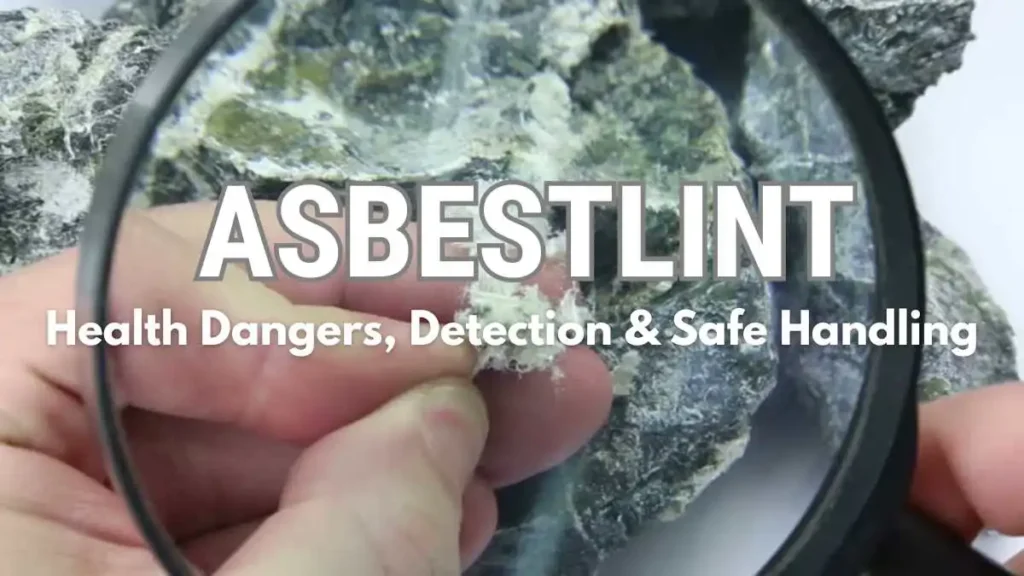
When I examine the word “asbestlint,” I find that it is important to distinguish the term from established scientific terminology. Asbestlint is not a recognized mineral classification, medical diagnosis, or standard asbestos product category used by major public-health authorities. I believe that distinction is essential because the word itself can create the impression that asbestlint is a separate substance, when the real concern is asbestos exposure.
Asbestos itself is a group of naturally occurring fibrous minerals that historically became valuable because of their strength, heat resistance, and resistance to chemical attack. Those characteristics encouraged widespread use in construction, insulation, roofing, fire protection, automotive components, and other industrial applications. The problem is that asbestos fibers can become airborne when asbestos-containing materials are damaged, cut, drilled, broken, sanded, demolished, or otherwise disturbed. Once inhaled, these fibers can contribute to serious diseases, including asbestosis, lung cancer, and mesothelioma. The World Health Organization states that all forms of asbestos are carcinogenic to humans.
From my perspective, the most useful way to understand asbestlint is therefore not to treat it as a new chemical or special variety of asbestos. We should instead understand it as a descriptive term that draws attention to the appearance or behavior of fine asbestos-related fibers and dust. That distinction changes how we respond. If someone sees an unusual fibrous substance in an old building, guessing that it is harmless lint can be dangerous, but automatically declaring it asbestos can also be inaccurate. The responsible approach is to avoid unnecessary disturbance and seek appropriate identification where asbestos may reasonably be present.
Key Takeaways About Asbestlint and Asbestos Exposure
The first point I want to establish is that asbestlint should not be treated as an official scientific classification. The term may be used informally to describe fine asbestos-containing dust or fibers, but established health authorities generally discuss the issue under the broader terms asbestos, asbestos fibers, asbestos-containing materials, and asbestos exposure.
The second point is more important: asbestos is a recognized human carcinogen. The International Agency for Research on Cancer has concluded that all major forms of asbestos are carcinogenic to humans. The evidence links asbestos exposure to mesothelioma and cancers of the lung, larynx, and ovary, while additional associations have also been investigated.
Third, I would not assume that visible dust is necessary for asbestos exposure. Fibers can be microscopic, and asbestos-containing materials can release fibers without producing an obvious cloud that a person can see. WHO explains that exposure can occur through inhalation of airborne fibers, including fibers released when asbestos-containing materials are damaged or disturbed.
Fourth, the presence of asbestos-containing material does not mean that a person will automatically become ill. Risk depends on factors such as the amount and duration of exposure, fiber characteristics, source, and individual circumstances. The National Cancer Institute notes that dose, duration, fiber size and shape, source, smoking, and other factors can influence asbestos-related disease risk.
Finally, I believe the safest general principle is simple: when asbestos is reasonably suspected, avoid disturbing the material until its status can be evaluated appropriately. Cutting, drilling, sanding, sweeping, or breaking suspicious material can turn a relatively contained problem into an airborne exposure problem.
What Asbestlint Actually Means
The easiest way to understand the term is to separate the two concepts contained within it. “Asbest” points toward asbestos, while “lint” suggests fine, loose, fibrous material. Put together, asbestlint can be understood as an informal expression for lint-like or dust-like asbestos fibers or asbestos-contaminated fibrous debris.
That does not mean every strand of dust, insulation, fabric fiber, or construction debris is asbestos. I consider this distinction especially important because visual appearance alone is unreliable. Ordinary household lint can look fibrous. Fiberglass insulation can look fibrous. Textile fibers can look fibrous. Mineral wool can look fibrous. Damaged asbestos-containing materials can also produce fibrous debris. Without appropriate identification, appearance is not enough to establish composition.
The scientific concern arises from the properties of asbestos fibers rather than from the word asbestlint. Asbestos minerals occur in several forms, including chrysotile and amphibole varieties such as crocidolite, amosite, tremolite, actinolite, and anthophyllite. IARC identifies all six major forms as carcinogenic to humans.
A useful hypothetical example is an older building undergoing renovation. Imagine that a worker removes a damaged ceiling component and notices fine fibers around the work area. It would be inappropriate to announce that the material is definitely asbestlint simply because it resembles lint. It would also be inappropriate to assume that it is ordinary dust. The correct response is to stop unnecessary disturbance and arrange appropriate assessment if asbestos is a credible possibility.
This is why I prefer to use the term cautiously. It can help people search for information about fine asbestos-related debris, but it should never replace professional terminology when communicating with laboratories, occupational-safety specialists, building managers, or health authorities.
Why Asbestos Fibers Become a Health Concern
Asbestos becomes particularly concerning when its fibers can enter the air and be inhaled. WHO explains that exposure occurs through inhalation of fibers in workplace environments, ambient air near sources, or indoor air where friable asbestos-containing materials are present.
The physical characteristics that once made asbestos attractive commercially also contribute to the difficulty of managing it. Asbestos fibers are extremely durable and can remain in the environment when asbestos-containing products deteriorate or are mechanically disturbed. The concern is therefore not simply that a building contains an old asbestos product. The more immediate issue is whether fibers can become airborne and whether people can inhale them.
This distinction helps explain why maintenance and renovation can be particularly important. A material that remains relatively undisturbed may behave differently from the same material after drilling, cutting, sanding, demolition, or other mechanical work. WHO specifically notes that people involved in construction, maintenance, and demolition can potentially be exposed even many years or decades after asbestos was installed.
I believe this is one of the most misunderstood aspects of asbestos safety. People sometimes assume that age makes asbestos harmless. In reality, the age of a material does not eliminate its hazardous properties. An old asbestos-containing product can remain a source of exposure if it becomes damaged or is disturbed.
Which Diseases Are Associated With Asbestos Exposure?
The health consequences of asbestos exposure are serious because the fibers can contribute to several diseases. WHO identifies lung cancer, mesothelioma, cancers of the larynx and ovary, and asbestosis among the established health effects associated with asbestos exposure.
Asbestosis is a chronic lung disease involving fibrosis, or scarring, of lung tissue. It is generally associated with significant occupational exposure and can impair respiratory function. The disease is not the same as cancer, although the broader health consequences of asbestos exposure can include both non-cancerous and cancerous conditions.
Mesothelioma is a particularly important asbestos-related disease. It is a cancer affecting the lining of structures such as the pleura around the lungs or the peritoneum in the abdomen. One reason asbestos remains a major public-health concern is that diseases such as mesothelioma may appear many years after exposure.
Lung cancer is another major concern. The relationship becomes particularly important when asbestos exposure occurs alongside tobacco smoking. WHO reports that co-exposure to tobacco smoke and asbestos fibers substantially increases lung-cancer risk, with heavier smoking associated with greater risk.
The long delay between exposure and disease can make asbestos risks difficult for individuals to understand. A person may encounter asbestos-containing material during one period of life and develop an asbestos-related disease much later. WHO has described latency periods for asbestos-related diseases that can extend over decades.
A useful hypothetical scenario illustrates this point. Imagine someone who worked around asbestos-containing insulation decades ago and currently feels healthy. It would be incorrect to interpret the absence of current symptoms as proof that the historical exposure was harmless. At the same time, it would also be wrong to conclude from exposure alone that the person will definitely develop disease. Medical risk assessment requires information about the person’s exposure history and individual circumstances.
What the Evidence Says About Asbestos Risk
I find the evidence particularly clear on one fundamental point: asbestos is not simply a material that has become unpopular; it is a recognized carcinogenic hazard. WHO’s current fact sheet states that all forms of asbestos are carcinogenic to humans and estimates that occupational exposure causes more than 200,000 deaths globally each year.
The figures are global estimates rather than predictions for any individual. I would therefore caution readers against using them to calculate their personal risk. Population-level statistics tell us why asbestos is a major public-health issue, while an individual assessment requires information about exposure intensity, duration, circumstances, and other factors.
The WHO also emphasizes that asbestos-related diseases are preventable. Its recommended public-health approach includes stopping the use of asbestos, replacing it with safer alternatives, preventing exposure during removal, and improving diagnosis and treatment of asbestos-related diseases.
This leads me to an important practical conclusion: prevention is more useful than trying to determine whether an unidentified fiber is dangerous by looking at it. If a suspicious material could contain asbestos, avoiding disturbance can reduce the possibility of unnecessary airborne exposure while appropriate identification is arranged.
A WHO housing guideline makes the principle especially clear:
“There is no safe level for asbestos exposure.”
World Health Organization housing and health guidance.
I interpret that statement as a reason to prioritize exposure prevention rather than trying to establish an informal threshold that makes household disturbance acceptable. It does not mean that every accidental contact will result in disease. Instead, it reinforces the public-health principle that unnecessary exposure should be avoided.
Where Asbestos May Be Found
Asbestos was incorporated into a wide variety of products because manufacturers valued its heat resistance, strength, insulation properties, and durability. Historical uses included roofing products, insulation, floor and ceiling materials, cement products, pipe insulation, fire-resistant materials, gaskets, brake components, and other industrial products. WHO documents describe both building and automotive applications.
The exact materials used in a particular building depend on its construction date, location, renovation history, and local manufacturing practices. I therefore would not recommend using a simple “old building equals asbestos” rule. Age can raise suspicion, but it cannot identify a material.
The same caution applies to appearance. A textured surface, insulation board, ceiling tile, pipe covering, or roofing product may resemble known asbestos-containing materials, but visual similarity is not confirmation.
The following table summarizes common situations in which asbestos may become relevant without claiming that every example contains asbestos.
Common Situations Where Asbestos Exposure Can Become Possible
| Situation | Why asbestos may be relevant | Safer general response |
|---|---|---|
| Renovating an older building | Walls, ceilings, flooring, insulation, or other components may contain historical asbestos products | Avoid disturbing suspicious materials until appropriately assessed |
| Removing old insulation | Some historical insulation systems used asbestos | Stop unnecessary handling and seek qualified evaluation |
| Demolition | Breaking materials can release fibers if asbestos is present | Follow applicable asbestos survey, control, and removal requirements |
| Cutting old cement products | Mechanical cutting can create dust from asbestos-containing products | Do not cut suspected asbestos-containing material casually |
| Repairing old pipe systems | Pipe insulation or other components may historically contain asbestos | Treat suspicious insulation as potentially hazardous until assessed |
| Handling damaged building debris | Broken asbestos-containing products can release fibers | Keep people away and use appropriate professional procedures |
| Cleaning renovation dust | Sweeping can redistribute fine particles | Avoid disturbing potentially contaminated dust and obtain appropriate advice |
The key takeaway from this table is that the activity often matters as much as the material. A building component that is left undisturbed presents a different situation from one being demolished or mechanically altered. However, I would not use this distinction as a reason to perform DIY asbestos work. The appropriate response depends on the material, condition, local requirements, and exposure circumstances.
How Asbestos Exposure Can Happen
Inhalation is the principal route of concern in most asbestos-exposure discussions. Fibers may enter the air when asbestos-containing materials are disturbed, damaged, or deteriorated. WHO describes inhalation of microscopic fibers as the major route of exposure.
Workplace exposure has historically been especially important because many industries used asbestos-containing materials extensively. Construction, demolition, maintenance, manufacturing, mining, and other occupations can create opportunities for exposure.
However, exposure is not limited to workers who deliberately handled asbestos. A person performing renovation in an older building might unknowingly disturb an asbestos-containing product. Workers can also potentially carry fibers away from contaminated workplaces on clothing or equipment, creating concerns about secondary exposure.
I think this is why asbestos safety should be treated as an environmental and occupational issue rather than merely a problem affecting a small group of industrial workers. WHO notes that people involved in building maintenance and demolition may remain at risk decades after asbestos was originally installed.
What I Would Do If I Suspected Asbestlint
If I encountered an unidentified lint-like or fibrous material in a setting where asbestos might reasonably be present, my first recommendation would be restraint rather than investigation by hand. I would not deliberately shake it, sweep it, vacuum it with an ordinary household vacuum, scrape it, blow it with compressed air, or collect it casually for inspection.
The reason is straightforward. If the material contains asbestos fibers, unnecessary manipulation could increase airborne contamination. The visual curiosity of identifying a strange material is not worth creating additional disturbance.
The next step would be to identify the source of the material. Is it coming from insulation? A ceiling? A damaged board? Pipe covering? Roofing? Floor material? Construction debris? Or is it simply ordinary textile lint? Knowing the source can help a qualified professional determine what type of assessment is appropriate.
Testing may be appropriate when the identity of a suspect material needs to be established. I would not recommend relying on an internet photograph or an informal visual comparison. Laboratory analysis may be necessary because asbestos fibers are microscopic and cannot reliably be identified by casual inspection.
If the material has already been disturbed, the response should focus on preventing further exposure rather than attempting to clean everything personally. The appropriate response can depend on the size of the affected area, the material involved, the type of disturbance, local regulations, and whether contamination may have spread.
A Step-by-Step Approach to Suspected Asbestos Material
Step 1: Stop Unnecessary Disturbance
The first practical action is to stop activities that could release additional dust or fibers. If renovation work is underway, continuing to drill, cut, sand, scrape, or demolish suspicious material can potentially increase exposure.
I believe this is one of the easiest preventive measures because it does not require specialized equipment. The goal is simply to avoid making the situation worse while the material is being assessed.
Step 2: Keep People Away From the Immediate Area
If suspicious debris is present, unnecessary access should be minimized. Children, visitors, pets, and unprotected workers should not be encouraged to enter an area where potentially contaminated material has been disturbed.
This does not mean that every suspected asbestos situation requires evacuating an entire building. The appropriate response depends on the circumstances. The practical principle is to prevent unnecessary contact and disturbance.
Step 3: Do Not Use Ordinary Cleaning Methods
Sweeping, dry dusting, brushing, or ordinary vacuuming may not be appropriate if asbestos contamination is suspected. The purpose of asbestos-control procedures is to prevent fibers from becoming airborne or spreading to other areas.
I would therefore avoid treating suspected asbestos debris as ordinary household dust. Professional asbestos-control work uses specialized procedures, equipment, containment methods, and waste-handling requirements where applicable.
Step 4: Seek Appropriate Assessment
Where asbestos is a credible possibility, an appropriately qualified asbestos professional or other competent authority should determine the next step. Depending on the situation, this may involve a building survey, material assessment, sampling, laboratory analysis, or a controlled removal plan.
The exact legal requirements vary by jurisdiction. I would therefore avoid copying a procedure designed for another country and assuming it applies locally.
Step 5: Follow Applicable Removal and Disposal Requirements
Asbestos-containing waste should not simply be placed into ordinary household rubbish. WHO emphasizes prevention of exposure during asbestos removal and appropriate management of asbestos waste.
The details of waste classification, packaging, transport, disposal, licensing, and notification can vary considerably between jurisdictions. For that reason, I would treat local regulatory requirements as an essential part of any removal decision.
What Not to Do With Suspected Asbestlint
A common mistake is trying to identify suspicious material by touching it. That approach is unreliable because texture does not establish chemical or mineral composition.
Another mistake is assuming that a material is safe because it looks clean. Asbestos fibers can be microscopic, and the absence of visible dust does not prove the absence of fibers.
A third mistake is assuming that a small quantity is automatically harmless. I would not translate the idea of “small” into a personal safety guarantee. WHO guidance emphasizes that no safe exposure level can be established for asbestos.
A fourth mistake is believing that asbestos is only dangerous when it is being manufactured. Historical materials can still create exposure concerns during maintenance, renovation, demolition, deterioration, or disposal.
Finally, I would avoid relying on online images to identify asbestos. Images can be useful for general education, but they cannot reliably determine the composition of an unknown material.
Common Misconceptions About Asbestlint
“Asbestlint Is a New Type of Asbestos”
I have found no authoritative evidence that “asbestlint” is a formal mineralogical category comparable to chrysotile or the amphibole forms of asbestos. The term appears to be an informal description rather than an established scientific classification.
That does not make the underlying concern unimportant. If the term is being used to describe loose asbestos fibers or asbestos-containing dust, the health issue remains asbestos exposure.
“If I Cannot See Fibers, They Are Not There”
This is not a reliable assumption. Asbestos fibers can be microscopic. A person cannot establish the absence of asbestos merely by looking at a surface.
“Old Asbestos Automatically Becomes Harmless”
Age does not neutralize asbestos. An old product may remain hazardous if it can release fibers. WHO specifically notes that people can remain at risk from asbestos-containing materials many years or decades after installation.
“One Exposure Means I Will Develop Cancer”
This is also incorrect. Exposure does not guarantee disease. Risk depends on several factors, including dose and duration, among others. The National Cancer Institute specifically identifies exposure dose, duration, fiber characteristics, source, smoking, and individual factors as relevant considerations.
“No Immediate Symptoms Means No Harm”
Asbestos-related diseases can have long latency periods. A person may not experience immediate symptoms after exposure, and the absence of short-term symptoms cannot be used as proof that exposure was harmless.
Asbestlint, Smoking, and Combined Risk
I believe smoking deserves special attention whenever asbestos exposure is discussed. Asbestos and tobacco smoke are both important lung-cancer hazards, and their combination can substantially increase lung-cancer risk.
This does not mean that a smoker exposed to asbestos will necessarily develop cancer. Rather, it means that the combination represents a particularly serious risk pattern. WHO explicitly reports that co-exposure to tobacco smoke and asbestos fibers substantially increases lung-cancer risk.
For someone who has a history of both smoking and occupational asbestos exposure, discussing that history with a healthcare professional can be more useful than trying to interpret isolated symptoms through online information. Medical professionals can consider the person’s overall history and determine whether any evaluation or screening is appropriate.
Why Professional Assessment Matters
I understand why people want a simple visual test for asbestos. Unfortunately, the reality is more complicated. Many asbestos-containing materials can resemble non-asbestos materials, and the fibers themselves are too small for ordinary visual identification.
Professional assessment can help answer several different questions. First, is asbestos actually present? Second, what material contains it? Third, is it damaged or likely to release fibers? Fourth, has work already disturbed it? Fifth, what controls are appropriate? Sixth, what removal or management requirements apply?
These questions are different from one another. Identifying asbestos does not automatically mean that the entire building must be demolished. In many situations, the appropriate management strategy depends on the condition and location of the material and the possibility of future disturbance.
The International Labour Organization has long emphasized preventing asbestos-dust exposure at work and establishing control procedures to minimize occupational exposure.
That principle remains useful today: the objective is not merely to name the material but to control exposure.
What the Major Health Authorities Say
The evidence becomes easier to understand when we compare the positions of major authorities.
| Authority | Main position | Practical implication |
| World Health Organization | All forms of asbestos are carcinogenic to humans | Avoid unnecessary exposure and work toward prevention |
| International Agency for Research on Cancer | Major asbestos forms are carcinogenic to humans | Asbestos should be treated as a serious cancer hazard |
| National Cancer Institute | Risk varies with exposure characteristics and individual factors | Exposure history matters when considering personal risk |
| International Labour Organization | Occupational asbestos-dust exposure should be prevented or minimized | Work controls and protective procedures are important |
| U.S. Environmental Protection Agency | Asbestos is a known human carcinogen | Identification and management of asbestos-containing materials are important |
The central message is remarkably consistent. These organizations do not describe asbestos as an ordinary nuisance dust. They treat it as a serious health hazard requiring exposure control.
Verified Perspectives on Asbestos Safety
A quotation is useful here because it shows how public-health authorities frame the issue rather than relying only on my interpretation. WHO has repeatedly emphasized elimination of asbestos-related disease through prevention.
“All forms of asbestos are carcinogenic to humans.”
World Health Organization.
I consider this the most important scientific starting point for understanding any term that refers to asbestos fibers, including informal expressions such as asbestlint. The variety of asbestos does not provide a simple “safe type” that ordinary people should handle casually.
A second authoritative statement helps explain why prevention is emphasized.
“There is no safe level for asbestos exposure.”
World Health Organization housing and health guidance.
I interpret this as a prevention principle rather than a prediction about individual outcomes. It tells us that unnecessary exposure should not be treated as acceptable simply because the amount is unknown or appears small.
The International Labour Organization also frames the issue around exposure prevention:
“to prevent the risk of exposure to asbestos dust at work”
International Labour Organization, Safety in the Use of Asbestos.
That emphasis on preventing exposure is important because asbestos safety is ultimately about controlling what happens to fibers, not merely recognizing the word “asbestos.”
How I Would Compare Intact, Damaged, and Disturbed Materials
The condition of an asbestos-containing material can influence how exposure concerns are managed. An intact, well-maintained product may be less likely to release fibers than a damaged or mechanically disturbed product. However, that does not mean intact asbestos is harmless or that anyone should manipulate it to test its condition.
| Material situation | General concern | What I believe is the sensible approach |
| Intact suspected material | Potential hazard if disturbed later | Leave undisturbed and obtain appropriate assessment when necessary |
| Damaged suspected material | Greater possibility of fiber release | Restrict unnecessary access and seek qualified advice |
| Material being cut or drilled | Mechanical disturbance can generate dust | Stop work if asbestos is reasonably suspected |
| Demolition debris | Fibers may be released during breakage | Use appropriate asbestos-management procedures |
| Unknown fibrous dust | Composition cannot be established visually | Avoid disturbance and arrange identification if warranted |
| Confirmed asbestos-containing material | Known hazardous material | Manage according to applicable professional and regulatory requirements |
The important distinction is that “less likely to release fibers” is not the same as “safe.” I would use the condition of the material to guide management decisions, not to justify casual handling.
Practical Recommendations for Homeowners and Building Occupants
For a homeowner, I think the first useful question is not “How do I remove this?” but “Do I have a reasonable basis to suspect asbestos?” If the answer is yes, the next question should be “Who is qualified to assess it?”
If renovation is planned in an older property, identifying potential asbestos-containing materials before work begins can be much safer than discovering them after demolition has started. Pre-work assessment can also reduce the chance of workers unexpectedly encountering suspicious material during construction.
For tenants, reporting suspicious damaged material to the landlord, building manager, or relevant authority may be more appropriate than attempting removal personally. The precise responsibility depends on local law and the nature of the property.
For employers and contractors, asbestos management should be treated as a workplace-safety issue. Workers should know which materials may contain asbestos, what procedures apply, and when work must stop pending assessment.
For anyone who believes they have already experienced exposure, I would avoid panic. Exposure is not equivalent to diagnosis. The sensible next step is to document what happened, including the type of work, duration, location, material involved if known, and whether dust was generated, then discuss the circumstances with an appropriate healthcare professional or occupational-health service if warranted.
The Difference Between Awareness and Alarm
I think asbestos communication works best when it avoids two extremes. The first extreme is complacency: assuming asbestos is harmless because it is old, hidden, or present in a small amount. The second is unnecessary alarm: assuming that every fiber-like material is asbestos or that every possible exposure guarantees cancer.
A balanced approach recognizes the hazard while acknowledging uncertainty.
If someone discovers ordinary textile lint, there is no reason to transform the situation into an asbestos emergency without evidence. If someone discovers suspicious fibrous material while demolishing an old building, dismissing it as ordinary lint is equally unreasonable.
The correct response sits between those extremes: identify the potential source, stop unnecessary disturbance, obtain appropriate professional assessment, and follow relevant safety requirements.
How the Meaning of Asbestlint Can Be Used Responsibly
Because the term is informal, I believe writers and publishers should explain it carefully. A responsible article should not present asbestlint as an officially recognized asbestos subtype unless authoritative evidence supports that claim.
The term can be useful as a search phrase because people may encounter it online while trying to understand asbestos-related fibers or dust. But once the discussion moves into health, occupational safety, laboratory testing, or regulation, established terminology is clearer.
For example, instead of saying, “This building contains dangerous asbestlint,” a more precise statement would be, “The building contains suspected asbestos-containing material that may release airborne fibers if disturbed.”
That wording separates what is known from what is suspected. I consider that distinction essential for responsible health communication.
What Readers Should Do With Information About Asbestlint
If the goal is simply to understand the word, the answer is relatively straightforward: asbestlint appears to be an informal term describing fine, lint-like, loose, or airborne material associated with asbestos fibers rather than a formal scientific asbestos category.
If the goal is to identify a material in a real building, the answer is more cautious. Do not rely on the term itself, photographs, texture, color, or casual inspection. Consider the building’s history and the possibility of asbestos-containing materials, avoid unnecessary disturbance, and seek appropriate assessment.
If the goal is to understand health consequences, focus on established asbestos science rather than the informal terminology. The health hazard comes from asbestos exposure, particularly inhalation of fibers, not from the word “asbestlint.”
If the goal is to manage an existing asbestos problem, professional and jurisdiction-specific guidance becomes especially important.
Conclusion
I believe the most useful way to understand asbestlint is to treat it as an informal term associated with fine, lint-like asbestos fibers or asbestos-containing debris rather than as a newly recognized type of asbestos. The distinction matters because the scientific evidence concerns asbestos exposure itself. WHO and IARC recognize all major forms of asbestos as carcinogenic to humans, and established evidence connects exposure with serious diseases including mesothelioma, lung cancer, and asbestosis.
From my perspective, the practical lesson is equally clear: an unidentified fibrous material should not be tested by casual handling when asbestos is reasonably possible. We can reduce unnecessary risk by avoiding disturbance, keeping people away from questionable material, seeking appropriate assessment, and following professional and local requirements for removal and disposal.
I would also encourage readers not to confuse awareness with fear. A suspected exposure does not automatically mean disease, and an old building does not automatically mean that every fiber is asbestos. What matters is accurate identification, exposure prevention, and appropriate medical or occupational guidance when a genuine exposure may have occurred.
Frequently Asked Questions
What does asbestlint mean?
Asbestlint is best understood as an informal term rather than an official scientific classification. It appears to describe fine, lint-like, loose, or airborne material associated with asbestos fibers or asbestos-containing products. The recognized health concern is asbestos exposure itself. Because asbestos fibers can be microscopic, visual appearance is not enough to determine whether an unidentified fibrous substance contains asbestos. If suspicious material is found where asbestos may reasonably be present, I recommend avoiding unnecessary disturbance and seeking appropriate professional assessment.
Is asbestlint the same as asbestos?
Not exactly. Asbestlint is not an established mineral category such as chrysotile, crocidolite, or amosite. It is better treated as a descriptive or informal expression referring to fine asbestos-related fibers or debris. Asbestos itself is a group of naturally occurring fibrous minerals with established scientific classifications. WHO and IARC recognize the major forms of asbestos as carcinogenic to humans.
Can you identify asbestlint by looking at it?
No. A person should not assume that a lint-like or fibrous substance is asbestos based only on its appearance. Ordinary lint, insulation fibers, mineral fibers, and other materials can look similar. Asbestos fibers can also be microscopic. If an unknown material is located in an older building or around renovation work where asbestos is plausible, visual inspection alone is not a reliable identification method.
Is there a safe level of asbestos exposure?
WHO guidance states that there is no safe level for asbestos exposure because a threshold below which risk can be considered absent has not been established. This does not mean that every exposure will cause illness. Individual risk depends on circumstances including exposure amount and duration. The practical implication is that unnecessary exposure should be avoided, particularly during renovation, demolition, maintenance, or handling of suspected asbestos-containing materials.
What should I do if I find suspected asbestos fibers?
I would avoid touching, sweeping, blowing, sanding, drilling, scraping, or otherwise disturbing the material. If possible, keep unnecessary people away from the immediate area and seek appropriate professional advice. The correct response depends on what the material is, how much has been disturbed, where it is located, and local regulations. If an exposure has already occurred and you are concerned about its health implications, documenting the circumstances and discussing them with a healthcare or occupational-health professional may be appropriate.
Can old asbestos still be dangerous?
Yes. Asbestos does not become harmless simply because a product has been installed for many years. Older asbestos-containing materials can remain a concern if they deteriorate or are disturbed. WHO notes that people involved in construction, maintenance, and demolition can potentially be exposed many years or decades after asbestos was originally installed.
Does exposure to asbestos always cause cancer?
No. Exposure does not mean that a person will definitely develop cancer. Risk varies according to factors such as exposure dose, duration, fiber characteristics, source, smoking, and individual circumstances. However, asbestos is a recognized human carcinogen, so exposure should be taken seriously rather than dismissed.
Why is asbestos especially dangerous during renovation?
Renovation can disturb materials that have remained relatively stable for years. Cutting, drilling, sanding, breaking, scraping, or demolishing asbestos-containing products can release fibers into the air. This is why identifying potential asbestos-containing materials before major renovation work is an important preventive measure. I would not recommend beginning destructive work on suspicious materials simply to determine what they contain.
Sources and References
World Health Organization. Asbestos. Chemical Safety and Health, 2024.
World Health Organization. Reducing health risks from asbestos. WHO Regional Office for Europe.
International Agency for Research on Cancer. About Asbestos. Asbest Chrysotile Cohort Study.
National Cancer Institute. Asbestos Exposure and Cancer Risk Fact Sheet.
International Labour Organization. Safety in the Use of Asbestos.
World Health Organization. Elimination of asbestos-related diseases.
Disclaimer
This article is provided for general educational and informational purposes. It is not a medical diagnosis, occupational-safety assessment, asbestos survey, laboratory identification, legal opinion, or substitute for advice from a qualified professional. The term “asbestlint” is used here as an informal descriptive expression and should not be interpreted as an official scientific classification. If you suspect that a building material or airborne debris contains asbestos, avoid unnecessary disturbance and consult an appropriately qualified professional who can assess the situation under the requirements applicable in your location. If you believe you have experienced asbestos exposure, discuss your individual circumstances with a qualified healthcare or occupational-health professional.