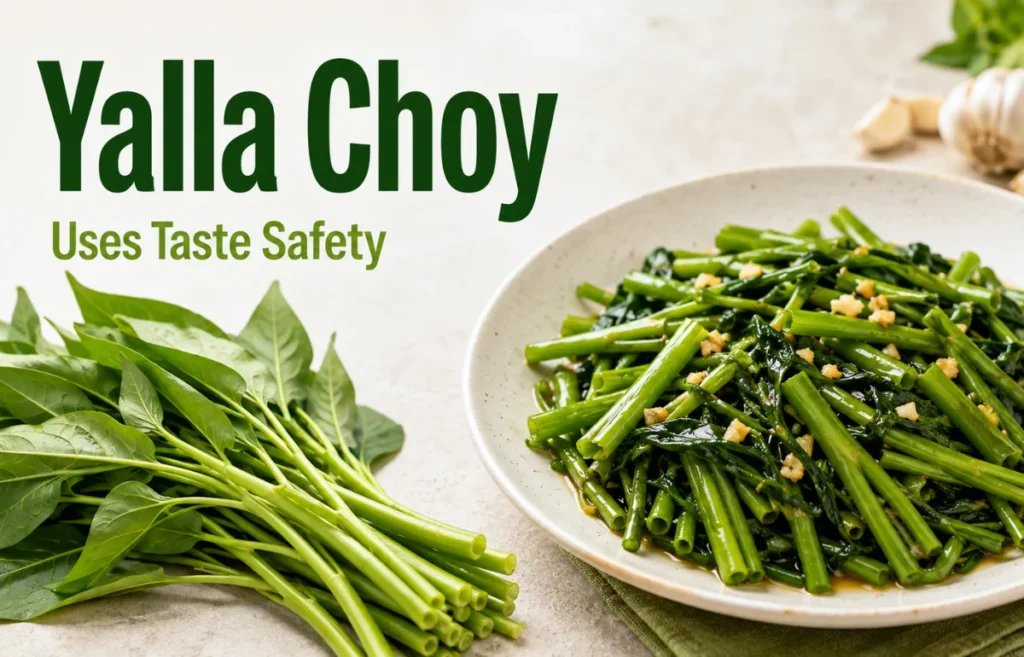
When I first examine the phrase Yalla Choy, the most important point is that it does not have the kind of universally established definition we would expect from a conventional dictionary word. That uncertainty is actually what makes the expression interesting. People searching for Yalla Choy may encounter explanations describing it as slang, a playful expression, a food-related phrase, or a combination of words from different linguistic traditions. Based on the available evidence, I believe the safest interpretation is that Yalla Choy is an informal and context-dependent expression rather than a standardized term with one universally accepted definition.
The first part, “yalla,” is much easier to establish. Academic research on Arabic shows that yalla functions as an interjection or discourse marker and can express meanings such as “come on,” “let’s go,” “hurry,” encouragement, or a transition in conversation. A 2023 study by Murad Al Kayed, Mohammad Al-Ajalein, Sami Khalaf Al Khawaldah, and Majd Alkayid specifically examined its functions in Jordanian Spoken Arabic.
The second part, “choy,” is considerably less certain in this particular expression. Similar spellings occur in Asian food terminology, particularly in English representations of Cantonese vegetable names. Yet I have found no strong scholarly evidence establishing that “choy” has one fixed meaning inside the complete phrase Yalla Choy. Some online explanations connect it with vegetables, while others treat it as a playful addition to yalla. Because these explanations conflict, I would not present one speculative origin as proven fact.
In this article, I will therefore separate what we can establish from what remains uncertain. We will look at the meaning of yalla, the possible interpretations of choy, why the full expression attracts attention, how it may be used in informal communication, what cultural considerations matter, and how readers can avoid treating an emerging phrase as though it were an established dictionary expression.
Key Takeaways About Yalla Choy
Yalla Choy is best understood cautiously. I would not describe it as a formally standardized word because the available evidence does not establish a single authoritative definition for the complete expression.
The strongest linguistic evidence concerns yalla. Academic research describes it as a multifunctional expression in Arabic, capable of signaling urgency, encouragement, conversational transitions, and other pragmatic meanings.
The word choy is more complicated. Similar forms appear in Cantonese food vocabulary, including terms for vegetables and dishes. For example, Cantonese dictionaries record coi in words such as choy sum, referring to Chinese flowering cabbage.
The full phrase should therefore not automatically be translated word-for-word as though it were an established Arabic expression.
From my perspective, the most responsible explanation is that Yalla Choy appears to be an informal, modern phrase whose intended meaning can depend on the community, platform, speaker, and surrounding conversation.
That distinction matters. A phrase can circulate online without having a stable dictionary definition, and language can change long before dictionaries or academic publications document every emerging expression.
What Does Yalla Choy Mean?
The simplest answer is that Yalla Choy can function as a playful expression of movement, encouragement, excitement, or collective action, but its exact meaning is not firmly standardized.
If someone uses the phrase casually in a social-media caption or group conversation, the intended sense may be close to “come on,” “let’s go,” or “let’s get moving.” That interpretation is strongly influenced by the established meaning of yalla.
However, I would be careful about saying that “Yalla Choy” officially means one particular English sentence. The evidence available for the complete phrase is much weaker than the evidence available for yalla itself.
This is an important distinction between documented linguistic meaning and contextual interpretation.
For example, imagine a hypothetical group chat in which several friends are preparing to leave for dinner. One person writes, “Yalla Choy!” The phrase could reasonably be interpreted as an energetic “Come on, let’s go!” The second word may add humor or rhythm rather than contribute a precise dictionary meaning.
In another hypothetical situation, a social-media creator might use Yalla Choy as a catchy caption before starting an activity. In that setting, the expression may communicate enthusiasm more than literal urgency.
The surrounding language is therefore essential.
The Established Meaning of “Yalla”
The word yalla has a much stronger linguistic foundation than the complete phrase Yalla Choy. Research on spoken Arabic identifies yalla as a multifunctional expression rather than a word that always translates identically.
A 2025 study published by De Gruyter Brill explains that yalla originated from a theophoric expression and is now used in several Arabic dialects as an exclamation and, more frequently, as an exhortative expression conveying meanings such as “let’s go” and “come on.”
That research is particularly useful because it demonstrates why a simple dictionary translation can be insufficient.
The meaning of yalla can change with tone and situation. A friendly “yalla” may encourage somebody. A sharply spoken “yalla” can express impatience. Another use can help signal that a conversation or activity is coming to an end.
A 2023 study by Al Kayed and his co-authors reached a similar conclusion, finding several discourse functions for yalla in Jordanian Arabic, including initiating or ending conversational activity and managing turns in interaction.
This gives us a useful foundation for understanding Yalla Choy: the first component already carries a strong sense of social action.
Why “Choy” Is More Difficult to Define
The second component creates the real uncertainty.
The spelling “choy” appears in English-language representations of several Asian food terms. For instance, choy sum is commonly associated with a Chinese flowering cabbage, and Cantonese lexical resources identify the underlying Cantonese term as coi sam.
That does not prove, however, that the “choy” in Yalla Choy comes directly from Cantonese.
I think this is where many explanations of the phrase become too confident. Because “choy” appears in familiar vegetable names, it is tempting to assume that Yalla Choy literally combines Arabic “let’s go” with an Asian word for vegetables. But similarity in spelling is not sufficient evidence of etymology.
A responsible linguistic explanation needs evidence showing how speakers actually formed and used the expression.
At present, the available evidence does not establish such a definitive chain of development.
Is Yalla Choy an Official Dictionary Term?
I would not treat it as one.
The phrase appears in online articles and informal discussions, but that is different from having a recognized entry in a major general dictionary or a well-documented linguistic corpus.
That distinction does not mean the phrase is meaningless. It simply means that we should describe its status accurately.
Language is constantly changing. Linguist Larry Trask made this point particularly clearly in his discussion of linguistic change.
“Every language is always changing.”
— Larry Trask, Why Do Languages Change?, Cambridge University Press
I find that observation especially relevant here because emerging expressions often exist in an intermediate stage. People may use them before researchers have determined their origin, before dictionaries record them, and before speakers agree on a fixed meaning.
Why Yalla Choy Is Difficult to Research
Searching for an unfamiliar expression can create a misleading impression of certainty. If several websites repeat the same explanation, the explanation can appear authoritative even when those websites are simply repeating one another.
That is particularly important with Yalla Choy.
I found multiple online explanations that describe the expression as a blend involving yalla and choy, but those explanations do not consistently agree about what choy means. Some associate it with vegetables, some with tea, and others describe it mainly as a playful or rhythmic addition.
From my perspective, that disagreement is itself useful evidence. It tells us that the phrase does not currently have a sufficiently stable interpretation to justify one definitive origin story.
We should therefore distinguish between three levels of confidence.
| Element | What the evidence supports | Confidence |
|---|---|---|
| “Yalla” | Arabic interjection associated with “come on,” “let’s go,” urging, and related pragmatic functions | High |
| “Choy” | Appears in several Asian food-related terms and may have been adopted or interpreted playfully in this phrase | Moderate for the general linguistic association, low for the exact Yalla Choy origin |
| “Yalla Choy” as a complete phrase | Informal online expression with an energetic or encouraging interpretation in some uses | Moderate for observed online interpretation, low for a single fixed definition |
| Exact origin of the complete phrase | No sufficiently strong evidence establishes one creator, date, location, or documented linguistic pathway | Low |
The table shows why I would avoid a simplistic answer. We can be confident about yalla, reasonably confident that choy has associations elsewhere, but much less confident about the precise history of the complete expression.
The most important takeaway is that Yalla Choy should be explained as an emerging informal phrase rather than as a formally established lexical item.
How Language Mixing Helps Explain Expressions Like Yalla Choy
Languages rarely develop in complete isolation.
People travel, migrate, trade, study, work, form families, use social media, and participate in multilingual communities. These interactions create opportunities for words to move from one linguistic environment into another.
Professor Kate Burridge, discussing borrowed vocabulary for the Australian Broadcasting Corporation, described English as “a polyglot language; one that borrows words from other languages.”
That observation helps explain why unusual combinations can become understandable even when their components originate in different linguistic traditions.
A multilingual speaker does not necessarily treat language as a collection of sealed compartments. Instead, speakers choose whatever expression communicates the intended social meaning.
Imagine a hypothetical conversation between friends who routinely move between Arabic, English, Urdu, Hindi, Punjabi, Cantonese, or other languages. A playful combination may emerge simply because the sounds are memorable and the participants understand the intended tone.
That does not automatically create a new official word.
It creates something more organic: a social expression.
Code-Switching and Informal Speech
Code-switching occurs when speakers use more than one language or linguistic variety during communication. It can happen between sentences, within sentences, or through individual words and expressions.
A phrase such as Yalla Choy can be interesting precisely because it appears to occupy this informal space.
The first component immediately signals an Arabic linguistic connection. The second may evoke another language, food vocabulary, or simply playful internet language depending on the speaker.
I believe this ambiguity is part of what makes unusual phrases attractive online. A short expression can feel culturally rich without requiring the speaker to explain every component.
At the same time, we should avoid assuming that every hybrid-looking phrase is a genuine historical fusion of two languages. Sometimes people create expressions simply because they sound entertaining.
How Yalla Choy Can Function in Casual Communication
If I were explaining the practical use of Yalla Choy to a reader, I would emphasize tone before translation.
The expression may work best when the speaker intends friendliness, momentum, humor, or excitement.
Consider these hypothetical scenarios.
Scenario one: friends leaving.
One friend is ready while everyone else is still talking. They might jokingly write, “Yalla Choy, we’re leaving!” The phrase functions as an energetic push toward action.
Scenario two: starting a project.
A group has spent twenty minutes discussing an idea but has not begun. Someone could use the expression playfully to signal, “Let’s finally start.”
Scenario three: social-media caption.
A creator preparing to begin a trip, meal, game, workout, or event might use an energetic phrase as a caption. Here the expression could communicate enthusiasm rather than literal urgency.
Scenario four: teasing between friends.
A person taking too long to choose a restaurant might receive a playful “Yalla Choy!” The meaning is closer to “Come on, decide already!” than to a formal command.
These examples are hypothetical. I am not presenting them as documented cases of actual Yalla Choy usage. Their purpose is to show how an informal expression can derive meaning from context.
Yalla Choy Compared With Similar Expressions
Understanding the phrase becomes easier if we compare its possible communicative function with established expressions.
| Expression | Typical function | Formality | Tone |
| Yalla | Encouragement, movement, urgency, transition | Informal | Energetic |
| Come on | Encouragement, impatience, disbelief, invitation | Informal | Context-dependent |
| Let’s go | Starting or moving toward an activity | Informal to neutral | Motivational |
| Hurry up | Requesting faster action | Informal to neutral | More direct |
| Yalla Choy | Emerging playful expression; meaning depends on context | Very informal | Energetic or humorous |
The comparison makes one point particularly clear: Yalla Choy should not automatically be treated as a direct synonym for every possible use of “let’s go.”
The established word yalla can already perform several conversational functions. The addition of “choy” appears to create a more distinctive, playful expression, but the exact semantic contribution of the second component remains uncertain.
How to Decide Whether Yalla Choy Fits a Conversation
I would use a simple contextual test.
First, ask whether the conversation is informal.
Second, ask whether the people involved understand playful or multilingual expressions.
Third, consider whether the intended message involves movement, encouragement, excitement, or starting something.
Fourth, consider whether misunderstanding would matter.
If the answer to the final question is yes, I would choose a clearer expression.
For example, in a workplace email about a deadline, “Please complete the report by Friday” is much clearer than an unfamiliar slang phrase.
In a casual group chat among friends, ambiguity may be harmless because the participants can ask what the expression means or infer the intended tone.
This difference is important because language is not only about dictionary meaning. It is also about audience expectations.
Common Misconceptions About Yalla Choy
Misconception 1: Yalla Choy Has One Official Translation
I do not believe the evidence supports that claim.
The expression has several interpretations online, and the second component is especially uncertain. Treating “Yalla Choy” as having one official translation creates more certainty than the evidence allows.
A better approach is to describe its likely conversational function and acknowledge the ambiguity.
Misconception 2: Choy Definitely Means One Specific Thing Here
This is another conclusion I would avoid.
The spelling “choy” has documented associations with Asian vegetable terminology, but that does not establish its origin in this particular expression.
A word can resemble another word without having the same etymological history.
Misconception 3: Every Website Explaining Yalla Choy Is an Authority
Search visibility is not the same thing as linguistic authority.
Several websites currently explain Yalla Choy, but many provide informal interpretations rather than references to linguistic research.
For that reason, I prefer academic research when discussing the established meaning of yalla and treat claims about the complete phrase more cautiously.
Misconception 4: New Slang Must Immediately Have a Dictionary Entry
It does not.
Words and expressions can circulate for years before lexicographers document them. Even after dictionary recognition, meanings may continue to change.
Research and teaching materials on language change consistently emphasize that vocabulary, pronunciation, grammar, and meanings evolve over time.
The Cultural Importance of Context
A phrase involving multiple linguistic influences should be handled with some cultural awareness.
From my perspective, the best approach is neither to dismiss Yalla Choy as meaningless nor to exaggerate it into a fully established cultural tradition.
Both extremes create problems.
Calling it meaningless ignores the fact that speakers can use unconventional expressions successfully. Declaring it an ancient or formally recognized cultural phrase without evidence creates a different kind of misinformation.
The middle position is stronger: we can recognize the phrase as an emerging informal expression while distinguishing documented linguistic facts from speculation.
This is particularly important when a phrase contains words associated with identifiable cultures.
Using a word from another language casually is not automatically disrespectful. But pretending to explain a cultural expression without understanding its context can lead to inaccurate representations.
I believe curiosity should therefore be paired with humility.
A Practical Guide to Using Yalla Choy
If someone wants to use Yalla Choy casually, I would recommend keeping the situation informal.
| Situation | Recommended approach | Why |
| Friends planning an outing | Potentially suitable as playful slang | The social context supports informality |
| Casual group chat | Potentially suitable | Participants can interpret or clarify the meaning |
| Social-media caption | Potentially suitable | Informal and expressive language is common |
| Professional email | Avoid | The meaning may be unclear to recipients |
| Academic writing | Avoid | The phrase lacks standardized scholarly definition |
| Formal announcement | Avoid | Clear conventional language is preferable |
| Cross-cultural discussion | Use with explanation | Context helps prevent misunderstanding |
| Language research | Define the usage carefully | The phrase’s exact origin remains uncertain |
The table suggests a simple rule: the less formal the setting, the more room there is for experimental language.
In formal communication, clarity should normally outweigh novelty.
Why Yalla Choy May Feel Catchy
There is another reason the expression attracts attention: sound.
Short phrases with rhythm are easier to remember than long explanations. “Yalla Choy” contains two compact words with contrasting linguistic associations, making the phrase distinctive.
The first word already carries strong conversational energy. Adding a short second element creates a rhythmic ending.
That does not prove why the phrase originated, but it can help explain why a phrase like this may be memorable.
Social media intensifies that effect. Captions, comments, memes, short videos, and group chats reward language that is brief and recognizable.
A phrase does not necessarily need a precise dictionary meaning to become useful within a particular community. Speakers may understand it through repeated exposure.
What Research on Yalla Tells Us About Meaning
The strongest academic evidence concerns yalla itself.
The 2023 study by Al Kayed, Al-Ajalein, Al Khawaldah, and Alkayid examined 104 scenarios involving yalla in Jordanian Spoken Arabic and concluded that the expression performs multiple discourse functions.
This is significant because it challenges the idea that translation is always a one-to-one process.
If yalla can signal encouragement in one situation, impatience in another, and conversational transition elsewhere, then translating it mechanically as “let’s go” can miss part of the meaning.
The same principle applies to emerging slang.
Meaning is often created by interaction between words, tone, context, speaker, listener, and situation.
That is why I would not analyze Yalla Choy solely by opening a dictionary and translating each component separately.
Yalla Choy and the Evolution of Internet Language
Internet communication has accelerated the creation and circulation of informal expressions.
A phrase can appear in one community, be copied by another, become a meme, change spelling, and acquire a new meaning within a relatively short period.
This does not mean the internet creates language from nothing.
Rather, digital communication provides an unusually efficient environment for linguistic experimentation.
People already use abbreviations, borrowed words, altered spellings, emojis, memes, and multilingual combinations. Yalla Choy fits naturally into that broader environment if speakers adopt it as an expressive phrase.
Research on language change provides a useful theoretical framework here. Larry Trask emphasized that new words, pronunciations, grammatical forms, and meanings continuously emerge and disappear.
That means uncertainty around a phrase like Yalla Choy is not necessarily evidence of linguistic failure.
It may simply indicate that the expression is still developing, remains niche, or has never developed beyond informal online use.
How to Explain Yalla Choy to Someone Who Has Never Heard It
If I needed to explain it in one sentence, I would say:
“Yalla Choy is an informal, playful expression that can suggest ‘come on,’ ‘let’s go,’ or energetic encouragement, but its exact meaning and origin are not standardized.”
That explanation is deliberately cautious.
That is a much better answer than inventing a precise birthplace, creator, date, or cultural tradition.
Why Accurate Uncertainty Matters
I think one of the most valuable lessons from Yalla Choy is that not knowing something completely is not a weakness.
Online language produces countless claims that sound authoritative because they are repeated confidently. A careful writer should resist that pressure.
That approach is particularly important for language and culture because false etymologies can spread quickly. Once an invented origin story becomes popular, later writers may repeat it without checking the original evidence.
Yalla Choy provides a useful example of why source quality matters.
The existence of the phrase online is one question.
Those questions should not automatically receive the same answer.
Expert Recommendations for Understanding Emerging Expressions
My first recommendation is to separate the known component from the uncertain combination.
With Yalla Choy, we have substantial evidence for yalla. We have evidence that “choy” appears in Asian food vocabulary. But we have less evidence about how the two became connected in this exact phrase.
My second recommendation is to examine usage rather than relying entirely on literal translation.
If speakers consistently use an expression to encourage action, that communicative function may matter more than the literal meaning of every syllable.
My third recommendation is to consider the audience.
A phrase that works perfectly among friends may be inappropriate in a formal document.
My fourth recommendation is to avoid presenting online speculation as established history.
Finally, I recommend treating emerging language as something worth observing rather than immediately classifying.
Language does not always arrive with an official announcement. Sometimes people simply start saying something, others understand it, and only later does scholarship determine what happened.
What We Can Reasonably Conclude About Yalla Choy
At this point, I think the evidence allows us to make several careful conclusions.
First, Yalla Choy is best treated as an informal expression rather than a standardized dictionary term.
Second, the Arabic word yalla is well documented and carries meanings involving encouragement, movement, urgency, and conversational management.
Third, “choy” has recognizable associations in Asian food vocabulary, but its exact role in Yalla Choy has not been conclusively established.
Fourth, the phrase can be interpreted as energetic, playful, or encouraging when used informally.
Fifth, context is essential.
Sixth, there is no strong evidence in the sources I reviewed that justifies assigning one specific creator, date, location, or universally accepted translation to the complete expression.
That last point may seem less exciting than a dramatic origin story, but I believe it is more useful.
Conclusion
I believe the most practical way to understand Yalla Choy is to treat it as an emerging informal expression rather than a phrase with a single officially established definition. The word yalla provides the strongest linguistic foundation, carrying well-documented meanings related to “come on,” “let’s go,” encouragement, urgency, and conversational transitions.
The second element, “choy,” is more uncertain. Its spelling resembles terminology found in Asian food vocabulary, but I would not present that resemblance as proof of the phrase’s exact origin. The available evidence simply does not justify that level of certainty.
From my perspective, the best next step for anyone encountering Yalla Choy is to look at the surrounding conversation. If friends use it playfully while preparing to leave or begin something, an energetic “come on” interpretation may make sense. In formal communication, however, I would choose clearer language.
Ultimately, Yalla Choy demonstrates something broader about language: expressions can emerge before dictionaries define them, cross linguistic boundaries, and acquire meaning through repeated social use. We can appreciate that creativity while still being honest about what the evidence proves and what remains uncertain.
Frequently Asked Questions
What does Yalla Choy mean?
Yalla Choy is generally interpreted online as an informal, playful expression associated with encouragement, movement, excitement, or “come on, let’s go.” However, I would not describe that as an official dictionary definition because the complete phrase does not have the same level of established documentation as the Arabic word yalla. Context matters considerably. In a casual conversation, the phrase may function as a humorous call to action, while another community could use it differently. The safest explanation is therefore that Yalla Choy is an emerging expression whose precise meaning depends on usage.
Is Yalla Choy an Arabic phrase?
Not in the sense of being a standard, established Arabic phrase documented as one unit. The word yalla is strongly associated with colloquial Arabic and has been studied academically as a multifunctional expression meaning or signaling ideas such as “come on,” “hurry,” “let’s go,” encouragement, and conversational transitions. The status of “choy” within the complete expression is much less certain. I therefore would not describe Yalla Choy as a traditional Arabic phrase without stronger evidence.
What does “yalla” mean by itself?
“Yalla” is a common colloquial Arabic expression that can mean “come on,” “let’s go,” or “hurry up,” depending on context and tone. Academic research shows that its function extends beyond a simple literal translation. It can help initiate or end conversational activity, encourage action, express urgency, and perform other pragmatic functions. The word’s flexibility explains why it can appear in many different informal situations.
Does “choy” mean vegetable?
“Choy” appears in English spellings of several Asian food terms, particularly those associated with Chinese or Cantonese vegetables. For example, choy sum refers to Chinese flowering cabbage, and Cantonese lexical resources record the underlying term as coi sam. However, that does not prove that “choy” in Yalla Choy literally means vegetable. The exact origin and function of the second element in this particular phrase remain uncertain.
Is Yalla Choy a real word?
Yalla Choy can certainly function as a real expression when people use it to communicate with one another, but I would not classify it as a standardized dictionary word. There is a difference between an expression being used socially and being formally documented in dictionaries or linguistic research. Language frequently develops new slang and informal expressions before scholars or lexicographers record them. That appears to be the more appropriate framework for understanding Yalla Choy at present.
Where did Yalla Choy originate?
The precise origin of Yalla Choy is not established by the reliable sources I reviewed. The Arabic component yalla has a documented linguistic history, including its development from a theophoric expression and its later use across Arabic dialects. The complete phrase, however, does not have an equally well-documented origin. I would therefore avoid claims naming a particular person, city, website, or date as the definitive creator unless stronger primary evidence becomes available.
Can I use Yalla Choy in everyday conversation?
You can use Yalla Choy in an informal setting if the people around you understand or enjoy the expression. I would particularly reserve it for casual conversations, friendly group chats, jokes, captions, or playful situations. If the audience is unfamiliar with the phrase, the meaning may not be immediately clear. In professional, academic, legal, or formal communication, I would choose a conventional expression such as “let’s go,” “please proceed,” or “let’s get started” instead.
Why is Yalla Choy becoming searchable online?
Unusual phrases can attract online searches because people encounter them without knowing what they mean. Once several websites publish explanations, additional readers may search the same phrase to compare interpretations. That can create the appearance that a term has a highly established history even when its documentation is limited. In the case of Yalla Choy, I think the uncertainty surrounding the phrase is itself one reason people want an explanation. Different online descriptions currently provide different interpretations.
Is Yalla Choy related to tea?
Some informal explanations connect the phrase with tea or other food-related meanings, but I would not present that interpretation as established fact. The word choy can resemble terms associated with Asian food vocabulary, while yalla is clearly associated with colloquial Arabic. Without reliable evidence documenting the formation of the complete expression, it is safer to describe the tea interpretation as one possible online association rather than a proven etymology.
What is the safest definition of Yalla Choy?
The safest definition is: an informal, playful expression that may convey encouragement, movement, excitement, or “come on, let’s go,” with an uncertain and context-dependent second component. I prefer this wording because it distinguishes what is reasonably supported by evidence from claims that remain speculative. As more authentic examples of the phrase are documented, its meaning may become clearer. Until then, context should guide interpretation.
Sources and References
Al Kayed, M., Al-Ajalein, M., Al Khawaldah, S. K., & Alkayid, M. (2023). The Textual Functions of Discourse Marker yalla in Jordanian Arabic. World Journal of English Language, 13(2), 33–41.
Burridge, K. Australian Broadcasting Corporation. Can We Help?: Borrowed words: the processes of language change.
Trask, L. (2009). Why Do Languages Change? Cambridge University Press.
Bybee, J. Language Change. Cambridge University Press.
The National. “Yallah: Arabic word for ‘let’s go’ is a call to action and an encouragement.” 2025.
Disclaimer
This article distinguishes documented linguistic information from interpretations found in informal online discussions. The meaning of Yalla Choy may vary between communities and contexts, and its exact origin has not been established by the reliable sources reviewed for this article. Readers should not treat the phrase’s speculative etymologies as confirmed historical facts. Where the article discusses hypothetical conversations or examples, those examples are illustrative rather than verified reports of actual usage.