When I think about the challenges of international travel, I often think beyond airports, hotels, maps, and transportation. One of the most immediate challenges can appear when we sit down at a restaurant and receive a menu filled with unfamiliar words, ingredients, cooking styles, and dish names. At that moment, understanding what we are ordering can become surprisingly difficult.
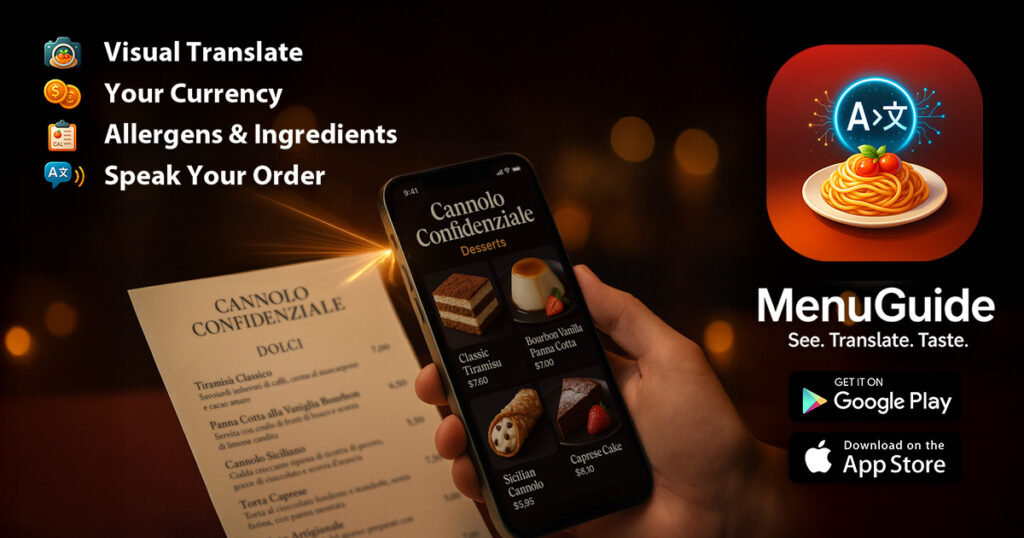
I believe this is where Menu Mate presents an interesting use of artificial intelligence. Rather than treating translation as a general language problem, the app is designed around a very specific situation: understanding food menus while dining in another language. The current iOS version allows users to photograph a menu or select an existing image and receive translated information, dish descriptions, dietary and allergen-related information, pronunciation assistance, and useful dining phrases.
For me, the most interesting aspect is that Menu Mate attempts to go beyond simply replacing one word with another. A restaurant menu is not always a straightforward vocabulary exercise. A dish name may refer to a regional tradition, a cooking method, an ingredient, or a cultural reference that does not translate neatly into another language.
We can therefore look at Menu Mate as a practical dining assistant rather than merely a translation tool. It is intended to help travelers understand what they are seeing, make more informed choices, and communicate more comfortably at the table.
At the same time, I think it is important to maintain realistic expectations. AI-generated information can be useful, but it should not automatically be treated as a guarantee about a restaurant’s exact recipe or preparation. The developer’s own product information emphasizes that ingredient and preparation details can vary, particularly when allergies are involved.
Key Takeaways About Menu Mate
The first point I would emphasize is that Menu Mate is built around a simple interaction: capture a menu and use AI-assisted technology to make that menu easier to understand. The App Store describes the app as a dining companion for foreign countries and lists features including menu translation, dish information, allergen and dietary-risk detection, pronunciation help, dining phrases, translation history, and iCloud synchronization for supported history features.
The second point is that the app focuses on the context surrounding food. A traveler may not only want to know that a particular word means “dumpling” or “noodles.” They may also want to know what type of dish it is, what ingredients are commonly associated with it, how it is prepared, and whether it may conflict with a dietary preference.
Third, I see the communication features as especially useful. Translation can help us read a menu, but ordering involves another step. We may need to ask whether something contains a particular ingredient, request a modification, or simply pronounce a dish name correctly. Menu Mate includes common dining phrases and pronunciation assistance to address this part of the experience.
Finally, I would not treat Menu Mate as a replacement for human confirmation in situations involving serious food allergies. The app itself makes this limitation clear in its product information. AI can identify potential concerns, but restaurant staff remain the appropriate source for confirming what is actually present in a specific dish.
What Is Menu Mate and What Problem Does It Solve?
Menu Mate is an iOS application designed to help people understand restaurant menus written in unfamiliar languages. According to its current product information, users can take a photograph of a printed or handwritten menu or select an image from their gallery. The app then uses AI vision technology to interpret the menu and provide translations and additional information.
I think the distinction between ordinary translation and menu translation matters. A restaurant menu contains a combination of language and context. Even when a translation is technically correct, it may not tell us enough about what will actually arrive at the table.
For example, imagine that I am visiting a country where I cannot read the local script. I photograph a menu and receive a literal translation of a dish name. That solves only the first problem. I may still wonder whether the dish contains meat, whether it is fried or steamed, whether it is spicy, whether it traditionally contains nuts, or whether the name describes an ingredient rather than the finished dish.
Menu Mate attempts to bring these questions into the same experience.
I believe this approach reflects a broader change in how AI applications are being designed. Instead of asking users to interact with a general-purpose technology and figure everything out themselves, specialized applications can organize AI around a particular real-world task.
A traveler does not necessarily want “AI.” The traveler wants to know what is on the menu.
That difference is important because good technology often becomes more useful when its complexity stays in the background.
Why Translating a Restaurant Menu Is Different From Translating Ordinary Text
We can understand Menu Mate better by considering why menus can be unusually difficult to translate.
A normal sentence usually has grammatical context. A menu item may consist of only a few words. Those words might describe an ingredient, a preparation technique, a regional specialty, a traditional name, or even an expression whose literal meaning has little to do with the food itself.
A dish can also have multiple interpretations depending on the restaurant.
Consider a hypothetical example. A traveler sees a dish described by a regional name. A basic translation might reproduce the name in English but provide almost no useful information. A more helpful explanation could identify the dish’s general style, likely ingredients, cooking technique, and relevant cultural context.
That is the kind of distinction that makes a food-focused translation assistant potentially valuable.
The developer describes Menu Mate as providing dish descriptions, ingredient information, cultural context, allergen alerts, pronunciation guidance, and useful restaurant phrases.
I believe the practical advantage is not simply that the application can translate more words. Its value comes from organizing several related pieces of information around the decision we are actually trying to make: “Do I understand this dish well enough to order it?”
Food also carries cultural meaning, which makes the subject broader than language alone. Research on food tourism has described food as a means through which travelers can engage with local culture and traditions.
That is why I see menu translation as part of the travel experience rather than merely a technical convenience.
How Menu Mate’s Main Features Work Together
Photographing a Foreign Menu
The most straightforward feature is menu scanning. Instead of typing every unfamiliar dish into a translation service, the user can photograph the menu or select a menu image from the device.
This is particularly practical in a restaurant because menus can contain dozens of dishes. Manually typing each one would interrupt the dining experience.
A hypothetical scenario illustrates the advantage. Imagine arriving at a restaurant where the entire menu is written in a script you cannot read. You could photograph the page and use Menu Mate to begin understanding the available dishes. Instead of translating one item at a time, you can approach the menu as a complete visual document.
The App Store description states that the app supports printed and handwritten menus across multiple languages.
Dish Descriptions and Context
Translation is more useful when it explains what the translated words mean in culinary terms.
According to the developer’s product information, Menu Mate provides detailed dish descriptions, ingredient information, cooking-style information, and cultural context.
I consider this one of the application’s more important ideas because dish names often do not communicate enough information by themselves.
Suppose a traveler sees the name of a traditional regional dish. A translation that simply converts the name into another language might still leave the traveler uncertain. A description can instead help establish expectations about texture, ingredients, preparation, or flavor.
We should still distinguish between a description of what a dish commonly represents and a guarantee about what a particular restaurant serves. Recipes can differ from one kitchen to another.
Potential Allergen and Dietary Information
Food-related translation becomes more significant when dietary restrictions are involved.
Menu Mate lists automatic identification of common allergens and dietary concerns among its features. The app also allows users to set preferences such as vegetarian requirements and certain ingredient-related concerns.
I think this can be useful as an initial screening tool. If a traveler is trying to avoid a particular ingredient, an alert may help them identify dishes that deserve further attention.
However, I would never interpret an automated alert as absolute confirmation.
Let us consider a hypothetical example. A traveler has a serious peanut allergy and uses the app to identify dishes that may contain peanuts. The application can help flag possibilities, but the traveler should still communicate directly with restaurant staff about ingredients and preparation. Cross-contact and recipe variations may not be visible to an AI system.
The developer specifically advises users with serious allergies to confirm ingredients and preparation directly with restaurant staff.
That limitation does not make the feature useless. Instead, I believe it tells us how to use the technology responsibly: use AI to narrow the choices and prepare questions, then use human confirmation for safety-critical decisions.
Pronunciation Assistance
Knowing what a dish means is one challenge. Saying its name is another.
Menu Mate includes phonetic pronunciation assistance and audio pronunciation for unfamiliar dish names.
This can reduce a small but real source of anxiety for travelers.
Imagine that I understand exactly what I want to order but cannot pronounce the name. A pronunciation guide gives me another way to communicate the order without pointing at the menu every time.
The benefit is not only convenience. I believe attempting a local pronunciation can also make restaurant communication feel more natural and respectful.
Useful Dining Phrases
Menu Mate also includes common phrases intended for restaurant communication, including requests related to dietary preferences and other dining situations.
This matters because a menu is only one part of the interaction.
A traveler may need to ask:
- Does this contain a particular ingredient?
- Can this be prepared without a specific ingredient?
- Is this dish spicy?
- Could I have the bill?
- Is this vegetarian?
- What do you recommend?
A translation assistant that addresses both the menu and the conversation can therefore be more useful than one that only translates printed words.
Menu Mate Features Compared With the Traveler’s Actual Needs
The following comparison helps me separate the app’s individual functions from the practical problems they are intended to address.
| Menu Mate feature | Traveler’s problem | Practical benefit | Important limitation |
|---|---|---|---|
| Menu photo translation | Cannot read the menu | Makes unfamiliar menu text easier to understand | Image quality and language complexity can affect results |
| Dish descriptions | Translation alone is unclear | Provides additional culinary context | Descriptions may represent typical rather than restaurant-specific preparation |
| Ingredient information | Uncertainty about what a dish contains | Helps narrow down choices | Exact recipes can vary |
| Allergen and dietary alerts | Difficulty identifying potential concerns | Flags dishes for closer review | Not a substitute for direct confirmation in serious allergy situations |
| Pronunciation assistance | Cannot say unfamiliar dish names | Makes ordering easier | Pronunciation guidance does not replace conversation |
| Dining phrases | Cannot communicate specific requests | Helps formulate questions and requests | Restaurant staff should confirm critical information |
| Translation history | Wants to revisit previous translations | Makes previously viewed information easier to access | Storage and synchronization depend on the app’s supported features |
The most important takeaway is that the features work best as a connected system. Translation helps us read, descriptions help us understand, dietary indicators help us screen, and communication tools help us ask questions.
A Practical Step-by-Step Way to Use Menu Mate While Traveling
Step 1: Photograph the Menu Clearly
I would begin by taking a clear photograph of the menu. Good framing matters because the application needs readable information to interpret the text.
If the menu is large, I would rather capture several clear sections than take one distant photograph containing tiny text.
Step 2: Review the Translation
After processing the menu, I would review the translated items instead of immediately selecting the first result.
The purpose is to understand the overall menu. I can compare dishes, identify unfamiliar terms, and decide which items deserve closer attention.
Step 3: Read the Dish Description
Once I find an interesting dish, I would examine its description and available ingredient information.
This is particularly useful when a dish name is culturally specific and does not provide enough information on its own.
Step 4: Check Dietary Indicators
If I have a dietary restriction, I would review the available indicators before ordering.
I would treat these indicators as screening information rather than a final guarantee.
Step 5: Use a Dining Phrase When Necessary
If something remains unclear, I would use the application’s communication features to formulate a question for restaurant staff.
This step is important because translation technology should support communication rather than eliminate it.
Step 6: Confirm Important Details With Staff
For ordinary preferences, the translated information may be enough to make a decision. For serious allergies or strict dietary requirements, however, I would confirm the ingredients and preparation directly with the restaurant.
Step 7: Save Useful Information for Later
The app supports translation history and, according to its App Store listing, iCloud synchronization for supported history features.
That can be useful if I encounter a dish I want to remember later or return to the same type of menu during a trip.
Common Mistakes Travelers Should Avoid When Using Menu Mate
The first mistake is assuming that every AI translation is perfect. I believe this is one of the most important principles for using any AI-powered translation application.
Menus can contain unusual fonts, handwritten text, regional terminology, abbreviations, and culturally specific names. Even a technically strong system can encounter ambiguous information.
The second mistake is treating a translated dish description as the restaurant’s exact recipe. A description can help us understand what a dish generally means, but preparation differs between restaurants.
The third mistake is relying entirely on automated allergen detection. The technology can help identify potential concerns, but a serious allergy requires direct confirmation.
The fourth mistake is ignoring the original menu. I would use the translated information as a guide while keeping the original dish name visible when possible. This can help restaurant staff identify the exact item being discussed.
The fifth mistake is assuming that a dish with a familiar English translation will taste exactly as expected. Cultural food terminology does not always map perfectly onto familiar Western categories.
The sixth mistake is using the application without considering image quality. A blurry, poorly lit, partially covered, or distorted menu may be harder for any vision system to interpret accurately.
The seventh mistake is forgetting the human side of dining. Technology can reduce a language barrier, but it does not eliminate the value of a smile, a polite gesture, or a simple attempt to communicate in the local language.
Why Food Translation Can Improve the Travel Experience
I believe the strongest argument for a tool like Menu Mate is not convenience alone. It is the possibility of making travelers more curious.
When a menu looks incomprehensible, a traveler may choose the safest familiar option. That is understandable, but it can also limit the opportunity to experience local cuisine.
If technology makes unfamiliar dishes easier to understand, we may become more willing to explore them.
Food has long been connected with cultural exchange. Research into food tourism describes local food as a way for visitors to engage with culture, traditions, and communities.
A translation tool therefore has an interesting role. It can remove some of the uncertainty without necessarily removing the cultural difference.
One of the most useful outcomes, in my view, is that the traveler can ask better questions.
Instead of saying, “I don’t understand this menu,” the traveler can ask something more specific: “Does this dish usually contain peanuts?” or “Is this prepared with pork?”
That shift from confusion to informed curiosity is valuable.
The Human Element Still Matters in Digital Dining
Technology can make international dining easier, but I do not think it should make the experience completely automated.
A restaurant is a social environment. The person serving the food knows details that an application cannot necessarily know. The chef may have changed an ingredient. A local specialty may be prepared differently that day. A menu may not fully describe a garnish or sauce.
This is why I appreciate the emphasis on communication within Menu Mate rather than translation alone.
Google has similarly described mobile interpretation technology as a way to help remove language barriers and make communication more seamless.
That principle applies particularly well to dining. The best technology does not have to replace the conversation. It can help make the conversation possible.
A useful way to think about Menu Mate is therefore as a bridge.
The application helps us move from an unfamiliar menu to a basic understanding. Then we can move from understanding to conversation, and from conversation to a more confident decision.
What Menu Mate Can and Cannot Tell You
I find it useful to establish this distinction before relying on any AI-powered dining application.
| Situation | What Menu Mate can potentially help with | What the traveler should still do |
|---|---|---|
| Unfamiliar menu language | Translate menu text | Check the original item when ordering |
| Unknown dish | Explain likely ingredients and culinary context | Ask staff if the exact preparation matters |
| Dietary preference | Highlight potential dietary concerns | Confirm ingredients if the requirement is strict |
| Serious allergy | Flag possible allergen concerns and provide communication phrases | Speak directly with restaurant staff and confirm preparation |
| Difficult pronunciation | Provide pronunciation assistance | Repeat or show the dish name if necessary |
| Cultural food terminology | Give additional context | Remain aware that regional meanings can vary |
| Handwritten menu | Attempt to interpret the photographed text | Retake the image or ask staff if the result is unclear |
| Returning to a previous dish | Store translation history where supported | Keep personal notes if the information is especially important |
The central lesson from this comparison is simple: Menu Mate can improve access to information, but it cannot guarantee that every piece of information is complete or restaurant-specific.
What I Find Most Valuable About Menu Mate
From my perspective, the most valuable feature is the combination of translation and context.
Many translation tools can help us understand words. What I find more interesting here is the attempt to answer the next question: “What does this mean as food?”
That difference can have a significant practical effect.
Suppose a traveler encounters ten unfamiliar dishes. A basic translation service may translate the names, but the traveler may still need to search separately for ingredients, cooking styles, pronunciation, and dietary information.
Menu Mate attempts to bring several of these tasks into one dining-focused workflow. Its listed features include translation, dish descriptions, allergen detection, pronunciation, dining phrases, and translation history.
I also think the app’s limitations are worth treating as a strength in responsible product design. The developer explicitly explains that the application cannot know the exact recipe inside a particular kitchen and advises users with serious allergies to confirm details with restaurant staff.
That is a more realistic approach than suggesting that an AI system can see everything happening in a kitchen.
A Short History of the Dining Problem Menu Mate Addresses
The underlying problem is not new.
Travelers have always faced language barriers when ordering food. Historically, people relied on phrasebooks, gestures, printed translations, local guides, or assistance from other travelers.
Digital translation changed the process by making language assistance available on a phone.
AI-powered visual recognition takes another step by reducing the amount of manual input required. Instead of typing unfamiliar characters, users can photograph what they see.
This matters because the restaurant environment is time-sensitive. We may be sitting at a table with other people, a server waiting nearby, and a menu that contains many unfamiliar choices.
The less effort required to access useful information, the more practical the technology becomes.
I believe that is one reason specialized AI applications can be compelling. They do not necessarily need to solve the entire problem of language. They only need to solve a particular moment well.
Verified Perspective on Food, Language, and Travel
The relationship between food and communication is worth considering because Menu Mate operates at that intersection. A Washington Post travel article describes shared food as “truly a universal language” and connects food phrases with opportunities to connect with people while traveling.
“Sharing food is truly a universal language.”
— Malia Yoshioka, The Washington Post
I find this relevant because Menu Mate does not attempt to remove food’s cultural character. Instead, its purpose is to make the menu more understandable so that travelers can participate more confidently.
Another useful perspective comes from Google’s explanation of interpreter technology, which described the goal as helping “remove language barriers” and making communication more seamless.
“remove language barriers”
— Google, discussing Interpreter mode
The significance of this short statement is broader than the specific Google product. It captures the practical purpose behind many translation technologies: reducing the friction that prevents people from communicating.
A third perspective comes from research on culinary tourism, which describes food as having the potential to help travelers immerse themselves in local culture.
“Food is seen as a universal language”
— Research on food tourism and cultural exchange
I would interpret this carefully. Food is not literally a universal language in the same way that a formal spoken language is. Rather, food can create shared experiences across linguistic and cultural differences. That is precisely why tools that make food easier to understand can have value beyond simple translation.
Menu Mate for Different Types of Travelers
International Tourists
For international tourists, Menu Mate can be useful when visiting restaurants where the menu is unfamiliar.
I think it is especially helpful for independent travelers who may not have a guide available to explain every dish.
Food Explorers
Travelers who deliberately seek local cuisine may benefit from the additional context surrounding unfamiliar dishes.
Instead of choosing only recognizable foods, they can use translation and descriptions to investigate something new.
Travelers With Dietary Preferences
People following vegetarian, gluten-free, or other dietary preferences may find automated indicators useful as an initial screening mechanism.
However, strict requirements still deserve direct confirmation.
Business Travelers
Business travelers often have limited time. A tool that can quickly interpret a menu may reduce the amount of time needed to understand available choices.
Families Traveling Abroad
Families can face multiple dietary preferences at the same table. Having menu information available in a familiar language can make group decisions easier.
First-Time International Travelers
For someone who has never ordered food in another language, pronunciation guides and dining phrases may provide additional confidence.
Is Menu Mate More Than a Translation App?
I would describe Menu Mate as a specialized translation and dining-assistance application rather than a general translation tool.
Its focus is narrow, but that narrowness may actually be one of its advantages.
A general translation service has to support thousands of everyday situations. Menu Mate can concentrate on the specific information that matters when we eat: dishes, ingredients, dietary concerns, pronunciation, and restaurant communication.
That specialization is visible in the feature set described by its developer and App Store listing.
In my view, the app’s real proposition is not “translate everything.”
It is closer to “help me understand this menu well enough to make a confident dining decision.”
That is a much more concrete problem.
How I Would Evaluate Menu Mate Before Relying on It
I would consider five questions.
First, does it consistently recognize the types of menus I encounter?
Second, are the dish explanations useful rather than merely literal?
Third, does the dietary information help me identify questions I should ask?
Fourth, are the communication and pronunciation tools practical at the table?
Fifth, does the app clearly communicate its limitations?
The final question is especially important to me.
An AI product should not only tell us what it can do. It should help us understand where its information becomes uncertain.
For a dining application, that distinction is particularly important because food information can affect health, preferences, culture, and personal choices.
The Future of AI-Assisted Dining
I believe Menu Mate represents a broader direction in consumer technology: AI is increasingly being embedded into specific moments rather than presented only as a general-purpose chatbot.
In the future, dining assistants could potentially become more contextual. They might combine menu translation with location information, dietary preferences, restaurant communication, cultural explanations, pronunciation, and personalized recommendations.
However, greater intelligence should not mean greater confidence without evidence.
The most useful future systems will likely be those that clearly separate known information from estimated information.
For example, an ideal system might distinguish between:
- What the menu explicitly says
- What the dish typically contains
- What the AI infers from the image
- What the restaurant staff confirms
That separation would help users make better decisions.
I think this principle extends beyond food. Whenever AI interprets real-world information, transparency about uncertainty becomes as important as speed.
Conclusion
From my perspective, Menu Mate is interesting because it approaches a very ordinary travel problem with specialized AI: understanding what we are actually being offered when a restaurant menu is written in an unfamiliar language. Its combination of menu translation, dish explanations, dietary and allergen indicators, pronunciation assistance, dining phrases, and translation history makes it more focused than a basic text translator.
I believe its greatest practical value comes from reducing uncertainty without pretending to eliminate it. A traveler can use the app to understand unfamiliar dishes, identify questions worth asking, and communicate more comfortably. At the same time, serious dietary and allergy concerns still require direct confirmation from restaurant staff.
The practical next step is simple: if I were evaluating Menu Mate for travel, I would first learn how its scanning, translation, dish-information, and communication features fit together, then use those features as assistance rather than unquestionable authority. Used that way, Menu Mate can turn an intimidating foreign menu into a more approachable part of the travel experience.
Frequently Asked Questions
What is Menu Mate used for?
Menu Mate is an iOS dining application designed to help users understand foreign restaurant menus. It can translate photographed or selected menu images and provide additional information about dishes, including descriptions, ingredients, dietary concerns, pronunciation, and useful dining phrases.
I see its primary purpose as helping travelers move from simply seeing unfamiliar menu text to understanding what they may actually be ordering. The app is particularly relevant when language differences make conventional menu reading difficult.
Does Menu Mate translate restaurant menus from photos?
Yes. Menu Mate is designed to let users photograph a menu or select an existing menu image and use AI-assisted technology to interpret it. The App Store listing says the application can work with printed and handwritten menus across multiple languages.
In practical terms, this means users do not necessarily have to type every unfamiliar dish manually. A clear photograph can serve as the starting point for translation and additional dish information.
Can Menu Mate identify allergens?
Menu Mate includes a feature for detecting potential allergens and dietary concerns.
However, I would treat these results as an informational screening tool rather than a safety guarantee. A particular restaurant may use different ingredients or preparation methods. The developer specifically advises people with serious allergies to confirm ingredients and preparation directly with restaurant staff.
Is Menu Mate useful for international travelers?
Yes, international travelers are one of the clearest audiences for Menu Mate because the application is specifically positioned as a dining companion for foreign countries.
The combination of translation, dish information, pronunciation assistance, and restaurant phrases can address several common challenges at once. I think the application is particularly useful when travelers want to explore local food without relying entirely on familiar dishes.
Does Menu Mate explain what unfamiliar dishes contain?
Menu Mate provides dish descriptions and ingredient-related information intended to help users understand unfamiliar food.
The important qualification is that this information should not automatically be interpreted as the exact recipe used by a specific restaurant. Cooking methods and ingredients can vary between kitchens. For that reason, I would use the description to guide my questions and choices rather than treat it as an absolute guarantee.
Does Menu Mate help with pronunciation?
Yes. The application includes pronunciation guidance for unfamiliar dish names, including phonetic assistance and audio pronunciation according to its product information.
This can be helpful when a traveler understands what they want to order but is unsure how to say the name. In my view, this is a small feature with practical value because it can make direct communication feel less intimidating.
Can Menu Mate replace a human translator at a restaurant?
I would not consider it a complete replacement for human communication. Menu Mate can help interpret menu information and provide useful phrases, but restaurant staff remain important sources of information about exact ingredients and preparation.
This distinction becomes especially important for serious allergies or strict dietary requirements. AI can support the conversation, but it should not be treated as the final authority on what happens inside a particular kitchen.
Does Menu Mate keep translation history?
The current App Store information says Menu Mate provides translation history and supports iCloud synchronization for translation history on supported premium functionality.
This can be useful when a traveler wants to revisit a previously translated dish or remember something they encountered earlier. The exact availability of individual features can depend on the current app version and subscription level.
Sources and References
- Apple App Store listing for Menu Mate: current product description, supported features, platform information, and version details.
- CODEBIT product information for Menu Mate: menu translation, dish descriptions, allergen alerts, pronunciation, dining phrases, and translation history.
- Menu Mate product information concerning dietary limitations and the need for direct confirmation in serious allergy situations.
- Google documentation discussing mobile interpreter technology and reducing language barriers.
- Research examining food tourism, cultural exchange, and the role of local food in traveler experiences.
- The Washington Post travel discussion of food, language, and communication while traveling.
Disclaimer
This article is provided for general informational purposes. Menu Mate’s features, availability, pricing, supported languages, subscription options, and technical capabilities may change as the application is updated. AI-generated translations and food descriptions may contain errors or omissions. Dietary and allergen information should not be treated as a medical or food-safety guarantee. Anyone with a serious food allergy or medically necessary dietary restriction should confirm ingredients, preparation methods, and cross-contact risks directly with qualified restaurant staff before ordering. This article does not constitute medical, legal, or professional advice.