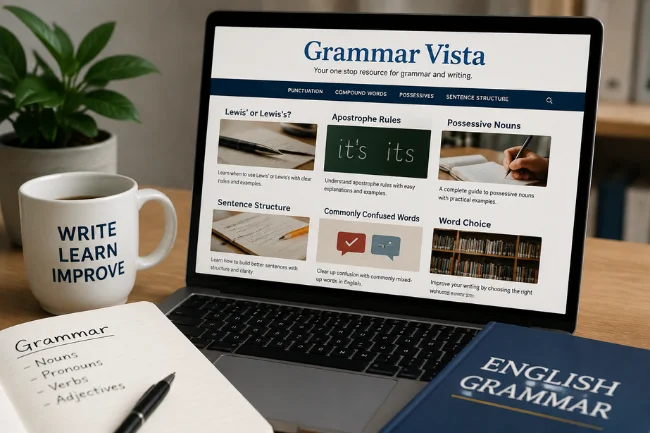
When I first look at a website built around grammar and vocabulary, I want to answer a practical question: does it actually help readers understand English more clearly? A large collection of language articles can look impressive, but quantity alone does not tell me whether the explanations are useful, accurate, or easy to apply. In my analysis of GrammarVista, I find that the website presents itself primarily as an educational resource focused on English grammar, vocabulary, corrections, punctuation, sentence structure, possessives, and related writing topics. Its own About page describes the site as a resource for students, professionals, language learners, and people who want to communicate with greater clarity.
That positioning is important because GrammarVista is better understood as a language-information website than as a conventional automated grammar checker. Based on the available evidence, I would not describe it as a direct replacement for software that scans a document and automatically flags every grammatical error. Instead, I see its principal value in its explanatory articles, examples, definitions, and discussions of common language problems.
I also think readers should approach GrammarVista with the right expectations. A language resource can be useful without being an all-in-one editing application. If I want to understand why a possessive form works in one sentence but not another, an explanatory article can be more educational than an automated correction. Conversely, if I need thousands of words checked instantly, I would expect a dedicated editing tool to be more appropriate.
My goal here is therefore not to promote or dismiss GrammarVista. I want to examine what the site currently offers, what its content appears designed to accomplish, where I think it can help, where I would exercise caution, and how I would use it as part of a broader writing process.
Key Takeaways From My GrammarVista Analysis
The first point I would emphasize is that GrammarVista presents itself as a resource for learning rather than merely correcting. Its stated areas include grammar guides, vocabulary enhancement, grammar and vocabulary corrections, and practical language guidance.
The second point is that the website covers familiar problems that frequently confuse English learners. Its articles address possessive forms, punctuation, compound words, sentence structure, and differences between similar grammatical constructions. The site’s category structure also reflects these subjects.
Third, I think the examples are one of the more useful elements of the site’s educational approach. Articles such as its discussion of “classmate’s,” “classmates’,” and “classmates” distinguish singular possession, plural possession, and ordinary plural usage with practical sentences.
Fourth, readers should distinguish between a grammar-learning website and a fully automated proofreading platform. From what I can verify, GrammarVista’s current presentation centers on published educational content. I therefore would not assume that the site provides the same document-scanning functionality as dedicated grammar software unless a specific feature is clearly identified.
Finally, I believe GrammarVista is most useful when I treat it as one learning resource rather than as an unquestionable authority. Grammar can involve style choices, dialect differences, context, and competing conventions. A good learner should understand the reason behind a correction instead of simply accepting it.
What GrammarVista Is and How I Understand Its Purpose
GrammarVista describes its mission in terms of making grammar and vocabulary easier to understand. The About page says the site aims to provide comprehensive grammar guides, vocabulary resources, corrections, and engaging content for readers at different levels.
That description gives me a useful framework for evaluating the site. Rather than asking only whether GrammarVista “checks grammar,” I think it is more accurate to ask what kind of learning problem the website attempts to solve.
Imagine a learner writing the sentence, “The students project was submitted yesterday.” An automated checker might identify a problem and suggest “students’ project.” That correction may solve the immediate problem, but the learner could still make the same mistake tomorrow.
An explanatory resource can go one step further by showing that “students” is simply a plural noun, while “students’” is a plural possessive form. GrammarVista uses this type of distinction in its articles about possessives. Its explanation of “classmate’s,” “classmates’,” and “classmates” follows exactly this learning pattern.
From my perspective, that difference matters. Correction answers the question, “What should I change?” Education answers the more valuable question, “Why should I change it?”
The distinction becomes even more important for learners who repeatedly encounter the same grammar problem. If I understand the underlying rule, I can transfer that knowledge from one sentence to another instead of depending on a correction every time.
GrammarVista’s current homepage also describes the site as offering guidance on grammar and vocabulary while emphasizing clear and effective communication.
The Main Grammar and Vocabulary Topics I Found
GrammarVista covers several areas that are central to everyday English writing. These include grammar, punctuation, compound words, possessives, and sentence structure.
Possessive Forms and Apostrophe Problems
Possessive nouns are a particularly useful example because a small punctuation mark can change grammatical meaning.
Consider these three sentences:
- “The student’s notebook is on the desk.”
- “The students’ notebooks are on the desk.”
- “The students are waiting outside.”
In the first sentence, one student possesses the notebook. In the second, multiple students possess notebooks. In the third, “students” is simply a plural noun.
GrammarVista’s article on “member’s,” “members’,” and “members” uses the same underlying principle: singular possession, plural possession, and ordinary plural usage need to be distinguished.
I find this type of explanation useful because it encourages the reader to identify the grammatical function before choosing the punctuation.
Sentence Structure and Clarity
Sentence structure is another area where grammar knowledge becomes practical. A sentence can contain familiar words and still be difficult to understand if clauses, phrases, or modifiers are arranged poorly.
For example, compare:
“After reading the report, the decision was changed.”
with:
“After reading the report, the manager changed the decision.”
The second version clearly identifies who performed the action. The first creates a dangling modifier because the grammatical subject does not logically perform the action described by the opening phrase.
When I evaluate educational grammar content, examples like this matter because they show how a rule affects actual communication rather than presenting grammar as a collection of abstract terminology.
Vocabulary and Word Choice
Grammar is only one part of effective writing. Word choice also determines whether a sentence sounds precise, natural, and appropriate for its audience.
GrammarVista’s About page identifies vocabulary enhancement as one of its areas, including word usage, synonyms, antonyms, and context-specific guidance.
I believe context is particularly important here. A dictionary definition may tell me what a word means, but it may not tell me whether the word fits a formal report, academic essay, casual conversation, or marketing message.
A strong vocabulary resource therefore should help readers understand not only meaning but also usage.
Why Clear Explanations Matter More Than Corrections Alone
One principle I repeatedly return to when evaluating writing resources is that good correction should lead to better future writing.
William Strunk’s classic writing guide provides a concise principle that remains relevant to this discussion:
“Omit needless words.”
William Strunk, The Elements of Style.
The quotation matters because writing improvement is not simply about identifying mistakes. It is also about developing judgment. A writer who understands why unnecessary words weaken a sentence can apply that principle independently.
For example, consider:
“Due to the fact that the meeting was canceled, we were unable to attend.”
A more direct version is:
“Because the meeting was canceled, we could not attend.”
The second sentence is not necessarily better merely because it is shorter. It is better because the relationship between cause and result is clearer and the wording is more direct.
This is where I see value in explanatory language resources. When a learner studies examples repeatedly, grammar rules can become part of their own editing process.
How I Would Use GrammarVista for Learning
I would use GrammarVista differently depending on my immediate goal. If I were trying to understand one confusing grammatical form, I would begin with a focused article. If I were preparing an important document, I would combine educational reading with a separate proofreading process.
The following comparison shows how I would approach different needs.
| Writing Need | How I Would Use GrammarVista | What I Would Add |
|---|---|---|
| Understanding a grammar rule | Read the relevant explanation and examples | Practice with original sentences |
| Learning possessive forms | Compare singular, plural, and possessive examples | Edit several sentences manually |
| Improving vocabulary | Study definitions and context | Check usage in reputable dictionaries or style guides |
| Understanding punctuation | Read explanations and compare examples | Apply the rule to my own paragraphs |
| Proofreading a long document | Use articles to understand recurring errors | Use dedicated proofreading and human review |
| Learning independently | Build a list of recurring mistakes | Revisit the rules and practice |
The most important takeaway from this table is that I would treat GrammarVista as a learning component rather than assuming that one website can perform every stage of the writing process.
Practical Examples of Using GrammarVista Concepts
Let us consider a hypothetical student who repeatedly writes “teachers lounge” when referring to a lounge belonging to teachers.
The writer needs to determine whether the phrase is showing possession. If multiple teachers collectively use or possess the lounge, “teachers’ lounge” is the conventional possessive construction.
Now consider a different sentence:
“The teacher’s lounge was renovated.”
Here, the context indicates a lounge associated with one teacher. The grammatical choice changes because the number of possessors changes.
A third example is:
“Teachers often meet after class.”
No apostrophe is needed because “teachers” is simply the plural subject.
GrammarVista’s possessive articles use this kind of three-way distinction to make grammatical differences visible.
Another hypothetical example involves compound words. Suppose I am unsure whether two words should be written separately, together, or with a hyphen. Rather than guessing based on how the phrase sounds, I would consult a focused explanation and then verify the preferred form against an authoritative dictionary or style reference.
That second verification step is important because English usage changes over time, and some compounds vary according to style, regional convention, or editorial preference.
How GrammarVista Can Help Students
Students can benefit from grammar resources because academic writing often requires more precision than ordinary conversation.
A student may understand an idea perfectly but lose clarity through inconsistent tense, misplaced punctuation, unclear pronouns, or incorrect possessive forms.
For example:
“The experiment was completed by the students, and they then analyzes the results.”
The sentence contains a subject-verb agreement problem in “they analyzes.” A learner who simply changes “analyzes” to “analyze” fixes the immediate error. A learner who understands that plural “they” takes the base form “analyze” has learned something transferable.
I think this distinction is one of the strongest reasons to use explanatory resources. Grammar becomes easier when the learner can connect a rule to a sentence.
GrammarVista’s stated audience extends beyond students, however. Its About page specifically identifies professionals, language learners, and people interested in improving communication as potential readers.
How Professionals Can Use GrammarVista Concepts
Professional communication creates a different set of demands. A workplace email does not necessarily need academic language, but it does need clarity, consistency, and appropriate tone.
Consider these two hypothetical messages:
“Please find attached the documents which we discussed in our meeting yesterday and kindly review them at your earliest possible convenience.”
and:
“I’ve attached the documents we discussed yesterday. Please review them when you have time.”
Both are understandable, but the second is more direct.
This connects naturally with Strunk’s advice about removing unnecessary wording. The goal is not to make every sentence extremely short. Instead, I want each word to contribute something useful.
A professional writer also needs to consider audience. A technical report may require specialized terminology that would be inappropriate in a customer-facing email. Vocabulary improvement therefore involves judgment, not simply replacing common words with complicated ones.
How GrammarVista Can Support English Learners
For someone learning English as an additional language, grammar explanations can provide a bridge between memorization and actual usage.
English contains many patterns that are difficult to predict from logic alone. Articles, prepositions, irregular verbs, possessives, phrasal verbs, and sentence structures can all create problems.
A learner might know that “book” is a noun and “read” is a verb but still struggle with:
“I have read the book.”
versus:
“I read the book yesterday.”
The difference involves tense and time reference. Understanding the grammatical pattern helps the learner produce new sentences instead of memorizing one example.
I would therefore encourage learners to use GrammarVista articles actively. Rather than reading an explanation once and moving on, I would write three or four original sentences using the rule, deliberately create one incorrect sentence, and then correct it.
That process turns passive reading into practice.
What I Would Not Assume About GrammarVista
One of the most important parts of my assessment is knowing what the available evidence does not establish.
The current GrammarVista homepage presents a publication containing grammar, vocabulary, and other articles. Its About page describes educational resources and corrections.
I would therefore avoid automatically describing GrammarVista as an advanced automated grammar-checking application.
That distinction matters because readers may search for a website expecting to paste a 10,000-word document into an editor and receive automated corrections. The material I could verify primarily demonstrates an article-based educational model.
This does not make the resource less useful. It simply means I would match the tool to the task.
If I want to learn why “members’” differs from “members,” an explanatory article may be exactly what I need. If I want automated checks across a lengthy manuscript, I would use dedicated proofreading software as an additional step.
A Practical GrammarVista Workflow I Would Recommend
I prefer a structured process because it prevents writers from becoming dependent on corrections they do not understand.
Step 1: Identify the Actual Problem
First, I would identify whether the problem concerns grammar, punctuation, vocabulary, sentence structure, or style.
For example, “The students project” is primarily a possessive problem, while “The students is ready” is a subject-verb agreement problem.
Step 2: Find a Focused Explanation
Next, I would look for an explanation that addresses the exact issue rather than reading broad grammar material without a clear purpose.
GrammarVista’s categorized approach can make this type of focused research easier because the site groups content around subjects such as grammar, punctuation, possessives, compound words, and sentence structure.
Step 3: Compare Multiple Examples
I would not stop after reading one example. I would compare several sentences and ask what changes between the correct and incorrect versions.
This is especially helpful for possessives because the difference may depend entirely on whether the noun is singular, plural, or non-possessive.
Step 4: Write My Own Examples
The next step is active practice.
If the lesson concerns plural possessives, I might write:
“The players’ uniforms were washed.”
“The teachers’ meeting begins at noon.”
“The players are warming up.”
The objective is to make the grammatical distinction automatic.
Step 5: Verify Important or Ambiguous Usage
For high-stakes writing, I would cross-check questionable points with established dictionaries, academic style manuals, or other authoritative references.
This is not a criticism of GrammarVista. It is simply a sensible editorial habit. No single website should automatically become the final authority for every possible English usage question.
Step 6: Edit the Whole Sentence
Finally, I would consider the sentence as a whole. Correct grammar does not automatically create good writing.
A sentence can be grammatically correct and still be vague, repetitive, overly complicated, or inappropriate for its audience.
Common Mistakes Readers Should Avoid
The first mistake is assuming that every apostrophe represents possession. Apostrophes have multiple functions, including contractions, and the surrounding sentence determines the correct usage.
The second mistake is confusing plural and possessive forms. “Customers” means more than one customer, while “customer’s” indicates possession by one customer and “customers’” generally indicates possession by multiple customers. GrammarVista discusses this distinction directly in its customer-focused material.
The third mistake is assuming that a grammar rule has no exceptions or stylistic variation. English usage can differ between style guides, regions, and contexts.
The fourth mistake is believing that sophisticated writing requires complicated vocabulary. In my view, clarity should come first. A simple word that precisely communicates the intended meaning is usually preferable to an unnecessarily elaborate alternative.
The fifth mistake is accepting a correction without understanding it. If a writer repeatedly makes the same error, simply fixing each occurrence does not solve the underlying learning problem.
A Second Comparison: Strengths, Limitations, and Best Uses
I find it useful to evaluate GrammarVista through practical strengths and limitations rather than treating the website as either completely good or completely bad.
| Area | Strength I See | Limitation or Caution | Best Use |
| Grammar explanations | Focused explanations of common language questions | Readers should verify unusual or disputed usage | Learning rules |
| Examples | Concrete sentences make concepts easier to understand | Examples should not replace independent practice | Understanding context |
| Vocabulary | Useful for exploring word meaning and usage | Context still determines the best word | Vocabulary development |
| Possessives | Clear distinctions between similar forms | Learners still need practice | Apostrophe and noun practice |
| Punctuation | Helps readers investigate specific questions | Style conventions can vary | Focused reference |
| Writing improvement | Encourages attention to clarity | Reading alone does not guarantee improvement | Supplementary learning |
| Long-document proofreading | Educational articles can explain errors | I would not assume full automated document checking | Pair with editing tools |
The key lesson I take from this comparison is that GrammarVista’s value depends heavily on how I use it. A reader looking for explanations can find meaningful material, while someone expecting a comprehensive automated editor should establish that requirement separately.
What Strong Writing Principles Tell Us About Grammar Learning
A second verified quotation gives useful context for the importance of precise word choice. George Orwell’s essay “Politics and the English Language” contains a series of writing rules, including this one:
“If it is possible to cut a word out, always cut it out.”
George Orwell, “Politics and the English Language.”
I interpret this as an argument for deliberate writing rather than mechanical brevity. Orwell’s broader discussion is about language as a tool for expressing thought. The lesson applies to grammar education because writers should ask whether a construction communicates the intended idea clearly.
For example, “at this point in time” can often become “now.” “In the event that” can often become “if.” But simplification should not be automatic. Technical, legal, scientific, and literary contexts sometimes require specific terminology.
The important skill is judgment.
That is also why I would not evaluate GrammarVista solely by counting how many rules it contains. A useful resource should help readers develop the ability to recognize appropriate usage in context.
A Third Quotation on the Importance of Exact Word Choice
Word choice is another reason grammar and vocabulary learning overlap. Mark Twain is frequently associated with a distinction between the exact word and a merely similar one. The quotation is documented in sources discussing his correspondence and writing advice:
“The difference between the almost right word and the right word is really a large matter.”
Mark Twain, letter to George Bainton, 1888.
I think this quotation is particularly relevant to vocabulary learning. Two words may appear similar in a dictionary while producing different meanings, tones, or implications in actual writing.
Suppose a writer describes a policy as “effective” when they actually mean “efficient.” The words are related, but they are not interchangeable. “Effective” concerns whether something achieves its intended result, while “efficient” generally concerns achieving a result with minimal wasted resources.
A vocabulary resource can help identify such distinctions, but the writer still needs to consider context.
My Recommendations for Using GrammarVista Effectively
My first recommendation is to search with a specific question. Instead of browsing randomly, I would begin with something like “difference between possessive and plural nouns” or “how to use an apostrophe with plural nouns.”
My second recommendation is to read examples actively. I would ask why each example works rather than simply memorizing the final form.
My third recommendation is to create original sentences. If I can apply a rule to a new situation, I have probably understood it.
My fourth recommendation is to maintain a personal error list. If I repeatedly confuse “its” and “it’s,” for example, I would write the distinction down and revisit it.
My fifth recommendation is to use multiple sources for high-stakes work. Academic papers, legal documents, business contracts, and published material deserve more than a casual grammar check.
My sixth recommendation is to separate correctness from style. A sentence can be grammatically acceptable while still being weak stylistically. Conversely, two style guides may prefer different forms without one necessarily being universally wrong.
My seventh recommendation is to edit for meaning before editing for punctuation. If a sentence is unclear, adding commas will not necessarily solve the problem.
When I Think GrammarVista Is Most Useful
I see the greatest potential value for learners who want explanations of individual English language questions.
A student struggling with possessive nouns can study several examples. A professional uncertain about wording can review a vocabulary explanation. A writer who repeatedly makes punctuation mistakes can research the underlying rule.
The site can also function as a quick reference when a writer encounters an unfamiliar construction.
Its own description emphasizes accessibility and practical guidance, and the current site includes categories devoted to grammar, punctuation, compound words, possessives, and sentence structure.
For me, that makes the website more naturally suited to “learning while writing” than to a workflow in which an application automatically analyzes every sentence in a document.
When I Would Use Another Resource Alongside It
I would use another resource when accuracy has significant consequences.
For academic writing, I might combine grammar explanations with the required institutional style guide.
For professional writing, I would consider the organization’s established terminology and tone.
For technical writing, I would consult the relevant industry documentation.
For important public-facing content, I would perform a final human review.
This layered approach makes sense because grammar is only one component of communication. A document can have perfect punctuation and still contain an incorrect fact, misleading claim, weak argument, inappropriate tone, or unclear structure.
GrammarVista can contribute to the language layer of that process, but I would not confuse language editing with complete editorial review.
How I Would Judge the Overall Value of GrammarVista
After examining its current presentation and examples, I would describe GrammarVista as a grammar and vocabulary resource with a strong emphasis on explanatory content.
I appreciate the focus on practical distinctions. The site’s articles do not merely list terminology; many of them illustrate differences through examples. The “classmate’s,” “classmates’,” and “classmates” article, for instance, explains how singular possession, plural possession, and simple plurality differ.
At the same time, I would keep my expectations realistic. The available material does not establish that GrammarVista should be treated as a full replacement for automated proofreading software.
I also notice that the site’s current homepage contains articles extending beyond its core grammar categories, including business, health, technology, and other subjects. That broader editorial mix means readers should evaluate individual articles according to their subject and evidence rather than assuming that every article has the same level of specialist authority.
In my view, that is a reasonable principle for almost any online information resource.
My Step-by-Step Method for Improving English With GrammarVista
If I wanted to use GrammarVista as part of a long-term writing improvement plan, I would follow a simple cycle.
First, I would identify recurring errors from my own writing.
Second, I would search for explanations of those errors.
Third, I would compare several examples.
Fourth, I would write new sentences using the rule.
Fifth, I would deliberately test myself without looking at the explanation.
Sixth, I would return to the original writing and correct similar mistakes.
Seventh, I would repeat the process with another category.
This approach turns a website from a passive reading experience into an active learning tool.
For example, if possessives are my weak area, I would spend one session distinguishing singular possessives from plural possessives. I might then practice with “student,” “teacher,” “customer,” “member,” and “player.” After that, I would write a short paragraph containing all five forms.
The next day, I would try to reconstruct the rules without referring to the article.
That repetition is what I believe creates lasting improvement.
Final Assessment of GrammarVista
My overall assessment is that GrammarVista has a clear educational identity centered on grammar, vocabulary, punctuation, sentence structure, and related language questions. The website’s own description supports that positioning, while its published examples demonstrate a practical approach to explaining confusing forms.
I particularly value the distinction between learning a rule and merely receiving a correction. A writer who understands why “members’” differs from “members” has acquired knowledge that can be transferred to other words and sentences.
At the same time, I would not treat GrammarVista as an automatic substitute for every editing or research tool. Based on the material I could verify, its strongest role is as an educational and reference resource.
For a student, English learner, writer, or professional trying to understand recurring grammar and vocabulary questions, that can still be useful. The best results will come when I combine reading with active practice, independent verification, and careful editing.
Conclusion
My assessment of GrammarVista is ultimately based on what the website currently presents: an educational resource focused on English grammar, vocabulary, punctuation, sentence structure, possessives, and practical writing guidance.
I believe its greatest strength is explanatory learning. When I encounter a confusing form, seeing several examples and understanding the underlying distinction can be more valuable than simply changing one incorrect sentence. GrammarVista’s treatment of possessive forms illustrates this approach particularly well.
At the same time, I would use GrammarVista as part of a broader writing process rather than assuming it handles every proofreading requirement. For important documents, I would combine its educational material with authoritative references, dedicated editing tools where appropriate, and human review.
If I were starting today, my next step would be simple: identify one recurring grammar or vocabulary problem in my writing, study the relevant explanation, create several original examples, and then apply the rule to my own work. Used that way, GrammarVista can become a practical learning resource rather than just another website to browse.
Frequently Asked Questions
What Is GrammarVista Used For?
GrammarVista is used primarily as an online resource for English grammar, vocabulary, punctuation, possessives, sentence structure, and related writing questions. The site’s About page says it provides grammar guides, vocabulary resources, corrections, and practical guidance for students, professionals, and other language learners.
I would therefore use GrammarVista mainly when I want to understand a language issue, compare examples, or improve my knowledge of English usage. I would not automatically assume that it provides every function associated with dedicated automated grammar-checking software.
Is GrammarVista a Grammar Checker?
GrammarVista presents itself primarily as a grammar and vocabulary educational website. Its homepage and About page emphasize articles, explanations, guidance, and language resources rather than establishing it as a comprehensive automated document-checking application.
For that reason, I would distinguish between GrammarVista as a learning resource and software designed specifically to scan large documents automatically. If automatic proofreading is my main requirement, I would verify the availability of that specific feature before relying on it.
Who Can Benefit From GrammarVista?
Students, English learners, writers, professionals, and general readers can potentially benefit from GrammarVista because its stated purpose includes improving grammar, vocabulary, corrections, and communication.
I think beginners may find the examples particularly helpful, while more experienced writers can use focused articles as quick references. The greatest benefit comes when readers actively apply the explanations rather than simply reading them.
Does GrammarVista Explain Possessive Nouns?
Yes. GrammarVista publishes articles explaining distinctions between singular possessive, plural possessive, and ordinary plural forms. For example, its article on “classmate’s,” “classmates’,” and “classmates” explains how the forms communicate different grammatical meanings.
I find this type of material useful because possessive punctuation is easier to understand when the reader compares several sentences rather than memorizing an isolated rule.
Can GrammarVista Help Improve Vocabulary?
GrammarVista says vocabulary enhancement is one of the areas covered by the website. Its About page describes resources involving word usage, synonyms, antonyms, and context-specific language guidance.
I would use those resources to investigate unfamiliar words and usage distinctions, then confirm important choices with established dictionaries or style references. Vocabulary improvement is strongest when I learn not only a word’s definition but also its context, tone, and grammatical behavior.
Should I Rely Only on GrammarVista for Important Writing?
I would not rely exclusively on any single online resource for high-stakes writing. GrammarVista can help explain language questions, but important academic, legal, technical, business, or public-facing documents may require additional references and human review.
My approach would be to use GrammarVista for learning and clarification, then verify disputed or consequential points against authoritative sources appropriate to the subject. This layered approach reduces the risk of treating one explanation as universally applicable when English usage may vary by context or style guide.
What Is the Best Way to Learn From GrammarVista?
I recommend turning each explanation into active practice. After reading a rule, I would write several original sentences, create an intentionally incorrect example, correct it, and then return to my own writing to find similar mistakes.
This method is more effective than passively reading because it forces me to retrieve and apply the rule. Over time, repeated practice can turn an unfamiliar grammatical distinction into a natural part of my editing process.
Sources and References
- GrammarVista homepage and current site description.
- GrammarVista About page describing its grammar, vocabulary, correction, and language-learning resources.
- GrammarVista article explaining “classmate’s,” “classmates’,” and “classmates.”
- GrammarVista article explaining “member’s,” “members’,” and “members.”
- William Strunk, The Elements of Style, including the principle “Omit needless words.”
- George Orwell, “Politics and the English Language,” including his writing rules on concise language.
- Mark Twain quotation documentation concerning the distinction between the “almost right word” and the right word.
Disclaimer
This article is an independent informational assessment based on publicly available material reviewed at the time of writing. Website content, features, categories, and policies can change. I have not represented hypothetical examples as personal experiences, customer case studies, professional results, or verified outcomes. Readers should independently verify important grammar, language, legal, academic, technical, or professional requirements against appropriate authoritative sources before relying on them.