
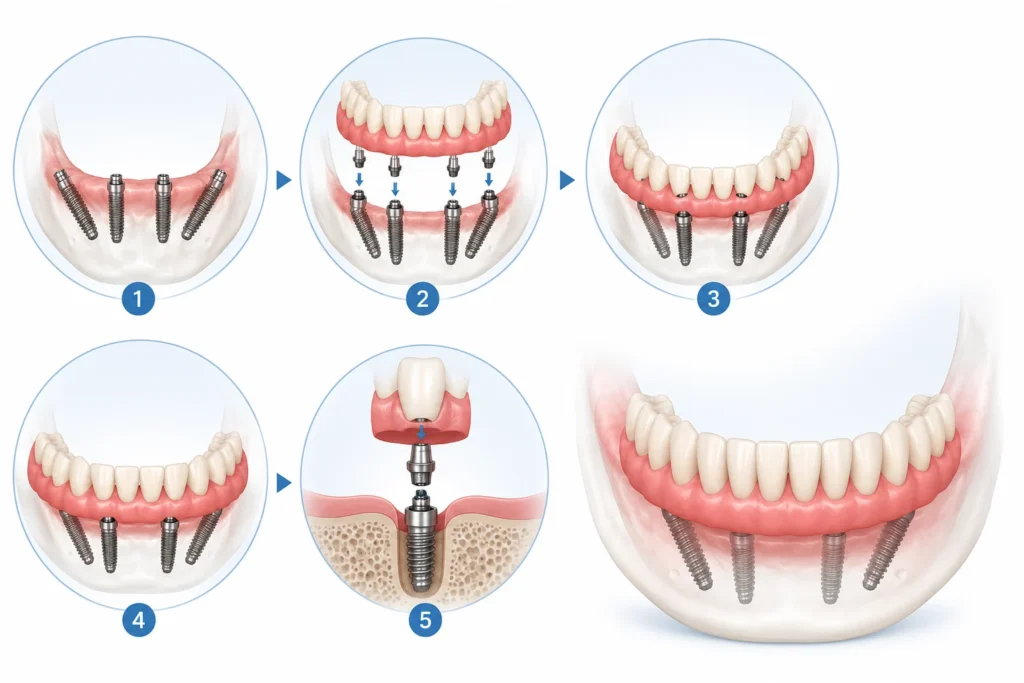
When I look at full-arch tooth replacement, I see All-on-4 dental implants as one of the treatment approaches that deserves careful consideration. The concept is designed to replace an entire arch of missing or failing teeth with a fixed restoration supported by four strategically positioned dental implants. For suitable patients, this can provide an alternative to conventional removable dentures and to some more extensive multi-implant treatment plans.
I believe, however, that the phrase “All-on-4” can sometimes make a complex treatment sound simpler than it really is. The number four is only one part of the concept. Successful treatment also depends on diagnosis, bone anatomy, implant positioning, prosthetic planning, bite forces, oral hygiene, medical considerations, and long-term maintenance.
We can therefore understand All-on-4 dental implants more accurately by looking beyond the marketing language. The real question is not simply whether four implants can support a full arch. The more useful question is whether this particular treatment design is appropriate for a particular patient’s anatomy, health, expectations, and long-term needs.
Key Takeaways About All-on-4 Dental Implants
I would summarize the most important points before going into the details:
- All-on-4 is a full-arch implant treatment concept rather than a treatment for replacing only four individual teeth.
- Four strategically positioned implants can support a fixed prosthesis containing a complete arch of replacement teeth.
- The posterior implants are commonly tilted to make better use of available bone.
- Some patients may receive a fixed provisional restoration shortly after surgery or on the same day, but immediate loading is not appropriate for everyone.
- The treatment may reduce the need for certain bone-grafting procedures in carefully selected patients.
- All-on-4 does not mean that bone is unnecessary or that complications cannot occur.
- Long-term maintenance is essential for protecting both the implants and the prosthesis.
- Smoking, poor oral hygiene, periodontal problems, heavy biting forces, and certain health conditions can affect outcomes.
- Published research generally reports high implant and prosthetic survival, but individual results vary.
- I recommend comparing the complete treatment plan rather than choosing a clinic solely because it advertises a low price.
A systematic review of the All-on-4 treatment concept found that the approach can provide predictable outcomes in appropriately selected patients, while also noting limitations in the quality and duration of the available evidence. That balance is important because positive research does not mean that every individual patient will experience the same result.
What Are All-on-4 Dental Implants?
All-on-4 dental implants are designed to replace an entire dental arch using four implants as the supporting foundation for a fixed prosthesis. The treatment can be performed in the upper jaw, lower jaw, or both, depending on the patient’s needs.
The concept is different from replacing a single missing tooth with one implant and crown. In a single-tooth treatment, the implant generally replaces the missing tooth root and supports one crown. With All-on-4, the four implants are strategically distributed to support a complete arch of replacement teeth.
The posterior implants are commonly angled. From my perspective, this is one of the most important parts of understanding the treatment. The angulation can help the clinician make use of available bone while avoiding certain anatomical limitations.
The goal is not simply to place four implants wherever there is space. The implants have to work together with the planned prosthesis. The clinician must consider the final position of the replacement teeth, the patient’s bite, available bone, implant stability, hygiene access, and the forces that will be transferred through the restoration.
A hypothetical example can make this easier to understand. Imagine someone who has lost most of the teeth in the upper jaw and has experienced significant bone resorption. Instead of placing implants directly beneath every planned tooth position, a clinician may use four strategically selected implant positions to support one complete fixed arch. The posterior implants may be angled to use available bone more effectively.
That example is hypothetical, but it illustrates why All-on-4 is fundamentally a treatment-planning concept rather than simply an implant-counting exercise.
How the All-on-4 Treatment Concept Works
The treatment generally starts with a detailed assessment. This can include an examination of the remaining teeth, gums, bite, jaw relationship, bone, and general oral condition. Imaging is also important because the clinician needs to understand the three-dimensional anatomy before deciding where implants should be placed.
The remaining teeth must also be evaluated carefully. I believe this is one of the most important ethical considerations. If some natural teeth can be predictably preserved, their removal should not be treated as an automatic part of an implant package.
When teeth cannot reasonably be maintained, extraction may be included in the treatment plan. Depending on the circumstances, implants can sometimes be placed immediately following extraction. Other patients may require a different healing sequence.
Once the surgical plan is established, four implants are positioned according to the planned design. The two anterior implants are generally positioned more vertically, while the posterior implants are angled.
After placement, the clinician evaluates implant stability and other clinical factors. If the patient meets the appropriate criteria, a provisional fixed restoration may be attached relatively quickly.
This is where I think patients should be especially careful with the expression “teeth in a day.” Receiving a fixed provisional restoration quickly does not necessarily mean receiving the final permanent prosthesis on that same day. The definitive restoration can require additional planning, laboratory work, appointments, and healing time.
Why Are the Back Implants Angled?
The angulation of the posterior implants is one of the defining features associated with the traditional All-on-4 concept.
The reason is primarily anatomical and prosthetic. When bone has resorbed, the areas where implants would ideally be positioned may not contain enough useful bone. Angling the posterior implants can allow the clinician to engage available bone in a different direction.
In the upper jaw, this strategy can also help the clinician work around anatomical structures such as the maxillary sinuses. In the lower jaw, the anatomy of the mandibular canal is an important consideration.
This does not mean that angled implants are automatically superior to vertical implants. They are one possible solution to particular anatomical and prosthetic challenges.
I believe the strongest explanation is that All-on-4 uses implant positioning strategically. The clinician is trying to create a stable foundation for a full-arch prosthesis while making efficient use of the patient’s existing anatomy.
Who May Be Suitable for All-on-4 Dental Implants?
Patients with severely failing teeth, extensive tooth loss, or complete edentulism may potentially be considered for All-on-4 treatment.
However, eligibility cannot be determined simply by counting missing teeth. A complete assessment is necessary.
The clinician may need to evaluate:
- Bone volume and quality
- Gum and periodontal health
- Remaining teeth
- Bite and jaw relationship
- Oral hygiene
- Smoking habits
- General medical history
- Previous implant treatment
- Ability to attend maintenance appointments
- Expectations regarding appearance and function
A person with extensive bone loss may still be a candidate, but the treatment plan could be more complicated. Some patients may require additional procedures or may be better suited to another implant configuration.
Smoking is another important consideration. Research involving mandibular All-on-4 treatment has found smoking to be associated with increased implant failure risk and greater marginal bone loss. This does not mean every smoker will lose an implant, but it does mean smoking should be discussed honestly during treatment planning.
When All-on-4 May Not Be the Best Option
I would be cautious about treating All-on-4 as a universal answer to tooth loss.
Some patients may benefit more from conventional dentures, implant-retained overdentures, All-on-6 treatment, individual implants, or another full-arch rehabilitation strategy.
The appropriate option can depend on anatomy, expectations, budget, maintenance ability, and clinical risk.
Uncontrolled oral infection or severe periodontal problems may need to be addressed before implant placement. Certain medical conditions may also require additional assessment. The clinician must consider the complete health picture rather than focusing only on the missing teeth.
Another issue is expectations. A patient who believes implant-supported teeth will require absolutely no maintenance may not be an ideal candidate from a practical perspective. Fixed teeth still require daily cleaning and professional monitoring.
Benefits of All-on-4 Dental Implants
The potential benefits explain why this treatment approach has become widely discussed.
A Fixed Full-Arch Restoration
One major advantage is that the restoration is fixed to dental implants rather than designed to be removed by the patient each day.
For someone who struggles with movement of a conventional denture, this can represent a significant functional difference. A fixed restoration can provide greater stability during speaking and chewing.
That does not mean the restoration feels exactly like natural teeth. The prosthesis still has a different relationship with the gums and jaw, and patients may need time to adapt.
Strategic Use of Available Bone
Another potential benefit is the strategic use of available bone.
Because the posterior implants can be angled, some patients may be treated without procedures that would otherwise be considered for additional bone volume.
I would emphasize the word “some.” All-on-4 does not eliminate the need for bone in general. It is simply a technique that can allow certain patients to use their existing anatomy efficiently.
Potentially Fewer Surgical Stages
If a patient can be treated without extensive bone augmentation, the overall treatment sequence may be shorter than some alternative approaches.
This can be particularly valuable for patients who want a fixed restoration without undergoing several separate surgical procedures.
However, the number of appointments and treatment stages varies between individuals. I would never assume that a particular clinic’s advertised timeline will apply to everyone.
Improved Stability Compared With Conventional Dentures
A conventional denture rests on the soft tissues and can move, particularly in the lower jaw.
An implant-supported full-arch restoration gains retention from implants anchored in bone. This can improve stability and chewing function for appropriate patients.
Potential Psychological and Social Benefits
Tooth loss can affect confidence, communication, eating, and social interaction. The World Health Organization describes oral health in terms that include essential functions such as eating, breathing, and speaking, as well as broader psychosocial well-being.
I believe this broader perspective is useful. The value of full-arch rehabilitation should not be judged only by whether the teeth look attractive. Function, comfort, confidence, hygiene, and long-term oral health also matter.
Potential Disadvantages of All-on-4 Dental Implants
Every treatment has trade-offs, and All-on-4 is no exception.
The procedure requires surgery, so there can be discomfort, swelling, bruising, infection, or other surgical complications.
The patient is also relying on a relatively small number of implants to support the entire arch. If an implant fails, the prosthetic plan may need modification.
The restoration itself can experience mechanical problems. Screw loosening, component problems, fractures, wear, or chipping can occur.
Another consideration is hygiene. The underside of a fixed full-arch restoration can be difficult to access. Patients need to learn appropriate cleaning methods and maintain professional appointments.
Cost can also be substantial. Although four implants may appear simpler than placing a larger number of implants, the overall treatment includes surgery, prosthetic design, laboratory work, provisional teeth, definitive teeth, imaging, follow-up, and maintenance.
All-on-4 Dental Implants Cost: What Patients Should Compare
There is no single worldwide price for All-on-4 dental implants. Costs can vary considerably according to location, clinic, implant brand, restoration material, laboratory fees, sedation, extractions, bone procedures, and follow-up.
I believe the biggest pricing mistake is comparing two headline figures without comparing what those figures actually include.
What an All-on-4 Treatment Quote May Include
| Treatment component | Why it matters |
|---|---|
| Consultation | Establishes whether treatment is appropriate |
| Diagnostic imaging | Helps evaluate bone and anatomy |
| Extractions | May be required if remaining teeth cannot be retained |
| Four implants | Provides the surgical foundation |
| Abutments and components | Connect implants to the restoration |
| Provisional restoration | Provides temporary fixed teeth when appropriate |
| Definitive restoration | Provides the long-term full-arch prosthesis |
| Sedation or anesthesia | May be included or separately charged |
| Bone procedures | May be necessary in some patients |
| Follow-up visits | Allows healing and function to be monitored |
| Maintenance | Helps protect biological and mechanical health |
The most important takeaway is that patients should ask for an itemized quotation. A low advertised price may exclude the final restoration or other essential components.
A useful hypothetical comparison would be two clinics advertising very different prices. Clinic A might include only implants and surgery, while Clinic B includes surgery, provisional teeth, definitive teeth, imaging, and follow-up. In that situation, the higher initial quote may actually represent a more complete treatment package.
The Step-by-Step All-on-4 Treatment Process
Understanding the treatment sequence can make consultations easier.
Step 1: Examination and Diagnosis
The first stage is a comprehensive examination.
The clinician evaluates the teeth, gums, bite, bone, and overall oral condition. Imaging may be used to examine the jaw in three dimensions.
The purpose is to determine whether the patient is a suitable candidate and whether natural teeth can be preserved.
Step 2: Digital and Prosthetic Planning
The final restoration should influence the implant positions.
The team may plan the position of the replacement teeth first and then determine how the implants can best support that restoration.
This is often described as prosthetically driven implant planning.
Step 3: Extraction of Non-Restorable Teeth
When remaining teeth have a poor prognosis, extraction may be part of the treatment.
The exact timing varies. Some patients can receive implants immediately, while others require healing or additional treatment.
Step 4: Implant Placement
Four implants are placed according to the treatment plan.
The posterior implants are generally angled to make efficient use of the available anatomy.
Step 5: Provisional Restoration
When appropriate clinical criteria are met, the patient may receive a fixed provisional restoration.
This can be an important advantage because the patient may avoid a prolonged period without fixed teeth.
However, immediate loading is not automatically appropriate. Primary stability and other factors must be evaluated by the treating clinician.
Step 6: Healing and Follow-Up
The implants need time to integrate with the surrounding bone.
During this period, the patient may receive instructions about diet, cleaning, medication, and activity.
Follow-up visits allow the dental team to monitor healing and make adjustments if necessary.
Step 7: Definitive Prosthesis
After the appropriate healing and planning stages, the final prosthesis is fabricated.
Material selection can depend on aesthetics, available space, bite forces, restoration design, maintenance, and the clinician’s recommendation.
Step 8: Long-Term Maintenance
The treatment does not end when the definitive teeth are fitted.
Daily cleaning and professional maintenance remain important for protecting the implants, gums, and prosthesis.
Recovery After All-on-4 Surgery
Recovery varies from person to person.
Because implant surgery involves manipulation of the gums and bone, swelling and soreness are common possibilities. Some patients may also experience bruising or temporary difficulty eating normally.
The treating clinician should provide personalized instructions because recovery depends on the number of procedures performed, implant stability, bone condition, restoration type, and individual health.
Diet is often an important consideration during early healing. A patient may be advised to eat softer foods and avoid excessive forces on the restoration.
I would not recommend relying on a generic recovery schedule found online. The surgeon’s instructions should take priority because the clinical circumstances can differ substantially between patients.
What Does the Final Restoration Look Like?
The definitive full-arch restoration is designed to resemble a complete row of natural-looking teeth.
The appearance depends on the design, material, tooth arrangement, gum-colored components, facial characteristics, and patient’s preferences.
A good prosthetic plan should consider more than tooth color. Tooth shape, size, position, lip support, speech, bite, and facial proportions can all influence the result.
I believe this is another reason why prosthetic planning should occur before implant surgery. The implants are ultimately supporting a restoration that has to function as part of the patient’s mouth and face.
Risks and Complications of All-on-4 Dental Implants
All-on-4 has a substantial research history, but no implant treatment is guaranteed to succeed.
Potential biological complications include:
- Peri-implant mucositis
- Peri-implantitis
- Bone loss
- Infection
- Implant failure
- Soft-tissue complications
Mechanical complications can include:
- Screw loosening
- Component fracture
- Prosthetic fracture
- Chipping
- Wear
- Prosthesis repair or replacement
A long-term study of All-on-4 treatment reported high cumulative implant and prosthetic survival over extended follow-up but also documented biological and mechanical complications.
This is an important distinction. A treatment can have a high survival rate while still requiring repairs and maintenance.
I believe patients should therefore ask two separate questions: “How likely are the implants to remain functional?” and “What maintenance or repair might the prosthesis require?”
What Research Says About Long-Term All-on-4 Outcomes
The published evidence generally supports All-on-4 as a viable full-arch treatment approach.
A systematic review published in 2017 concluded that All-on-4 could be predictable for treating atrophic jaws, but it also identified limitations in the existing evidence.
More recent research has continued to examine long-term outcomes and comparisons with other full-arch approaches.
A 2026 systematic review and meta-analysis comparing All-on-4 and All-on-6 evaluated dozens of studies and found broadly similar outcomes overall, while also noting substantial variation among the studies.
That finding is useful because it challenges the simplistic idea that more implants automatically guarantee better results.
At the same time, I would not interpret the evidence as saying that four implants are always preferable. The correct configuration remains patient-specific.
All-on-4 Versus Other Tooth Replacement Options
Patients should consider alternatives before making an irreversible decision.
Conventional Dentures
Conventional complete dentures are removable and do not require implant surgery.
They can be less expensive initially, but they may move during eating or speaking, particularly in patients with severe bone resorption.
Implant-Retained Overdentures
An overdenture is removable but gains additional retention from implants.
This can offer a middle ground between conventional dentures and fixed full-arch treatment.
All-on-6
All-on-6 uses six implants rather than four to support a full arch.
Whether six implants are better for a specific patient depends on anatomy, prosthetic requirements, bone availability, and the clinician’s treatment philosophy.
Multiple Individual Implants
Some patients may be candidates for several individual implants and separate crowns or bridges.
This can offer a different approach to tooth replacement but may require more implants and potentially more complex treatment.
Comparing Full-Arch Options
| Option | Fixed or removable | Implant surgery | Main potential advantage | Main consideration |
| Conventional denture | Removable | No | Simpler initial treatment | May move during function |
| Implant overdenture | Removable | Yes | Increased retention | Still requires removal and cleaning |
| All-on-4 | Fixed | Yes | Full-arch stability using four implants | Requires careful planning and maintenance |
| All-on-6 | Fixed | Yes | Additional implant support | May require suitable anatomy and greater treatment resources |
| Multiple implant-supported teeth | Usually fixed | Yes | More individual tooth replacement | Can involve more implants and procedures |
The main takeaway is that there is no universally superior option. The correct choice depends on clinical circumstances and personal priorities.
A Verified Quotation About Oral Health
The broader importance of oral function is captured clearly by the World Health Organization.
“Oral health is the state of the mouth, teeth and orofacial structures that enables individuals to perform essential functions such as eating, breathing and speaking.”
World Health Organization
This definition matters because I believe implant treatment should be judged through the broader lens of oral health. A successful restoration should not merely look convincing. It should be designed around function, comfort, health, and maintainability.
Common Misconceptions About All-on-4 Dental Implants
“All-on-4 Means Four Teeth”
This is incorrect.
The four implants support an entire arch of replacement teeth. The patient is not receiving only four replacement teeth.
“All-on-4 Means Permanent Teeth in One Day”
This statement needs clarification.
Some suitable patients may receive fixed provisional teeth quickly, sometimes on the day of surgery. The definitive restoration may be fitted later.
Immediate function depends on clinical criteria and should not be assumed.
“All-on-4 Requires No Bone”
This is also incorrect.
Implants require sufficient bone for stable placement. The treatment concept is designed to make strategic use of available bone and may reduce the need for certain augmentation procedures in selected patients.
“All-on-4 Never Fails”
No responsible dental treatment should be described as failure-proof.
Published research has documented implant failures and prosthetic complications.
“Fixed Teeth Need No Cleaning”
This is perhaps one of the most dangerous misconceptions.
Fixed implant-supported teeth still require daily cleaning. The areas beneath a full-arch restoration can collect plaque and food debris.
Professional maintenance remains important.
Practical Example: Comparing Two All-on-4 Treatment Plans
Consider a hypothetical patient who has severely damaged teeth throughout the lower jaw.
One clinic recommends four implants with a provisional restoration followed by a definitive prosthesis.
Another clinic recommends six implants and a different restoration.
I would not decide solely on price or implant count.
Instead, I would compare the diagnostic findings, implant positions, bone condition, prosthetic design, expected loading protocol, materials, maintenance requirements, complication policy, and total treatment cost.
If four implants can provide the necessary support predictably, there may be no reason to use six simply because six sounds stronger.
Conversely, if the patient’s anatomy or prosthetic requirements make six implants more appropriate, choosing four simply because the treatment is cheaper could be a poor decision.
The important principle is that implant number should follow clinical reasoning rather than marketing.
How I Would Assess an All-on-4 Consultation
I would begin by asking whether any natural teeth can be saved.
The next question would concern the diagnostic imaging. I would want the clinician to explain the bone anatomy and why the proposed implant positions are appropriate.
Then I would ask whether the first restoration is temporary or definitive.
I would also ask what happens if an implant fails, what is covered by the treatment agreement, and what future maintenance costs might arise.
Another important question concerns hygiene. The patient should know exactly how the restoration will be cleaned.
Finally, I would ask about alternatives. If the clinician cannot explain why All-on-4 is preferable to a denture, overdenture, All-on-6, or another implant plan, I would consider obtaining another professional opinion.
Long-Term Maintenance of All-on-4 Dental Implants
Maintenance is one of the most important parts of the treatment.
Patients need to clean around the implants and beneath the fixed restoration every day. Depending on the design, this may require specialized brushes, interdental cleaners, flossing aids, or water irrigation.
The exact technique should be demonstrated by the dental team.
Professional maintenance is equally important. The clinician can monitor the soft tissues, implants, prosthetic components, bite, and bone levels when clinically appropriate.
A patient with previous periodontal disease or other risk factors may require particularly careful maintenance.
I believe this is one area where patients should think beyond the initial treatment. A full-arch restoration is a long-term commitment, and maintenance should be included in the financial and practical planning from the beginning.
Smoking and All-on-4 Outcomes
Smoking deserves separate attention because it can affect implant treatment.
Research has reported associations between smoking and increased implant failure risk in All-on-4 patients.
This does not mean that a smoker automatically cannot receive implants. It means the risk profile may be different.
I would recommend discussing smoking openly with the implant team. If cessation or reduction is recommended, that should be considered part of preparing for treatment rather than an unrelated issue.
What Materials Can Be Used for the Final Prosthesis?
Full-arch restorations can be made using different materials and construction approaches.
The appropriate material depends on factors such as:
- Aesthetic expectations
- Bite forces
- Available restorative space
- Prosthetic design
- Strength requirements
- Repair considerations
- Cleaning access
- Laboratory capabilities
I would not choose a material simply because it is described as the most expensive or most advanced.
Instead, I would ask the clinician to explain why the proposed material is appropriate for my specific bite, anatomy, aesthetic requirements, and long-term maintenance needs.
Expert Recommendations for Choosing an All-on-4 Provider
I would pay close attention to how the clinic handles the consultation.
A responsible treatment plan should include appropriate diagnostics and a clear explanation of alternatives.
The clinician should be able to explain why four implants are recommended and why the implants will be positioned where they are.
The treatment plan should also distinguish between provisional and definitive teeth.
I would ask for a complete written cost estimate rather than relying on a promotional price.
Another important factor is the maintenance plan. The clinic should explain what follow-up care is expected and how complications will be handled.
Most importantly, I would avoid making a decision based solely on before-and-after photographs. Photographs can demonstrate aesthetic possibilities, but they do not tell me whether the treatment is appropriate for my anatomy or how the restoration will perform years later.
A Second Verified Quotation
The evidence-based perspective is particularly useful when evaluating claims about treatment predictability.
“The all-on-four treatment concept is a viable treatment option for rehabilitating edentulous patients.”
This conclusion comes from the systematic-review literature examining the treatment concept rather than from a promise of a guaranteed individual result.
For me, the important lesson is that evidence supports considering All-on-4 as a legitimate treatment option while still requiring individual diagnosis and careful risk assessment.
All-on-4 Decision-Making Checklist
Before agreeing to treatment, I would make sure I could answer these questions:
- Why do I need full-arch treatment?
- Can any of my natural teeth be saved?
- What does my diagnostic imaging show?
- Why are four implants appropriate for my anatomy?
- Why are the posterior implants being angled?
- Am I a candidate for immediate provisional teeth?
- Are the first teeth provisional or definitive?
- What material will be used for the final restoration?
- What is the complete treatment cost?
- Are extractions included?
- Are imaging and sedation included?
- Are temporary teeth included?
- Are definitive teeth included?
- What happens if an implant fails?
- How will I clean underneath the restoration?
- How often will I need maintenance appointments?
- What are my alternatives?
- What factors could increase my risk?
- What happens if the prosthesis fractures or needs repair?
- Would a second opinion be useful?
These questions can turn a complicated treatment discussion into a much more structured decision.
A Third Verified Quotation About Oral Health
A broader public-health perspective also helps put restorative dentistry into context.
“Oral health is integral to general health, well-being and quality of life.”
World Health Organization
I find this particularly relevant when discussing full-arch rehabilitation. Replacing missing teeth is not merely an aesthetic project. It involves chewing, speaking, oral hygiene, comfort, confidence, and the long-term health of the mouth.
Advantages and Risks at a Glance
| Area | Potential benefit | Potential concern | My practical recommendation |
| Implant count | Four implants may support a full arch | Implant failure can affect the overall plan | Ask why four are appropriate |
| Bone use | Angled implants may use available bone efficiently | Some patients still require augmentation | Review imaging carefully |
| Function | Fixed restoration can improve stability | Adaptation may take time | Discuss realistic expectations |
| Appearance | Can provide a complete smile | Results depend on prosthetic planning | Review tooth design before surgery |
| Treatment time | Some patients can receive provisional teeth quickly | Immediate loading is not suitable for everyone | Ask about loading criteria |
| Cost | May reduce some surgical stages | Complete treatment can still be expensive | Request an itemized quote |
| Hygiene | Fixed teeth do not need daily removal | Cleaning beneath the restoration can be challenging | Learn a specific cleaning routine |
| Longevity | Research reports strong long-term survival | Repairs and replacement can still be necessary | Plan for lifelong maintenance |
| Lifestyle | Can provide stable teeth for eating and speaking | Smoking and poor hygiene can increase risks | Address modifiable risk factors |
The main lesson from this comparison is that the advantages of All-on-4 are closely connected to the responsibilities that come with the treatment. A fixed restoration can improve stability, but it also requires disciplined maintenance.
How I Interpret the Long-Term Evidence
When I read implant survival statistics, I try not to treat a single percentage as the entire story.
Researchers may measure implant survival, prosthetic survival, patient-level survival, or treatment success. These are different outcomes.
For example, an implant can remain integrated even if a prosthetic tooth fractures and requires repair. Conversely, a patient may have a prosthetic complication even though the implants remain healthy.
Long-term studies have reported high survival rates for All-on-4 restorations, including follow-up extending well beyond five or ten years. That is encouraging.
However, long-term treatment also means long-term responsibility. The patient must continue cleaning, attending maintenance visits, managing risk factors, and addressing complications early.
From my perspective, this is a better way to understand implant longevity. Rather than asking whether the teeth will “last forever,” I would ask how the treatment can be maintained and what future maintenance or replacement may realistically involve.
Conclusion
I believe All-on-4 dental implants can be an effective full-arch treatment option for carefully selected patients who need extensive tooth replacement and want a fixed restoration. The major attraction is not simply the use of four implants, but the strategic way those implants can be positioned to support an entire arch while potentially making efficient use of available bone.
At the same time, I would not approach the treatment as a guaranteed one-day solution. The procedure requires careful diagnosis, appropriate implant planning, suitable prosthetic design, realistic expectations, and long-term maintenance. Research supports strong outcomes, but implant failure, biological complications, prosthetic damage, and maintenance needs remain possible.
My practical recommendation is to begin with a comprehensive examination and an itemized treatment plan. Ask why four implants are appropriate, what the provisional and final restorations include, what the complete cost will be, how complications are handled, and how the restoration will be maintained. From my perspective, understanding those details is the best way to decide whether All-on-4 dental implants are genuinely suitable for your circumstances.
Frequently Asked Questions
What Are All-on-4 Dental Implants?
All-on-4 dental implants are a full-arch tooth-replacement approach in which four strategically positioned implants support a complete fixed restoration. The posterior implants are commonly angled to make efficient use of available bone. The treatment can be used for an upper arch, lower arch, or both, depending on the patient’s condition and treatment plan. A provisional restoration may sometimes be provided quickly, while the definitive restoration is normally planned as a later stage.
How Long Does the All-on-4 Procedure Take?
The surgical portion can often be completed in a relatively short period, but the complete treatment timeline varies. Some suitable patients can receive a fixed provisional restoration soon after implant placement, while the definitive restoration may require additional healing and laboratory stages. The total timeline depends on extractions, bone condition, implant stability, healing, prosthetic design, and the clinic’s treatment protocol.
Are All-on-4 Dental Implants Better Than Dentures?
All-on-4 dental implants can provide greater stability than conventional removable dentures because the restoration is supported by implants. However, they also require surgery, greater financial investment, and long-term maintenance. Conventional dentures may be appropriate for people who cannot or do not want to undergo implant surgery. I believe the better option is the one that fits the patient’s anatomy, health, expectations, budget, and ability to maintain the restoration.
How Much Do All-on-4 Dental Implants Cost?
The cost varies significantly according to location, clinic, implant system, restoration material, extractions, imaging, sedation, temporary teeth, definitive teeth, bone procedures, and follow-up care. There is no single price that applies to every patient. I recommend asking for a complete itemized quotation rather than comparing advertisements based only on the number of implants.
Can All-on-4 Dental Implants Be Placed in One Day?
The implants can sometimes be placed during one surgical appointment, and selected patients may receive a fixed provisional restoration on the same day. However, this does not necessarily mean that the definitive teeth are completed that day. Immediate loading requires appropriate implant stability and other clinical conditions. The treating clinician must determine whether immediate function is safe and appropriate.
Do All-on-4 Dental Implants Require Bone Grafting?
Not necessarily. One potential advantage of the All-on-4 approach is that strategically positioned implants may allow some patients to use their available bone without certain grafting procedures. However, implants still require adequate bone for stable placement. Patients with significant bone loss may need additional treatment, and imaging is necessary to determine the appropriate approach.
How Long Do All-on-4 Dental Implants Last?
There is no guaranteed lifespan. Research has reported high long-term implant and prosthetic survival, including studies with follow-up extending beyond a decade. However, individual outcomes vary. Smoking, oral hygiene, periodontal health, bite forces, implant positioning, prosthetic design, and maintenance can all influence longevity. The prosthesis may also require repair or replacement even when the implants remain healthy.
What Are the Risks of All-on-4 Dental Implants?
Potential risks include infection, peri-implant disease, bone loss, implant failure, discomfort, prosthetic fracture, screw loosening, component damage, and difficulty maintaining hygiene beneath the restoration. Smoking and other risk factors can increase the likelihood of complications. A qualified dental professional should explain the risks specific to the patient’s health and anatomy before treatment.
Can I Eat Normally With All-on-4 Dental Implants?
Many patients can return to a broad diet after appropriate healing and adaptation, but the timing varies. Immediately after surgery, softer foods may be recommended to protect healing tissues and the provisional restoration. Even after healing, very hard or excessively sticky foods may present risks depending on the restoration and bite. The treating dental team should provide individualized dietary guidance.
How Do I Clean All-on-4 Dental Implants?
Cleaning involves removing plaque and food debris around the implants and beneath the fixed restoration. Depending on the prosthetic design, patients may use specialized brushes, interdental cleaning devices, flossing aids, or water irrigation. Professional maintenance is also important. I would ask the dental team to demonstrate the exact cleaning technique because access differs between restoration designs.
Is All-on-4 Suitable for Smokers?
Smoking does not automatically make implant treatment impossible, but research has associated smoking with increased implant failure risk and greater marginal bone loss in some All-on-4 populations. Patients should discuss smoking honestly with their dental team. Reducing or stopping smoking may be recommended to improve the treatment environment and reduce avoidable risk.
Should I Get a Second Opinion Before All-on-4 Treatment?
I believe a second opinion can be especially valuable when treatment involves removing multiple teeth and committing to a fixed full-arch restoration. Another qualified clinician can review the imaging, implant number, proposed positions, restoration design, alternatives, and costs. A second opinion is not necessarily a criticism of the first treatment plan; it can simply provide additional information before an irreversible decision.
Sources and References
- Soto-Penaloza D, Zaragozí-Alonso R, Penarrocha-Diago M, Penarrocha-Diago M. Systematic review of the All-on-4 treatment concept. Journal of Clinical and Experimental Dentistry, 2017.
- Tang Y and colleagues. Systematic review and meta-analysis comparing All-on-4 and All-on-6 implant-supported fixed prostheses, 2026.
- Maló P and colleagues. Long-term clinical research examining mandibular All-on-4 treatment and implant survival.
- Lopes A, Maló P, de Araújo Nobre M, and colleagues. Long-term clinical outcomes associated with the All-on-4 concept.
- World Health Organization. Oral health information and definition of oral health.
- Nobel Biocare. Clinical information concerning the All-on-4 treatment concept.
- Recent consensus literature concerning full-arch implant rehabilitation, periodontal risk, systemic risk, prosthetic materials, maintenance, and biological complications.
Disclaimer
This article is provided for general educational and informational purposes only. It is not a diagnosis, individualized dental treatment plan, medical recommendation, or substitute for consultation with a qualified dental professional. All-on-4 dental implants are not suitable for every patient, and treatment decisions should be based on an appropriate clinical examination, diagnostic imaging, medical and dental history, and discussion of available alternatives. Costs, treatment timelines, eligibility, materials, risks, maintenance requirements, and expected outcomes can vary significantly between individuals, clinics, and countries. Published survival statistics describe groups of patients and cannot guarantee a specific outcome for an individual.